■ City unveils plan to boost senior housing supply
12,000 units by 2035
Originally planned 8,000 units by 2040
Land purchase loans up to 10 billion KRW (≈ $7.5 million)
Construction loan interest support up to 24 billion KRW (≈ $18 million)
Securing sites such as Gaehwasan Station parking lot
12,000 units by 2035
Originally planned 8,000 units by 2040
Land purchase loans up to 10 billion KRW (≈ $7.5 million)
Construction loan interest support up to 24 billion KRW (≈ $18 million)
Securing sites such as Gaehwasan Station parking lot
Seoul will supply 12,000 "Seoul-style" senior housing units for residents aged 65 and older by 2035, offering services for meals, health and leisure. The city accelerated the timeline by five years and increased the planned supply by 50% compared with last May’s plan to deliver 8,000 units by 2040. Seoul has bolstered incentives—such as interest support for construction loans and relaxed floor-area-ratio rules—but officials say convincing private developers to participate and securing central-city sites remain major challenges.
On the 27th, Seoul released its "Seoul-style Senior Housing Supply Promotion Plan," reframing senior housing as core urban infrastructure rather than solely a welfare measure—covering safe senior housing, elderly welfare housing and owner-occupied senior housing. The plan moves beyond age-friendly design and affordable rents to add daily living support (meals, cleaning and laundry), medical partnerships and other services aimed at providing closer, more reliable support for middle-class seniors who fall outside existing welfare nets.
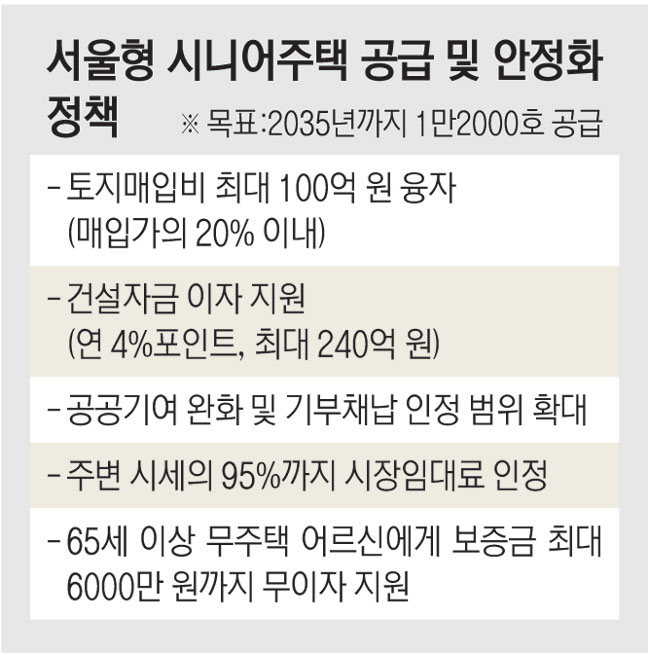 To encourage private developers to join senior-housing projects, the city will offer a range of incentives. With the domestic construction sector still weak and financing squeezed by fallout from the Middle East conflict, private builders face growing difficulty raising capital. Constraints on securing transit-oriented and downtown land, combined with rising operating costs, have made senior-housing supply a tougher policy challenge, prompting the city to add measures.
 First, the city will lend up to 20% of a site's purchase price, capped at 10 billion KRW (≈ $7.5 million). It will also subsidize construction loan interest—an additional 4 percentage points per year—capped at 24 billion KRW (≈ $18 million). If developers dedicate at least 30% of projects in transit-station areas to elderly welfare housing, required public contributions will be cut by 10%; if 50% or more is dedicated, contributions may be reduced by up to 20%.
When senior housing in district unit plan zones applies barrier-free design—such as removing thresholds—the city will offer incentives equivalent to up to an additional 10% in floor-area ratio and allow zoning upgrades. Introducing senior housing within urban-renewal-type redevelopments can qualify for an incentive of up to a 200% floor-area ratio and building heights up to 30 meters (about 98 ft). For closed or consolidated school sites resulting from falling school-age populations, Seoul will pursue ordinance changes to relax building coverage and floor-area-ratio limits for senior-housing projects.
To secure central-city sites, Seoul plans to build 800 elderly-welfare housing units on public land—including the Gaehwasan Station public parking lot in Gangseo District and the Seocho Fire Service School site in Seocho District—by 2031. The city also plans to add 132 elderly-welfare units at transit-oriented redevelopment sites such as Sungshin Women’s University Station in Seongbuk District.
Seoul will also increase direct support for seniors. To reduce housing costs, the city will provide interest-free deposit loans up to 60 million KRW (≈ $45,000) for houseless seniors aged 65 and over. For 10,000 designated senior homes, Seoul plans to prevent falls by 2035 through coordinated programs—such as safe home repairs, installing height-adjustable sinks and eliminating level differences to create barrier-free circulation.