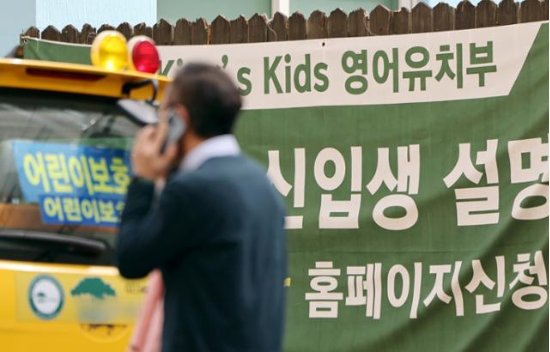
On April 1, the Ministry announced a policy package titled “Measures to Respond to Private Education for Infants and Young Children to Protect Children’s Development Rights,” which sets out these restrictions. In practice, English kindergartens—English-language academies for young children—are expected to be the main target.
The ministry plans to amend the Private Education Act (the Act on the Establishment and Operation of Hagwons and Private Tutoring) to block harmful teaching practices at infant and young child academies. Officials said they will accelerate the revision and seek to pass it through the National Assembly this year, either as government-initiated or lawmaker-initiated legislation, with implementation likely in the second half of next year.
Kang Min-gyu, director of the ministry’s Early Childhood Policy Bureau, called the measure “a very strong step that legally prohibits improper teaching practices at infant and young children’s academies.” He added, “Specifically, it means children under three should not be subjected to advance learning. English kindergartens will find it difficult to operate full-day programs.”
An amendment banning level tests used for recruitment or to assign students by ability has already been passed; if promulgated this month, it is expected to take effect around October.
The new revision targets three types of practices: ranking and comparative evaluations; cognitive instruction for children under three; and prolonged cognitive instruction for children aged three until school entry (more than three hours per day or more than 15 hours per week).
Under the ban on ranking and comparisons, academies would be prohibited from assigning ranks or notifying parents of class ranking and test-result standings.
The ministry defines “cognitive instruction” as rote, subject-focused teaching intended to impart knowledge in literacy, language, or numeracy. Because the line can be unclear, the ministry plans to issue guidelines and casebooks with concrete assessment criteria.
For English academies, prohibited examples would include writing “A is for Apple” on the board and having children repeat it ten times, or requiring a daily quota of alphabet-writing exercises in a workbook.
A math example cited by the ministry is showing number cards and forcing children to memorize numbers from 1 to 100 in order, repeating the exercise until they answer correctly.
The ministry also plans to include a prohibition on misleading or exaggerated advertising by infant and young child academies in the amendment. It will make false or inflated claims—during recruitment or in counseling and course explanations—subject to legal sanctions to prevent unnecessary parental alarm.
To strengthen enforcement, the ministry will introduce penalty surcharges of up to 50% of an academy’s revenue and raise existing administrative fines to 10,000,000 KRW (approximately $7,500). It also plans to increase whistleblower rewards to as much as 2,000,000 KRW (approximately $1,500) to encourage continuous monitoring of illegal practices.