|
Seoul has become the place where the burdens of marriage, childbirth, and childrearing weigh heaviest. When people struggle to balance work and family and view having children with fear, we are forced to reflect deeply. (Kim Gil-yeon, president, People to People International Korea)
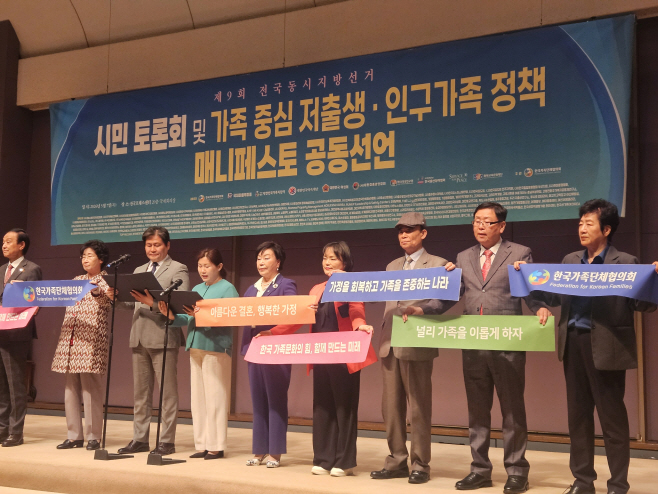
At the 9th Citizens' Forum on the Nationwide Local Elections and the Joint Declaration on Family-Centered Low Birthrate and Population Policies, held May 7 at the International Conference Hall on the 20th floor of the Korea Press Center in Jung-gu, Seoul, speakers sharply criticized current national low-birthrate policies. They urged candidates for Seoul mayor to adopt fundamental population policies centered on restoring familism. The event drew 172 organizations, including the Korea Family Organizations Council.
Before the event, Hwang opened the meeting, saying, "Even though Korea poured 380 trillion KRW (approximately 285 billion USD) into measures addressing low birthrates and aging, the effort ended in dismal failure." She argued that policies faltered because they remained palliative—distributing cash to fragmented individuals—rather than treating families as organic living communities. She called for moving away from segmented policies that divide by gender and generation and toward inclusive family policies in which every family member is both a caregiver and a beneficiary.
|
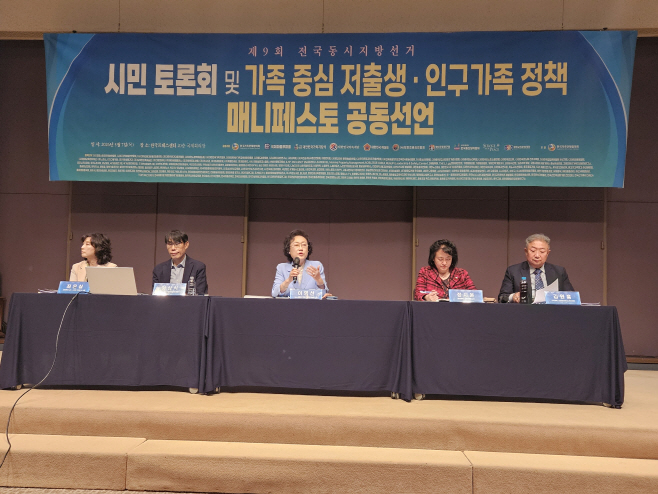
Choi Eun-sil, an adjunct professor at Korea University, presented on the need to shift the paradigm from economic to cultural-value policies. She argued that existing policy treats childbirth and childrearing as an "economic function." While financial support can operate as a necessary condition for having and raising children, it is not a sufficient condition to fundamentally motivate the younger generation. She said policymakers must seriously examine the deeper sociocultural contexts behind low birthrates, including rising individualism and presentism, gendered caregiving roles, and a competitive education culture.
The event concluded with a reading and signing of a joint declaration. The Korea Family Organizations Council proposed "Seven Core Strategies to Make Seoul Family-Centered and Open the Future." The strategies are: generational and class integration (encouraging communal returns for single-person households); comprehensive care (a no-gap caregiving responsibility from birth to 100); work-family compatibility (a culture of shared work and caregiving); housing stability (building a Seoul-style family housing ladder); guaranteed health rights (a medical safety net that respects life); tax and economic support (local tax innovation based on family units); and governance reform (an institutional foundation for a Family Happiness Special City).
Participating groups said they hoped the event would not produce mere election-season pledges but would serve as a platform for social compromise—rebuilding a fractured family community with Seoul's 10 million residents and designing a sustainable future for the city.