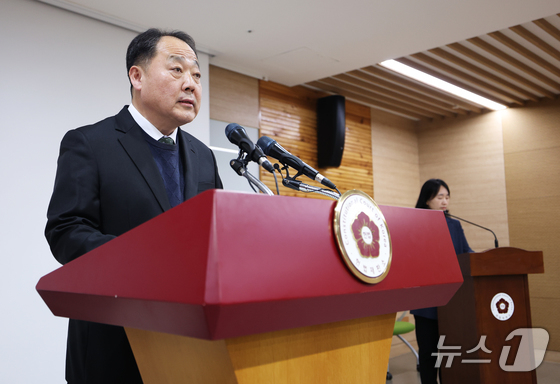
Son In‑hyeok, secretary general of the Constitutional Court, said on March 10 that the court is taking steps to prevent unintended effects from the so‑called “four‑tier” system and will work to ensure effective cooperation with the judiciary.
The Constitutional Court held a press briefing that afternoon at its annex in Jongno‑gu, Seoul, to explain the rationale for introducing the judicial review petition system and to outline its preparations.
Son said constitutional petitions have long protected citizens’ fundamental rights against state power and served to keep the legislative, executive and judicial branches within constitutional bounds. He noted, however, that the court has lacked a mechanism to scrutinize judicial rulings—the decisions that most directly affect people’s lives.
He added that the court’s research staff are conducting a careful review to guard against any negative consequences of a four‑tier system and that the court will pursue efficient coordination with the judiciary.
“The appeals process will be approached with greater caution, and the judicial review petition will help create a more robust framework for safeguarding fundamental rights,” he said.
Ahead of the system’s launch, the Constitutional Court met on March 3 to discuss case numbering, assignment procedures and electronic processing.
The court decided to use the same case prefix, '헌마', for judicial review petitions as it uses for existing constitutional petitions.
It also established a dedicated review division to handle these cases. The division consists of eight Constitutional Court researchers, each with at least 15 years of legal experience.
The Secretariat is advancing administrative preparations as well. Last week, the court formed an administrative preparation team of roughly 10 people to assess readiness for operating the new system.
Procedurally, the court is prioritizing immediate revisions to rules that need prompt amendment, including enforcement regulations and assignment guidelines. It will also revise adjudication rules to specify required case entries and attachments, and implement those changes when the bill is promulgated.
The electronic filing system is already in place. The court will publish guidance on its website explaining how to file a petition and complete the forms, and it plans to produce informational leaflets for callers and visitors seeking guidance.
Anticipating a potential increase in cases after the system takes effect, the court is negotiating with budget authorities to expand researcher staffing and secure additional funding.
It also plans to establish cooperation channels with the courts and prosecutors. Citing Article 32 of the Constitutional Court Act, the court said it can request court records or other materials when necessary for hearings and that related consultations will continue.
The bill introducing the judicial review petition (an amendment to the Constitutional Court Act), approved by the Cabinet on March 5, is slated to take effect immediately upon promulgation this week. Once in force, the Constitutional Court will be able to annul final Supreme Court decisions if it determines they violate fundamental rights.