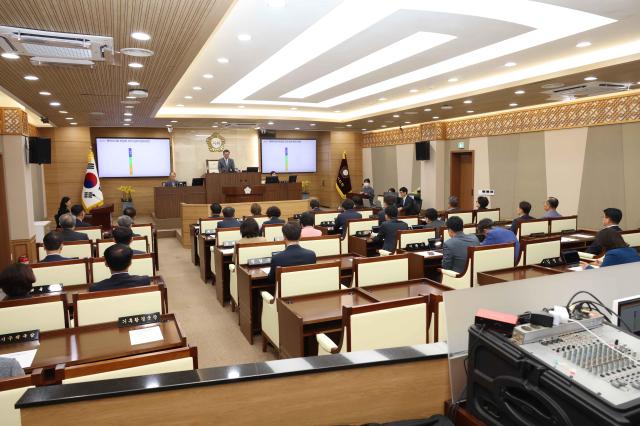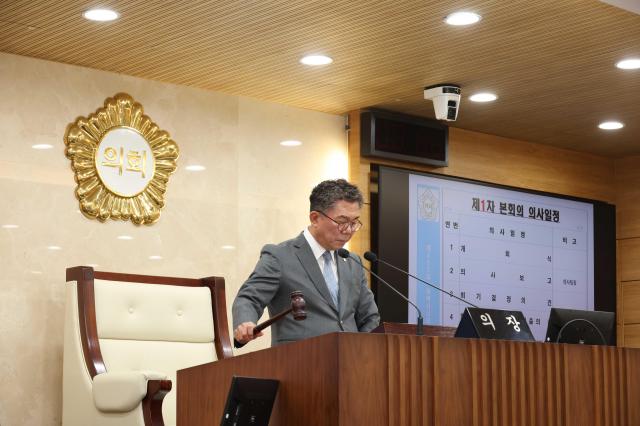
The session opened in the council chamber on the building’s second floor with Mayor Jung Jang-seon and other officials present. Over the course of a single day, members completed preliminary reviews in standing committees, a comprehensive review by the Budget and Accounts Special Committee, and a final plenary vote.
In the morning, standing committees heard the administration’s presentation on the second 2026 supplementary budget and conducted preliminary examinations. In the afternoon, the Budget and Accounts Special Committee performed a consolidated review based on the standing committees’ findings.
The second supplementary budget was prepared to reflect items that were not included in the main budget, such as adjustments to the local allocation tax, central and provincial government grants, compensatory revenues, internal transactions, and shifts in revenues and expenditures for general public administration and social welfare.
The package increases spending by KRW 65.4 billion (about USD 49.05 million) over the approved budget, a 2.52% rise that brings the total to KRW 2.6618 trillion (about USD 1.996 billion). The council passed the measure as proposed, without amendment.
With this approval, Pyeongtaek’s budget has risen again from the first supplementary budget of KRW 2.5963 trillion (about USD 1.947 billion) adopted in March. The current revision incorporates urgent fiscal needs, including relief for high fuel prices, into this year’s budget framework.
Council Chair Lee Yun-ha said before adjourning that she hopes the approved allocations for fuel-price relief will provide meaningful support to residents affected by the fallout from the Middle East conflict.
Lee also warned of a heightened wildfire risk due to the dry spring weather and urged public officials to reinforce surveillance and response systems.
A council official said the second supplementary budget focused on reflecting post-budget revenue and expenditure changes as well as urgent funding needs, and that the review prioritized timely allocation of resources to areas that directly affect citizens’ lives.
Pyeongtaek has already begun distributing fuel-price relief payments in phases, prioritizing vulnerable groups such as basic livelihood recipients, near-poverty households, and single-parent families.
The session was a one-point meeting centered on the supplementary budget; despite the condensed schedule, standing committees and the budget committee completed sequential reviews and finalized the approval process.
In March, during the 261st extraordinary session, the council examined and amended the year’s first supplementary budget to KRW 2.5963 trillion. This second supplementary budget is a follow-up measure to address additional fiscal needs that arose afterward.
Meanwhile, on the same day, Pyeongtaek City and the Pyeongtaek City Council signed an agreement in the council chair’s office to promote personnel exchanges.
The agreement, building on an existing personnel-management pact, aims to formalize administrative-legislative cooperation and enhance both institutions’ expertise and operational capacity through practical staff exchanges.