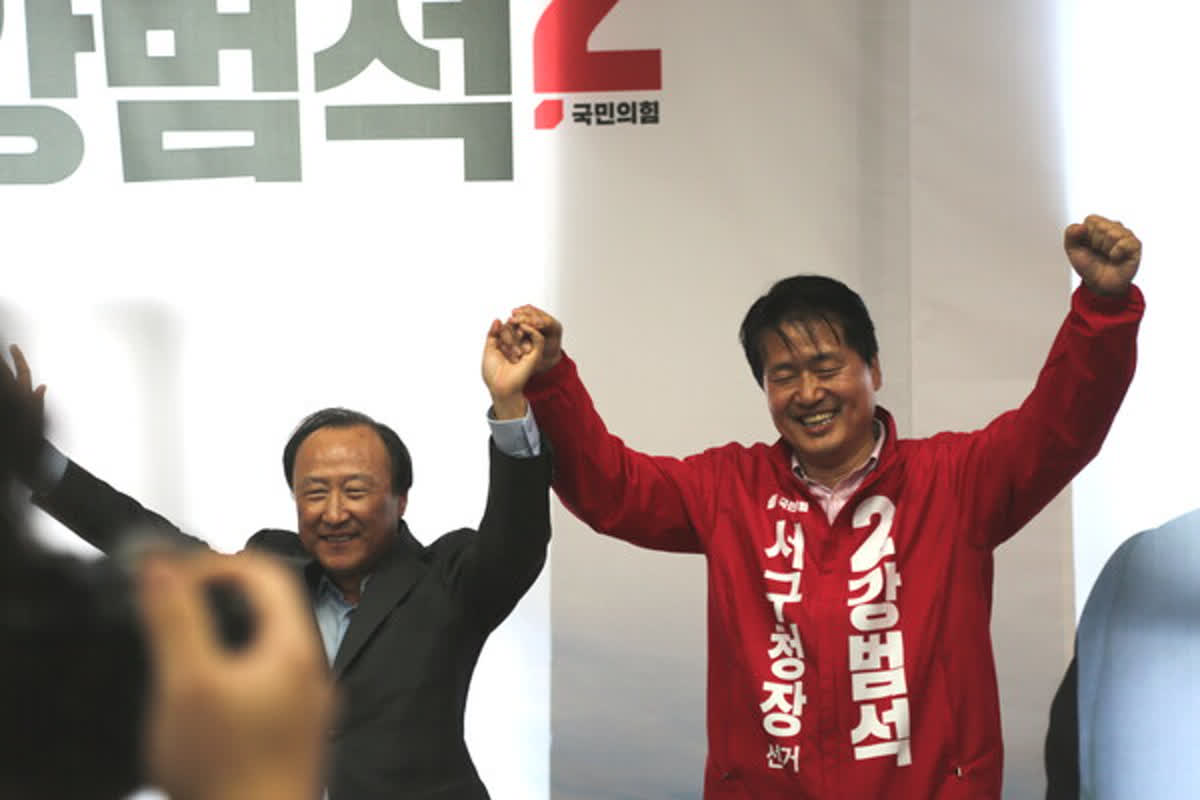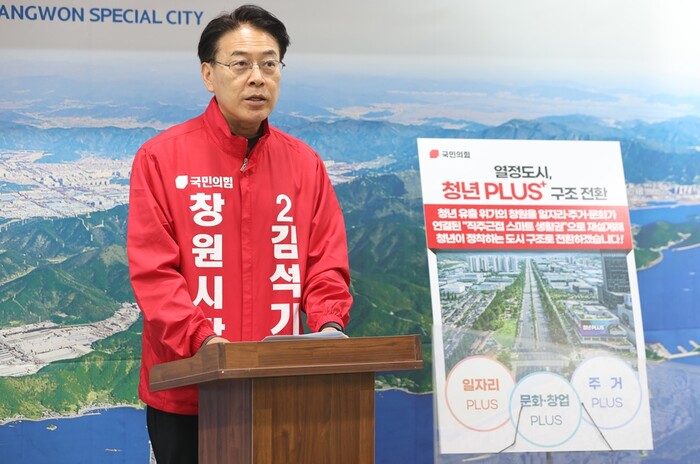
Kim Seok‑gi, a candidate for Changwon mayor, formally announced an urban restructuring plan aimed at reversing youth outmigration during his third policy briefing at the City Hall press center on the 10th.
“Youth policy is not simply welfare; it is a structural issue that shapes a city’s future competitiveness,” Kim said, pledging to transform Changwon’s approach into a “Youth PLUS” framework.
Net loss of 3,577 residents aged 20–39 in Changwon — “a structural warning”
Kim cited 2024 figures showing 47,327 residents moved out of Changwon while 40,524 moved in, yielding a net outflow of 6,803 people.
Young adults accounted for a disproportionate share: 2,888 were in their 20s and 689 in their 30s, together making up more than half of the net outflow.
“When young people leave, industry shrinks, tax revenue declines, and the city’s future erodes,” Kim warned. “Changwon faces a choice now: remain a city young people abandon, or become one where they can build their futures.”

Key elements of Kim’s youth plan — the three-part “Youth PLUS” package
To change the dynamics that push young people away, Kim proposed a three-part “Youth PLUS” package: Job PLUS, Housing PLUS, and Culture & Startup PLUS.
Job PLUS= Establish an industry‑academic employment platform jointly designed by high schools, universities, and employers.
The platform would create a one‑stop pipeline — vocational training → on‑site internships in industrial parks → hiring — to reshape youth employment pathways.
He also plans to cultivate healthcare, medical services, caregiving, and other service sectors as new sources of youth employment, and to develop specialized job tracks in service and tourism tailored for young women.
Housing PLUS= Redevelop 13 aging single‑family neighborhoods in the former Changwon area into youth‑friendly housing complexes.
The new complexes would be required to include rental housing for young people and workers, use underused land near industrial parks to create live‑near‑work housing, and introduce support measures such as lump‑sum deposit (jeonse) assistance for newlyweds, a secure rental program, and shared childcare facilities.
Culture & Startup PLUS= Create a startup and cultural corridor linking industrial parks with the old downtown.
By building shared offices, creative studios, and youth community hubs, the plan aims to foster a Changwon‑specific startup ecosystem where young people can take risks, innovate, and grow.
Core strategy — live‑near‑work smart living zones
Kim described “live‑near‑work smart living zones” as the core strategy of his youth policy.
This envisions an urban layout that connects industrial parks, housing, transit, and cultural amenities within compact living zones so young people don’t lose hours commuting and can live, work, and develop their careers within the city.
He also plans to create a dedicated Youth PLUS unit within the Changwon Industry Promotion Agency to coordinate job, housing, and startup initiatives.
“Many cities offer youth programs, but few build structures that actually keep young people in place,” Kim said. “I will go beyond standalone support programs and change the city’s structure itself. I want Changwon to be a place where young people work, marry, and raise their children.”
“The Youth PLUS framework I announced today is the first key to opening Changwon’s next decade,” he added.
Kim Seok‑gi previously served as Acting Mayor of Changwon (first vice mayor), vice mayor of Gimhae, vice mayor of Geoje, director of the Gyeongsangnam‑do Economic and Trade Bureau, and secretary‑general of the Gyeongsangnam Provincial Council. He passed the 36th national administrative exam.
After the third policy briefing, when asked why Kim should be elected mayor, a campaign official described him as “a prepared leader.”
The campaign pointed out that among the 10 People Power Party candidates, Kim is the only one who passed the national administrative exam. It argued that Changwon faces multiple complex challenges — including the Marine New City project, the NC baseball stadium, the SM mixed‑use development, the Daesang Park “Big Tree” issue, and a planned liquefied hydrogen refueling station — that demand an experienced administrative expert. The campaign said resolving these issues will require not only strong leadership but also constructive cooperation with Gyeongnam Province and the central government, and that Kim is well positioned to secure that cooperation.
They added that public sentiment favors electing a mayoralty without any ethical questions in the ninth term, and asserted that Kim has maintained an unblemished record of integrity and probity during his 30 years as a senior civil servant.