Seoul’s Line 5 extension to Gimpo and Geomdan, the Wirye–Sinsa urban rail project, and the Gadeokdo New Airport rail connector have all cleared the government’s preliminary feasibility review (예비타당성조사, commonly called “예타”).
The Ministry of Economy and Finance said on the 10th that it convened the “2026 3rd Fiscal Project Evaluation Committee,” chaired by Acting Minister Im Gi-geun, to review and approve the 예타 findings and related agenda items. The meeting also considered reforms to the preliminary feasibility review system.
Three projects passed the review at this meeting.
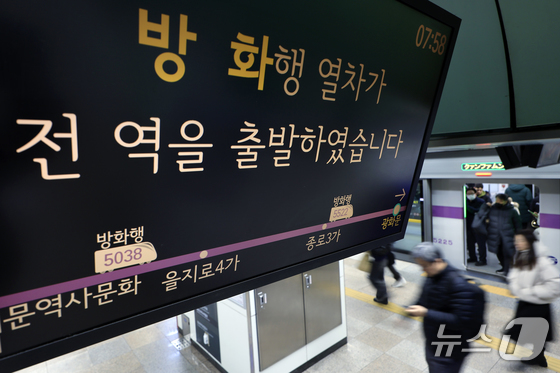
The Line 5 Gimpo–Geomdan extension will lengthen Line 5 from Banghwa Station through Incheon Geomdan to Gimpo by 25.8 km (about 16.0 miles). The project aims to improve public transit in Gimpo and Incheon, respond to demand from the Gimpo Hangang 2 compact-city development, and reduce crowding on the heavily used Gimpo Goldline—thereby improving safety.
The Wirye–Sinsa urban rail project will construct a new line linking Wirye New Town with Samseong and Sinsa stations. It is designed to relieve traffic pressure in southeast Seoul caused by large residential developments and to enhance transit convenience.
The Gadeokdo New Airport rail connector will link the Gyeongjeon Line with the Buhang New Port Line. That connection is intended to improve access to the Gadeokdo New Airport from the southeast region—including Busan and Ulsan—and to shorten rail freight distances from Busan New Port toward the East Sea corridor.
The committee also discussed a package of 예타 reforms. The plan is built around three core objectives: steer investment toward balanced regional growth, support projects that advance national priorities, and strengthen support for effective project delivery. The ministry identified 11 reform tasks and plans to revise guidance and produce new manuals, with implementation slated for June after completing preparations this year.
To encourage balanced growth, the ministry will reduce the economic-efficiency weight for projects in population-declining areas by five percentage points and increase the regional-balance evaluation weight by five percentage points. It will add a “balanced growth effect” criterion to assess regional specificity and long-term contributions to local growth across all construction projects (both SOC and building projects). Projects rated highly in the “balanced growth impact assessment” will receive priority in 예타 selection.
The evaluation framework will also be restructured to expedite projects that advance national agendas. The ministry will adapt social-value–centered policy evaluations so assessors can measure economic, social, and environmental effects on a project-by-project basis.
For information-technology projects, the 예타 process will shift to a “diagnostic” approach that goes beyond a pass/fail decision. The new approach will place greater emphasis on proposing alternatives and remedial measures and will shorten the review period from nine months to six months.
Economic analyses will broaden the benefits counted—such as pollution reduction and reductions in traffic-accident damages—to better capture value changes arising from economic and social development.
To support effective implementation, the ministry will revise 예타 coverage, evaluation items, and standards, and it will establish a consulting function.
The threshold for 예타 coverage of SOC projects will be raised: the trigger will move from a total project cost of 50 billion KRW (approximately 37.5 million USD) with national funding of 30 billion KRW (approximately 22.5 million USD), to a total cost of 100 billion KRW (approximately 75.0 million USD) with national funding of 50 billion KRW (approximately 37.5 million USD). The ministry will also create an exemption for projects that are simple replacements of aging hardware or software without substantive scope changes.
The ministry will refine economic-analysis criteria—such as analysis periods for transport projects and unit construction-cost standards. It will establish an expert consulting group to advise before 예타 applications, expand information sharing across pre-예타 stages like target selection and investigations, and designate additional 조사 agencies to accelerate and strengthen investigations.
The committee selected five projects as 예타 targets.
They are: the Seoul Subway Line 8 Pangyo extension; new construction and widening of the Jeju mid-mountain road (Surae-ri to Susan-ri); establishment of a Korea Coast Guard training and development center; construction of a National Maritime City Science Museum; and development of an AI system for the National Tax Service.
Acting Minister Im said, “We have reformed the 예타 system more substantially than at any time since April 2019 to reflect the demands of a changed era. Through this reform, we will guide strategic fiscal investment toward balanced-growth projects and focused support for the nation’s core agendas.”
He urged officials to accelerate coordination with private experts and relevant ministries, to complete guideline revisions and follow-up procedures by May, and to begin full implementation in June.