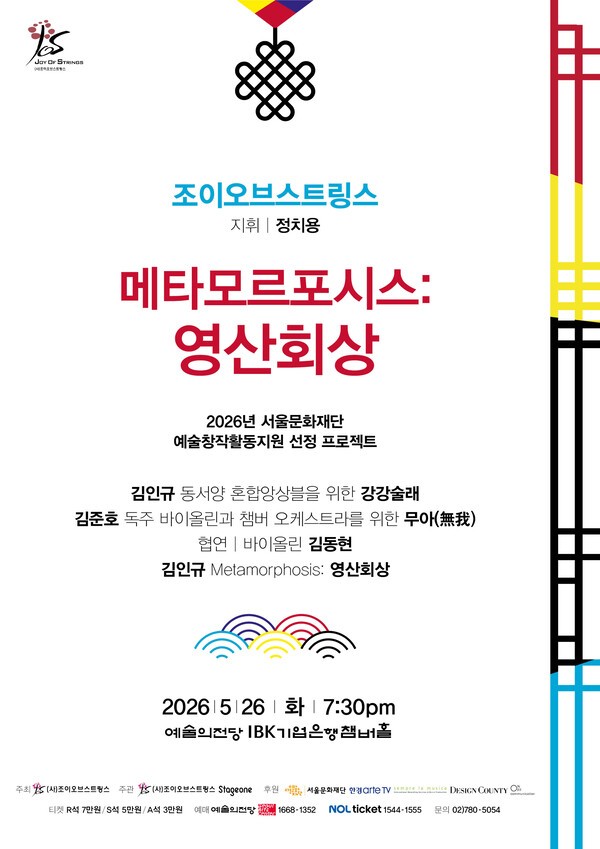
[NewsCulture reporter Lee Jun-seop] A melody that has crossed 600 years arrives in an unfamiliar form. Yeongsanhoesang—long regarded as the pinnacle of traditional Korean instrumental music—now encounters the language of a Western chamber orchestra. Metamorphosis: Yeongsanhoesang, opening May 26 at the Seoul Arts Center, sets out to rewrite a coordinate in Korea’s musical history.
This program is a daring initiative from the string ensemble Joy of Strings as it approaches its 30th anniversary. Since its founding in 1997, the group has amassed a wide repertoire and an experimental bent; now it is attempting to transplant the heart of Korean traditional music into Western musical frameworks.
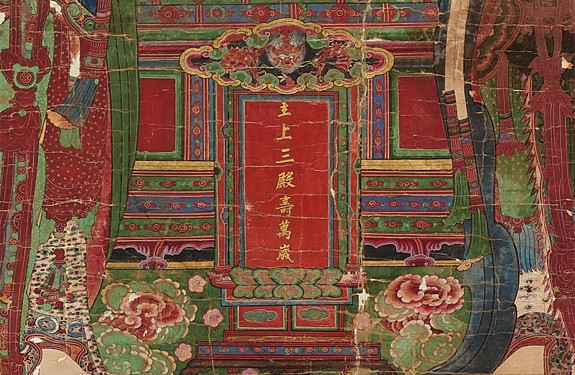
Yeongsanhoesang began as a Buddhist vocal piece and evolved, in the late Joseon period, into an instrumental suite. Long, breath-driven melodies woven by the piri and daegeum (bamboo wind instruments), the haegeum (two-string fiddle), the gayageum and the geomungo (plucked zithers) sustained this repertory for generations in intimate music salons. Recasting the entire suite, movement by movement, within a Western instrumental idiom is virtually unprecedented.
Composer Kim In-gyu treats this immense legacy not as a literal translation but as a retelling. He moves beyond transcription, allowing traditional melodies to be reborn within Western harmony and formal structures. The resulting Metamorphosis: Yeongsanhoesang retains the original’s emotional core while revealing a wholly new sonic texture.
Conductor Jeong Chi-yong, a long-standing figure in Korea’s music world, will lead the project. His résumé—stints with the National Symphony Orchestra and the Seoul Metropolitan Symphony Orchestra—lends the work necessary gravitas. The task before him is to weave a single narrative from a complex intersection of tradition and modernity, East and West.
Violinist Kim Dong-hyun, who has made his mark in international competitions, appears as soloist. In Kim Jun-ho’s concerto Mua, he will navigate between Korean rhythmic idioms and the conventions of the Western concerto.
Mua unfolds in three movements, each grounded in a different traditional idea. It draws on the asymmetric seven-beat chilchae jangdan, the gestures of the Cheoyongmu dance, and shamanic movement. These elements emerge through the tense interplay between solo violin and orchestra. Composer Kim Jun-ho uses that tension to rethink Korean musical notions of time and embodied performance for contemporary listeners.
Another central figure is guest concertmaster Shim Jeong-eun. Shim has long pursued a distinctly Korean ensemble sound, focusing on how Western instruments can convey traditional breathing and phrasing. His involvement signals that this project is not a one-off stunt but part of a sustained research trajectory.
The program opens with Ganggangsullae. As its repeating rhythm expands incrementally, Korean instruments and Western strings intersect. The breaths produced by the daegeum, piri, haegeum and ajaeng form a foundation that violins, violas, cellos and double basses layer over, producing a distinctive emotional register.
Following that, Mua ramps up dramatic contrast. The solo violin anchors the work while woodwinds, brass and strings interweave fragmented rhythms and motifs, sharpening the tension. Here, traditional jangdan operates not as background color but as a structural force.
The evening culminates with Metamorphosis: Yeongsanhoesang. A mid-sized ensemble—flute, oboe, clarinet, bassoon, horn, trumpet, timpani and strings—recasts the original’s slow, expansive flow in fresh timbral hues.
The work’s core idea is transformation. A single melody shifts instruments, timbres and formal contexts, revealing entirely different expressive faces. When traditional cyclical time collides with Western linear form, the result is a recurring play of surprise, tension and release.
The project also engages questions about the globalization of Korean music. In the century since Korea adopted Western musical practices, composers have continually reassessed identity. This performance can be read as the next step in that ongoing inquiry.
Many contemporary works draw on traditional music, but few attempt to translate an entire original suite into a Western ensemble. In that sense, this production is less an experiment than a directional statement.
Joy of Strings has expanded its activity beyond the concert hall—film scores, broadcast work and regional cultural projects have broadened its reach. This program marks another boundary the ensemble is crossing.
Metamorphosis: Yeongsanhoesang does not aim to recreate the past. It dismantles the past and rebuilds it in contemporary idiom. In the process, tradition appears not as a fixed relic but as a living, evolving structure.
What lingers after the performance may feel unfamiliar. That unfamiliarity, however, points toward a new path for Korean music.
NewsCulture Lee Jun-seop rhees@nc.press