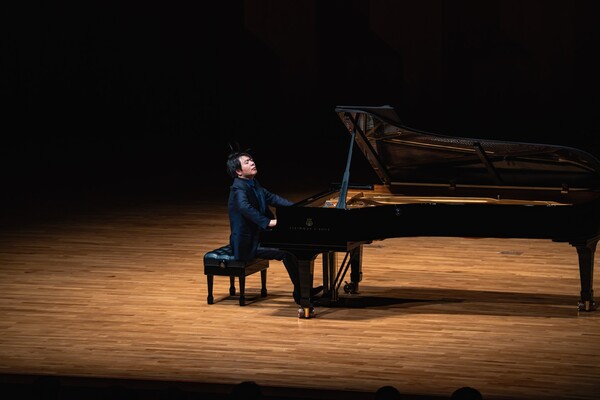
He has dialed back his showmanship and now sinks deeply into the music.
His shift toward a more serious, inward-focused pianism has become unmistakable.
Just over a decade ago, when Chinese pianist Lang Lang appeared on the Seoul Arts Center Concert Hall stage, audiences mostly associated him with showmanship and flair.
For many, Lang Lang conjured images of dramatic gestures—arching his back and torso—dazzling technique and clear star power. He greeted audiences like an idol, often raising both hands; exaggerated facial expressions and theatrical movements during performances became part of his public persona.
Now in his 40s, Lang Lang has softened that persona. Since his 2022 recitals in Korea, he has stripped away much of the theatrics and emerged as a performer who immerses himself in the repertoire.
The late-April 2026 Lang Lang piano recital made that transformation even clearer. Most notably, by moving beyond a Mozart- and Beethoven-centered canon to include Albéniz and Granados, he set this program apart from his earlier Korea performances.
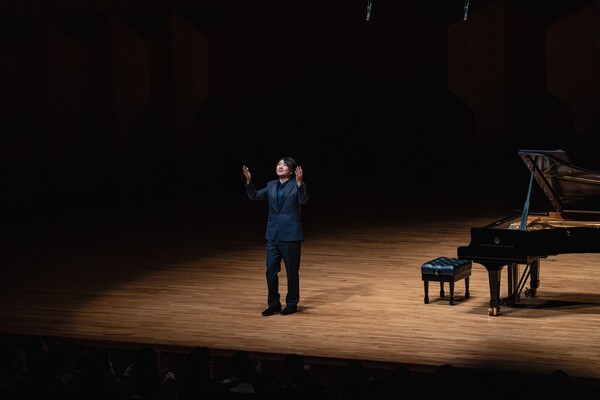
“He dials down past showmanship and immerses himself in the pieces.”
Looking back at Lang Lang’s recitals, his 2013 Seoul program left a strong impression with works such as Chopin’s Ballades Nos. 2, 3 and 4 and Rachmaninoff’s Piano Concerto No. 2.
At his early-December 2015 Korea recital he said he had spent a long time studying how to choose the repertory—and the performance showed that care. The first half juxtaposed the calm, elegant contrasts of Tchaikovsky’s The Seasons and Bach’s Italian Concerto; the second half offered Chopin’s four scherzos, each line rendered with clarity and purpose. The concert felt cohesive, as if a single poetic structure had been constructed and completed.
The Mozart rondo and Beethoven’s Piano Sonata No. 8 “Pathétique” and No. 31 that opened Lang Lang’s 2026 recital are staples of the repertory, inviting inevitable comparison with landmark readings by pianists such as Kun-Woo Paik, Rudolf Buchbinder, Daniel Barenboim and Boris Giltburg. On their own, these works rarely provide an easy point of distinction.
So the second-half choices—Albéniz, Granados, Liszt’s Consolation No. 2 and the Tarantella—were significant. They suggested a deliberate turn away from the image he once cultivated and toward an expanded repertory and artistic focus.
Isaac Albéniz, a founder of the Spanish national school, translated regional Spanish moods into piano idioms. Lang Lang’s selection of Spanish pieces included familiar favorites that reflect local rhythms and melodies; the program featured the well-known “Asturias,” and closed with “Cuba,” which added a touch of Caribbean color that gave listeners fresh points of interest.
Enrique Granados’s Goyescas is a signature piano suite inspired by the paintings and world of Francisco Goya. It is praised for rendering Spanish feelings—love, tragedy, elegance—into music.
When Kun-Woo Paik presented Goyescas during his 2022 sonata series, the piece stirred a dormant exotic sensibility for many listeners. For me and many concertgoers who attended that recital, it registered as a distinctly foreign esprit. Given that context, it was regrettable that Lang Lang did not perform the complete Goyescas suite this time.
Lang Lang played “Suspiros, or the Maja and the Nightingale” from Goyescas—a movement sometimes cited as an antecedent to the melody of the popular song “Bésame Mucho.”
He closed the program with Liszt’s Consolation No. 2 and the Tarantella from Venezia e Napoli—selections that reaffirmed his virtuosity. The Tarantella, part of Liszt’s Années de pèlerinage (Second Year: Italy), is famous for its repeated-note outbursts and demanding passages. It offered Lang Lang a chance to display his virtuosic strengths in a finale.
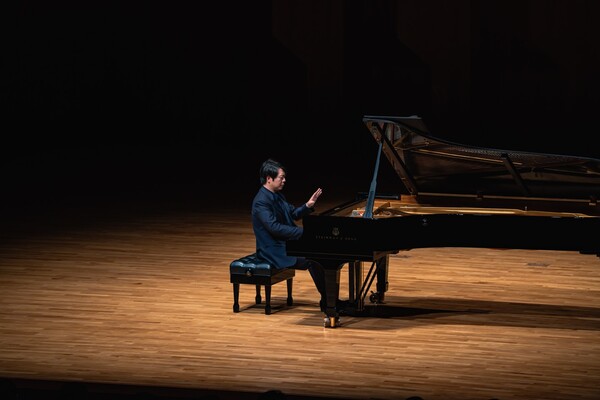
“Crossing forty, Lang Lang’s pianism evolves into deeper immersion.”
The shift toward a more introspective Lang Lang became evident in February 2022.
On the evening of February 23, 2022, at the Seoul Arts Center Concert Hall, he performed Bach’s Goldberg Variations. BWV 988 is a monumental work that contains a microcosm of Bach’s compositional world: an aria, 30 variations, and a return to the aria in a vast, tightly woven arc. Lang Lang’s reading revealed inventive moments and a carefully constructed flow that drew the audience into intense focus.
That recital signaled a turning point: Lang Lang was no longer relying on spectacle alone but entering the architecture of the works themselves. His Goldberg recording also marks an important milestone in his artistic life.
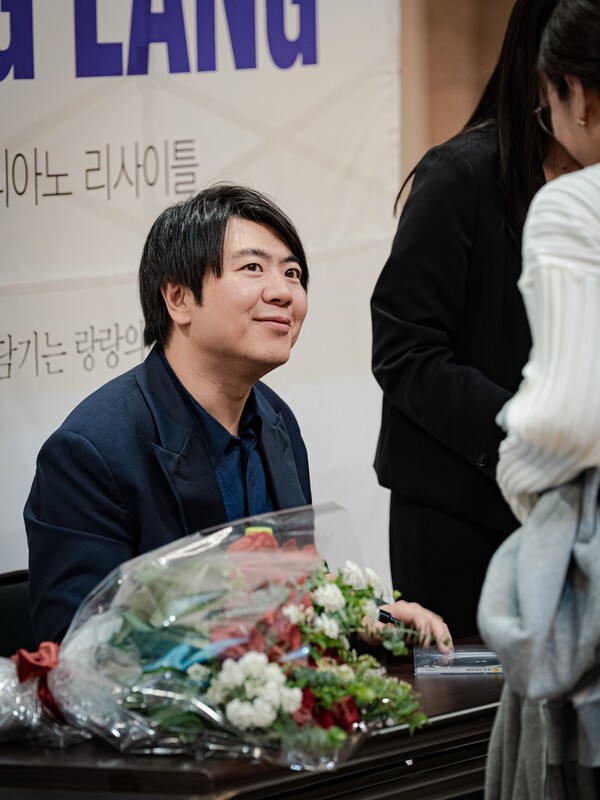
Lang Lang’s November 30, 2024 Korea recital reaffirmed that inward turn. If Evgeny Kissin’s recital at the same hall ten days earlier had shown a veteran pianist moving from encore-driven spectacle to condensation and restraint, Lang Lang’s performance in the same space shed much of his former showmanship and presented a more orthodox, inward-facing pianism.
From the opening—his performance of Gabriel Fauré’s Pavane in F-sharp minor—he largely abandoned exaggerated expressions and gestures. Instead, he focused intently on the music and sank into it. The pavane’s 16th-century dance rhythms, dreamlike harmonies and delicate melodies flowed and returned, suggesting the direction of his evolving pianism.
Chopin’s mazurkas, which he composed throughout his life, have always held special meaning. That made the twelve mazurkas Lang Lang played in the second half of the 2024 recital especially significant: they felt like evidence of a deepening, more introspective artistry.
As Liszt observed, “To play mazurkas properly, each piece needs the very best pianist; every piece demands accents and proper balance, and that secret is hard to achieve unless the performer feels it.” Chopin’s mazurkas may seem deceptively simple, but they demand improvisatory freedom and the performer’s creative sensitivity—qualities that reveal the summit of interpretive art.
The change we first noticed in the Goldberg Variations in 2022 grew clearer in 2024, and the 2026 program’s emphasis on Spanish repertory represented another extension of that evolution. Where an earlier Lang Lang captivated audiences with flashy gestures and star power, the current Lang Lang is evolving into a pianist who probes deeper into the music. The 2026 recital confirmed that trajectory.
By Yeo Hong-il
Edited by Ju Jin-no