|
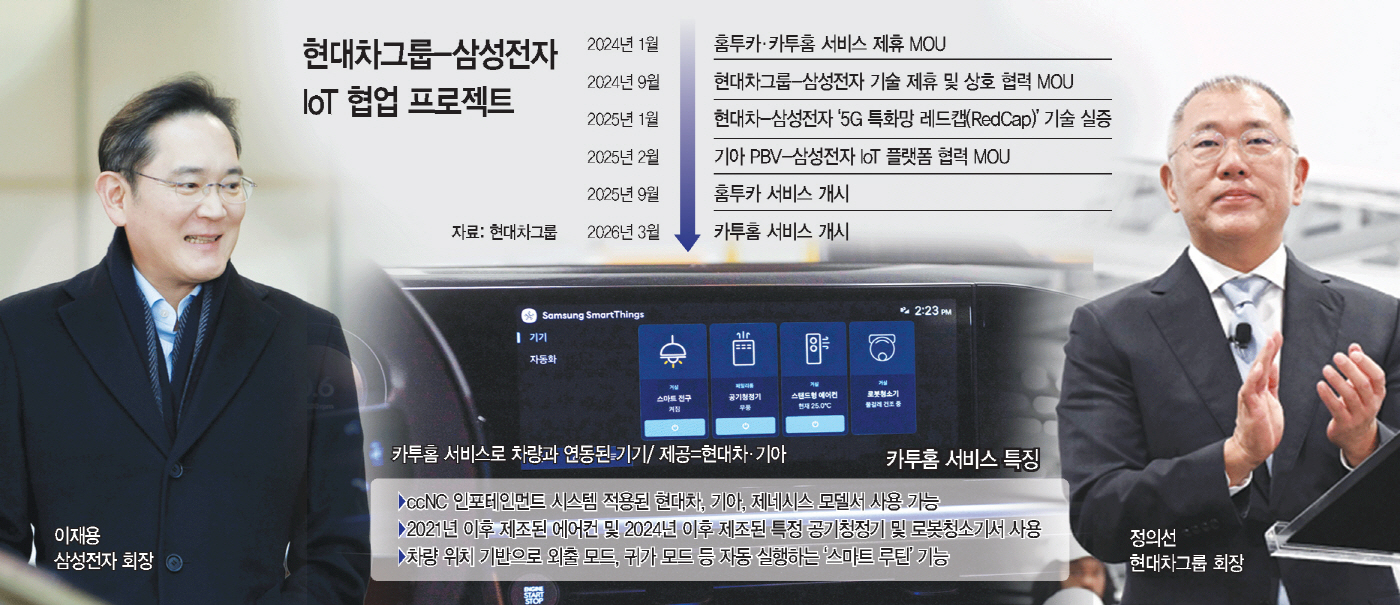
On the 23rd, Hyundai Motor Group said it officially launched a Car-to-Home service with Samsung Electronics, allowing drivers to control home appliances from their vehicles. The rollout is a concrete outcome roughly two years after Hyundai, Kia and Samsung signed a memorandum of understanding on Car-to-Home and Home-to-Car services in January 2024. The Home-to-Car service arrived first, in September of last year.
Car-to-Home is delivered through Hyundai and Kia’s connected-car services and Samsung’s SmartThings smart-home platform. Through the vehicle infotainment system, drivers can remotely operate home IoT devices such as air conditioners, air purifiers, lighting and robot vacuums.
Crucially, the service includes a Smart Routines feature that uses vehicle location to trigger appliances automatically when a user leaves or returns home. That elevates the offering from simple device control to a service that links daily life across mobility and residence, blurring the boundary between the two.
This cooperation is significant because it represents a shift toward a platform alliance rather than a simple feature add-on. The relationship accelerated after a May 2020 meeting between then-Hyundai Motor Group Vice Chairman Chung Eui-sun and then-Samsung Vice Chairman Lee Jae Yong.
The partnership quickly focused on core vehicle components. In June 2023, Samsung agreed to supply Hyundai with the Exynos Auto V920 infotainment semiconductor, putting their system-semiconductor collaboration on track. In October of that year, Samsung SDI signed a contract to supply prismatic batteries for Hyundai’s electric vehicles, expanding the collaboration into electrification.
Samsung Display’s OLED panels have been installed in key models, including Genesis. Samsung’s subsidiary Harman supplies audio systems for major Hyundai Motor Group models, embedding Samsung technology in the in-car user experience. More recently, the cooperation has extended into manufacturing infrastructure, including the construction of 5G private-network-based smart factories.
What began with semiconductors, batteries, displays, audio and factory infrastructure has now expanded into data and services with the Car-to-Home launch. The move also reflects a strategic effort to secure platform competitiveness as vehicles evolve into software-defined vehicles (SDVs).
With big tech companies such as Google and Apple vying for control of vehicle platforms globally, Hyundai and Samsung’s actions look like a strategic push to build an independent user-experience and data ecosystem.
Building on their strategic ties, the two companies have created two-way connections between vehicles and living spaces. With Home-to-Car — controlling a vehicle from a smart home — already in place and Car-to-Home now added, they have established an integrated service framework that connects car, home and user.
Industry observers say the partnership could also expand into B2B. At last year’s EV Day in Spain, Kia signed an IoT platform MOU with Samsung Electronics and is pursuing SmartThings-based B2B solutions for the purpose-built vehicles (PBVs) it produces.
Analysts view this as a sign that vehicles are evolving from mere transport into blended work-and-living spaces, and that the auto industry is shifting from a manufacturing focus toward services and platforms.
“Hyundai and Samsung’s cooperation is moving beyond parts supply to competition based on data and services,” an industry source said. “We will see full-scale competition to build integrated ecosystems that link mobility, homes and industrial spaces.”