The Netherlands’ transport authority, RDW, granted approval after more than 18 months of rigorous testing on closed tracks and public roads. The supervised FSD complies with UN R-171 and benefits from an exemption under Article 39 of EU Regulation 2018/858.
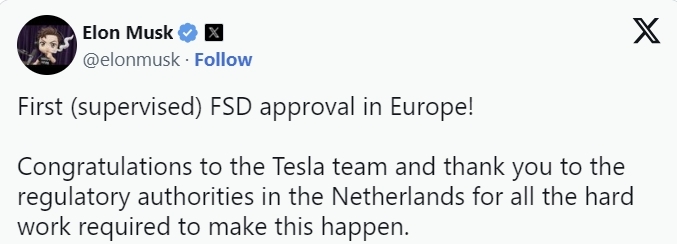
Tesla says it expects the Netherlands’ approval to lead to rapid acceptance in other European countries under the EU’s mutual recognition rules.
Tesla shares have slid more than 20% year-to-date after first-quarter EV deliveries missed expectations. Some market observers warn the stock could even test the psychological $300 level, so a European FSD approval is being watched as a potential catalyst for a share-price rebound.
뭐가 바뀌었길래...AI 4.0 최적화와 반응 속도 혁신
The technical advances in FSD are drawing attention as well. Tesla has rolled out 'FSD v14.3' starting in North America, a software release CEO Elon Musk said would make the car feel “as if it has its own consciousness.” Analysts and engineers describe the update as moving beyond a simple patch: the AI is entering a domain where it can “reason” about driving scenarios in a more human-like way. Early user reports of v14.3 have been positive and are spreading across social media, and investors are watching to see whether the technical leap can offset weak recent results and help restore the stock.
v14.3 focuses on pushing AI performance to its limits. Eunyoung Lim, an analyst at Samsung Securities, said the upgrade reduced response times by about 20%. Tesla also refined the reinforcement-learning stage of the FSD neural-network training to improve performance across a wider range of driving scenarios. The neural-network vision encoder received upgrades that boost understanding in low-visibility conditions and improve recognition of 3D geometric structures and traffic signs. In short, the system is better able to read 3D geometry and signage even in bad weather or at night.
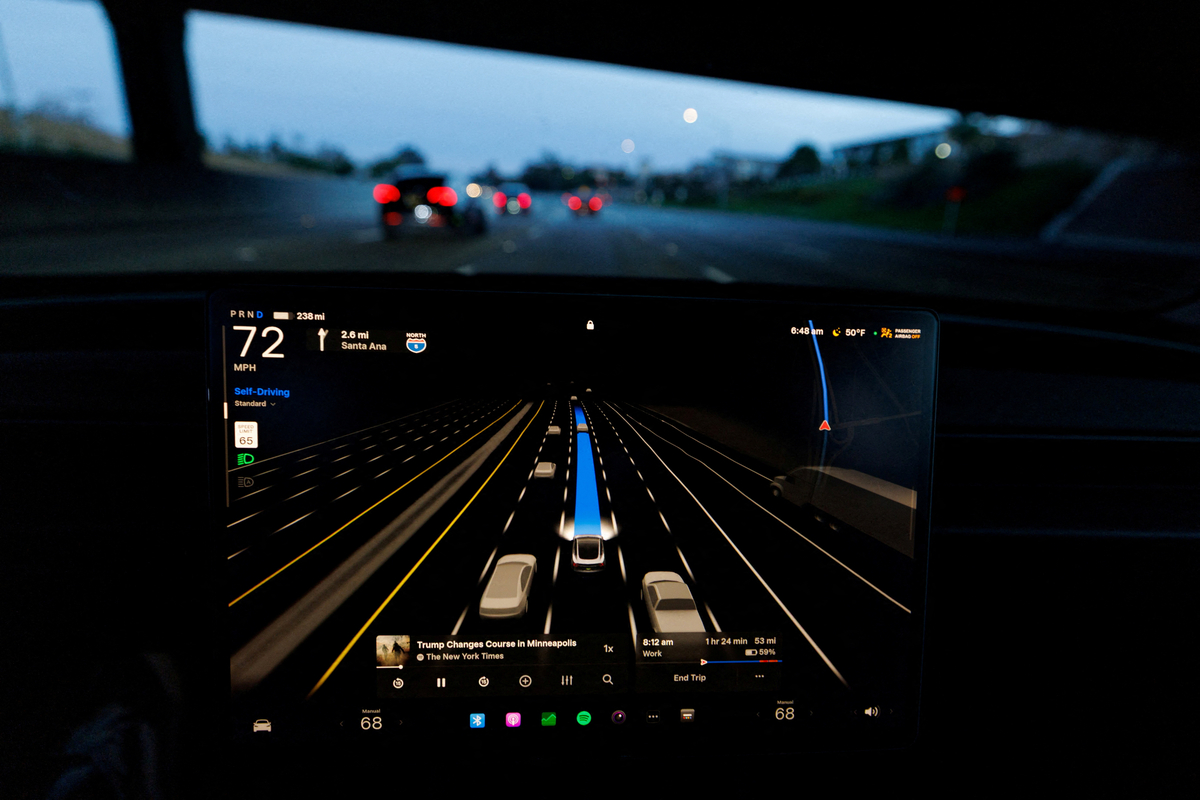
Going forward, Tesla plans to broaden the system’s reasoning capabilities to cover all behaviors beyond simple route following. Tesla’s AI approach is end-to-end (E2E), combining deep learning, reinforcement learning and multimodal perception. That architecture lets the AI learn many unstructured variables in the driving environment and maximize data-driven decision-making—enabling it to predict not only basic driving actions but also driver behavior, road risk and traffic flow.
A report from the Korea Automotive Technology Institute, “The Future of AI Mobility: E2E Autonomous Driving and SDV (Software-Defined Vehicles),” describes E2E autonomous driving as an integrated AI neural-network structure that learns and processes everything from sensor input to vehicle control, replacing traditional rule-based, stepwise processes defined by developers.