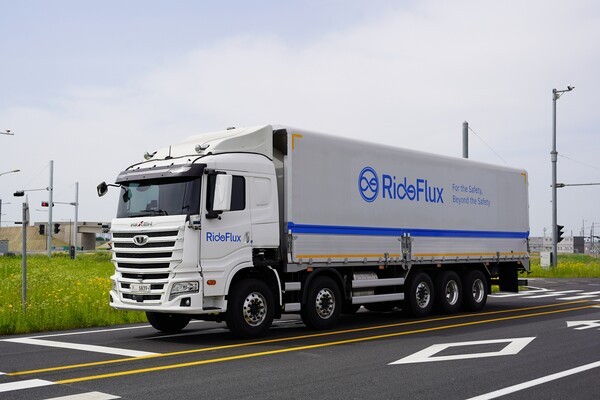
Public Times — Autonomous driving software startup RideFlux said on March 17 that it released the first footage showing a large autonomous truck carrying 11 metric tons (about 12.13 short tons) complete a long-distance run between Seoul and Jincheon without any safety-operator intervention, achieving what it calls zero-intervention autonomous driving.
The video captures a key milestone for RideFlux's middle-mile autonomous freight trial, which the company has been operating since October of last year.
RideFlux runs the autonomous truck regularly on a 224-kilometer round-trip route (about 139.2 miles) between the Songpa Dongnam logistics complex in Seoul and a logistics center in Jincheon, Chungcheongbuk-do, with the vehicle loaded with 11 metric tons of cargo.
The released footage shows the full one-way trip, demonstrating the truck perceiving its environment and making driving decisions on its own to complete the route on both highways and congested urban streets without a single operator intervention (zero intervention).
This achievement is significant because it proves a true hub-to-hub freight capability that goes beyond highway-only autonomous truck technology, extending into complex urban roads with signalized intersections and roundabouts. RideFlux holds the country's only temporary permit that allows large freight trucks to operate autonomously on urban roads.
RideFlux plans to begin paid freight service on the Seoul (Songpa)–Jincheon route as soon as it secures the necessary paid-transport permits in the first half of the year. The company also intends to launch services this year on the Gunsan Port–Jeonju–Daejeon corridor and in Gangneung, accelerating a nationwide rollout of middle-mile autonomous freight.
The company is also working to integrate with the existing freight ecosystem. It plans to commercialize the technology first on routes where driver supply is tight — overnight hours and long, repetitive runs that drive fatigue — so autonomous trucks can fill labor gaps. RideFlux says this approach will help ease the worsening driver shortage and improve efficiency and sustainability across the logistics industry.
Jung-hee Park, CEO of RideFlux, said, "This video provides visible proof of how our advanced unmanned technology operates reliably in real logistics environments. We will commercialize autonomous driving in the high-potential middle-mile freight market, shift our revenue model from B2G to B2B, and secure sustainable revenue streams to set a new standard for the domestic autonomous driving industry."
Meanwhile, RideFlux is leading the industry's shift toward unmanned operations and accelerating preparations for an initial public offering (IPO).
The company successfully conducted unmanned test runs under a permit that allows the driver's seat to be unmanned, demonstrating its distinctive unmanned-technology competitiveness. Based on these results, RideFlux has attracted more than 88 billion KRW (about 66 million USD) in cumulative investment to date.
RideFlux aims to complete a KOSDAQ technology-special listing by year-end after a technical evaluation slated for the first half of the year.
Middle-mile transport links logistics hubs over mid- to long-distance routes and precedes the last-mile stage, which delivers directly to consumers.
Reported by Ha-seong Kim (sungkim61@public25.com)