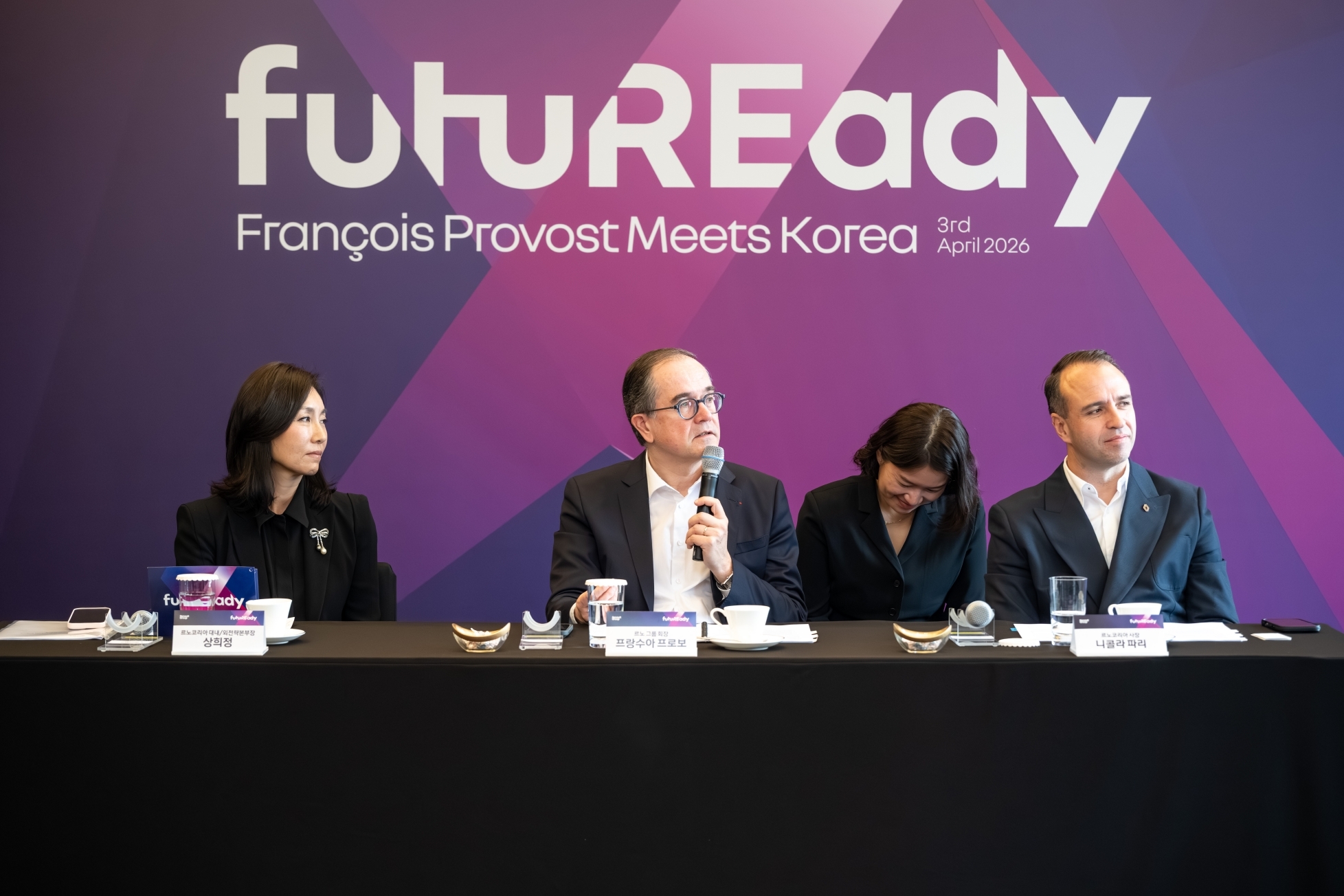
François Provot, the Renault Group chairman who played a key role in the SM6 success at Renault Samsung, outlined plans to strengthen Renault’s competitiveness in South Korea. He said the company will raise its brand profile and expand domestic market share by gradually broadening its model lineup.
Provot presented the strategy at a media roundtable on April 3 at the JW Marriott in Seoul.
He emphasized Korea’s strategic importance, saying the market has moved beyond adopting electrification to actively leading it — making Korea an important early-market for Renault Group.
“Customer demand for technology has become much more sophisticated, and the trend toward electrification is strong,” he said, adding that Korea is taking the lead in intelligent vehicle technologies.
Provot acknowledged that Korea’s market is smaller than India or South America, where Renault has focused historically, but said those characteristics make Korea strategically more important.
He noted that, while Korea’s market size is limited, the country has unique production capabilities for larger-segment vehicles for both domestic sales and exports — a distinctive and central role.
Renault Group now plans to accelerate its push into the Korean market.
“We concentrated on Europe because of a Europe-centered strategy, but now we need to restart growth outside Europe,” he said. “Korea is a priority, and we plan to expand our lineup there in stages.”
He added Renault will concentrate on expanding its lineup and accelerating electrification in Korea while broadening OEM partnerships with local automakers. Using existing assets, the company aims to boost market share and position itself more like a local OEM.
To support that effort, Renault is collaborating with Korean partners on localization, including LG Energy Solution, LG Electronics and POSCO.
Provot said that strategy is reflected in models such as the successful Grand Koleos and the promising Philant — assigning those two vehicles to Korea signals Renault’s intent to relaunch in the market.
“We wanted to regain momentum with these two models, and they have proven to be excellent fits for the Korean market,” he said. “They showcase Renault’s strengths and incorporate technologies optimized for Korea.”
He also raised the possibility of converting Korean production facilities into hubs focused on electrified vehicle manufacturing. “It’s time for Renault Korea to consider full EV production,” Provot said, adding that the group is evaluating timing and investments to upgrade the Korean base so it can produce fully electric vehicles in line with Renault’s global direction.