|
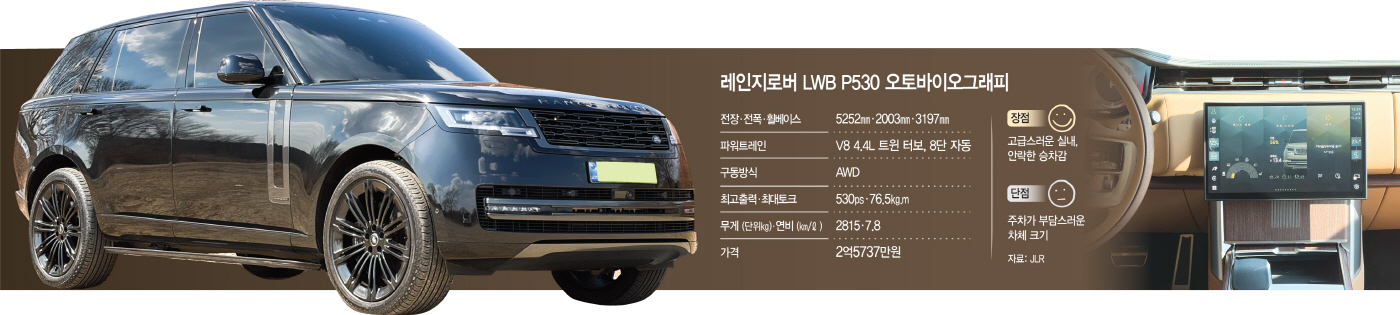
Range Rover still commands attention. South Korea remains a key market, where demand holds up despite prices that climb into the several hundred million KRW range (approximately several hundred thousand USD). That steady demand helps sustain reliable sales in the country’s imported SUV segment. The approach is simple: make it more luxurious, more refined and unmistakably Range Rover.
The exterior blends traditional cues with disciplined restraint. It’s instantly recognizable as a Range Rover, yet the surfaces and lines are cleaner and more contemporary.
The front end pares back the headlamps, grille and bumper to emphasize the vehicle’s broad stance.
The side profile balances a gently sloping roofline toward the rear, short overhangs and a long wheelbase. The taillights read as a dark panel when off and come alive when illuminated.
The cabin expresses the essence of luxury. Leather, wood and metal wrap the seats, door trims and dashboard. The materials are not only premium but are tuned for tactile quality.
Most functions are electric: seat adjustments and many convenience features operate at the push of a button. The settings minimize occupant movement, delivering a level of ease that goes beyond simple convenience and reflects what a true premium car should offer.
The 13.1-inch curved floating touchscreen is responsive and sharp; the interface is intuitive. Rear-seat space lives up to flagship expectations.
The long wheelbase delivers roominess comparable to a large sedan. Combined with generous SUV headroom, the cabin keeps passengers comfortable. The layout shifts naturally between owner-driven and chauffeur-driven roles.
Ride quality is defined by smoothness. The P530 Autobiography I drove pairs a BMW-supplied 4.4-liter twin-turbo V8 with a peak output of 530 horsepower and 76.5 kgf·m of torque (roughly 750 N·m / 553 lb-ft).
An integrated 48-volt mild-hybrid system further softens start-up feel and low-speed delivery. When a quick surge is needed for an overtake, the car pushes its substantial mass forward with surprising ease, making you forget the curb weight exceeds 2.8 tonnes (about 6,173 lb).
Range Rover’s air suspension does more than absorb impacts; it smooths road inputs so little reaches the cabin. It doesn’t merely cushion bumps — it almost erases them. The ride remains supple without ever feeling floaty.
The steering turns with light effort, yet the vehicle moves with the composed stability expected of a flagship. At speed, the large body and elevated seating position contribute to strong confidence.
The air suspension also shines in ride-height control: it lowers the body for easier entry and exit, trims the ride at high speeds to improve aerodynamics and raises significantly for off-road use. The system responds quickly. While many brands offer air suspension, few deploy it as naturally as Range Rover.
In the end, the Range Rover P530 Autobiography demonstrated what a luxury SUV can be. Expensive materials, a potent engine and lavish options are only part of the story; the model reflects decades of engineering and brand heritage. Range Rover still holds a measurable lead, and calling this car the epitome of luxury SUVs is far from hyperbole.