|
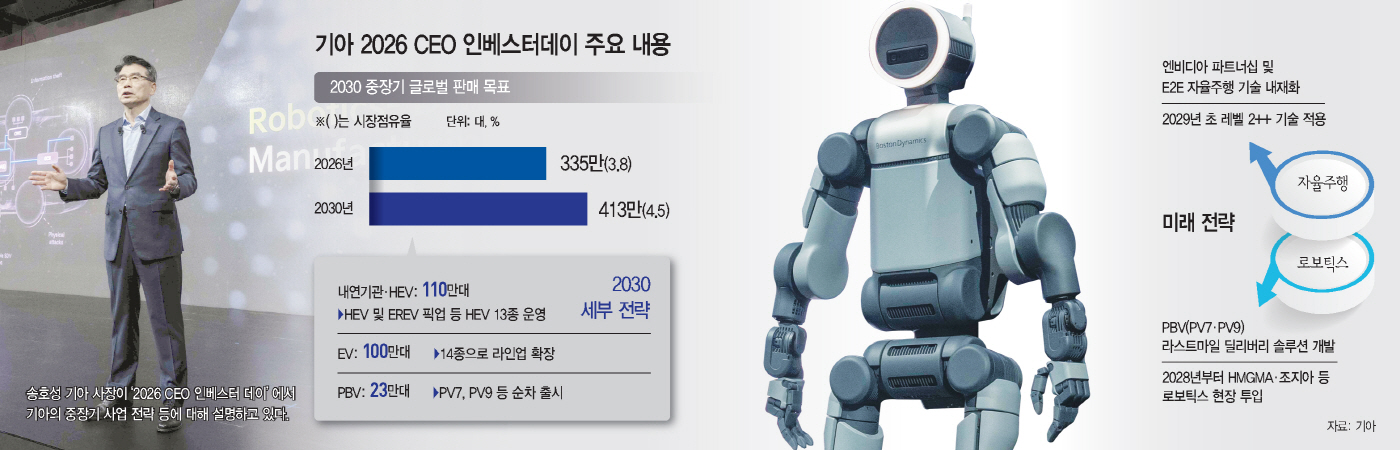
Kia held its 2026 CEO Investor Day at the Shilla Hotel in Jung‑gu, Seoul, on the 9th, where it unveiled its mid- to long-term business strategy and financial roadmap. The company set a goal of selling 4.13 million vehicles globally by 2030 and reaching a 4.5% market share. To achieve that, Kia will maintain a portfolio that includes internal-combustion vehicles, hybrid electric vehicles (HEVs) and battery-electric vehicles (EVs), and add purpose-built vehicles (PBVs), autonomous driving and robotics to its strategy.
Its sales approach is a dual-track strategy that grows EVs and HEVs together. Kia plans to expand HEV applications across small to large segments, including pickups, while widening EV reach with lower-cost, entry-level models. The automaker aims to increase HEV sales from 690,000 units in 2026 to 1.1 million in 2030 and add 400,000 units of HEV production capacity. For EVs, Kia is targeting 1 million sales in 2030 and plans to grow its EV lineup from 11 models in 2026 to 14 by 2030.
Kia’s electrification plan goes beyond raising sales targets. The company will introduce a next-generation EV platform to boost battery capacity, motor output and energy density, and will integrate autonomous driving capabilities with stronger software expertise.
To support that, Kia plans to complete development of its first software-defined vehicle (SDV) by the end of 2027 and to deploy \"Level 2++\" autonomous driving for highways and urban environments in early 2029. The initial SDV will incorporate the SDV architecture CODA, the next-generation infotainment platform Pleos Connect, and an in-vehicle agentic AI called Gleo AI.
Kia also laid out a clear strategy for capturing autonomous-driving data. The company will build a data alliance with NVIDIA and channel real-world driving data from production vehicles into autonomous-driving training, performance improvements and product applications. By combining external partnerships to accelerate market entry with its own accumulated datasets, Kia aims to refine end-to-end (E2E) autonomous-driving models and secure a technology lead.
Kia will strengthen its PBV strategy as well. It plans to roll out the PV7 in 2027 and the PV9 in 2029 to complete the lineup, targeting 232,000 PBV sales by 2030. The Hwaseong EVO plant will operate as a PBV-dedicated factory, linked with nearby conversion centers and global partners to create a flexible, low-volume, multi-product production system.
The company also detailed its robotics plan. Through collaboration with Boston Dynamics, Kia will pursue manufacturing innovation and new logistics businesses. It plans to deploy the humanoid robot Atlas at a Hyundai Motor Group facility in the U.S. in 2028 and expand its use to Kia’s Georgia plant in the second half of 2029, then scale deployments across production sites to improve safety, productivity and quality.
In logistics, Kia emphasized combining PBVs with robotics. The company plans to use robot-enabled solutions built around the PV7 and PV9 to target the last-mile delivery market. For example, autonomous logistics robot Stretch could be used for inventory sorting and unloading, while Spot could carry out doorstep deliveries.
Kia also outlined region-specific growth plans. In the U.S., it aims for 1.02 million sales and a 6.2% market share by 2030, expanding its HEV lineup from four to eight models while growing its SUV range and entering the pickup market. In Europe, Kia is targeting 746,000 sales and a 4.8% share by 2030 as EV demand rises, aiming to lift EVs to 66% of sales to secure electrification leadership. In emerging markets, led by India, Kia plans to grow eco-friendly lineups, expand dealer networks and increase local production flexibility to reach 1.48 million sales.
Kia will back the strategy with a significant investment increase. From 2026 through 2030, it plans to invest a total of 49 trillion KRW (approximately 36.75 billion USD), including 21 trillion KRW (approximately 15.75 billion USD) earmarked for future businesses such as electrification, autonomous driving and robotics.
At Investor Day, Kia signaled that SDVs, autonomous driving and robotics will become new pillars of growth alongside electrification. Kia President and CEO Song Ho-sung said, \"Building on five years of innovation, we will grow fastest in EVs, HEVs, autonomous driving and robotics. Even amid rising external uncertainties, we will proactively respond to market changes with differentiated strategies.\"