[Point Economy] Busan is accelerating its smart-city rollout with the official launch of autonomous mobility services in the Gangseo Eco-Delta national pilot city.
The city said on the 29th that it will hold an opening ceremony for the autonomous mobility service tomorrow at 10:30 a.m. at the Eco-Delta City Smart City Lab. Mayor Park Hyung-joon will attend, joined by National Assembly members, the Gangseo district mayor, city councilors and representatives from organizations such as the Korea Transport Institute and the Korea Water Resources Corporation.
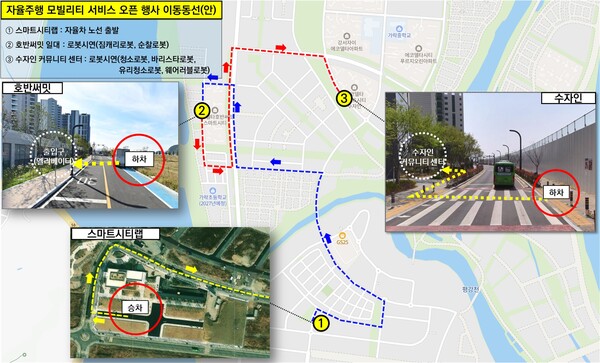
Beginning in April, an autonomous shuttle will start pilot operations on a roughly 10-kilometer (about 6.2-mile) round-trip route connecting residential neighborhoods and the Smart Village Urban Tech Houses, serving nine stops. The program aims both to improve mobility for residents and to validate autonomous-driving technology in an urban setting.
Vehicles rely on sensor-fusion systems—combining LiDAR, radar and cameras—to detect pedestrians, other vehicles and traffic signals in real time, delivering stable and reliable driving performance. The city says it will continuously refine service reliability by analyzing operational driving data and incorporating user feedback, with plans to expand the service to additional residential districts.
The event will also showcase community-oriented robot services. Demonstrations will include cargo-carrying robots, patrol robots for complex security, cleaning robots for shared spaces and barista robots that prepare drinks and interact with customers.
Busan will roll out an integrated robot control platform as well. The web-based system enables operators to monitor and manage robots’ locations, statuses and task progress in real time, establishing a foundation for unified operation of multiple smart services.
Using a public-private urban development model, Busan is accelerating the Eco-Delta smart-city project. City planners intend to phase in additional autonomous mobility and robotic services while advancing a data-driven urban operations framework to create a next-generation smart-city model.