If a death occurs or 10 or more people are seriously injured on an autonomous public transit vehicle, South Korea's Serious Accidents Punishment Act can apply.
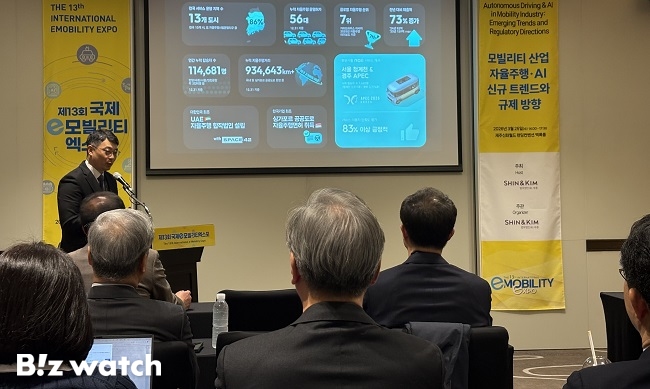
Lee Yong-woo, lead attorney at Sejong Law Firm, made the remark at the seminar "New Trends and Regulatory Directions for AI and Autonomous Driving in the Mobility Industry," held March 25 in Jeju. He warned that if a design, manufacturing or maintenance defect in a bus or other public transit vehicle causes at least one death or 10 or more injuries requiring two months or more of treatment, executives can face criminal liability — and the law would extend to autonomous public transit vehicles as well.
He cautioned that treating autonomous-driving crashes as criminal matters would shift the debate far beyond insurance and urged lawmakers to consider how to manage autonomous-driving risk through legislation such as a basic AI law. "If we criminalize autonomous-driving accidents, who will develop autonomous public transit?" he asked, adding that policy should not stifle technological progress.
Investigate autonomous-vehicle crashes the way we investigate aviation accidents
The seminar also examined liability for autonomous-vehicle crashes, particularly for fully autonomous cars that require no driver intervention.
Jung-ki Lee, deputy director of the Korea Transportation Safety Authority's Automotive Safety Research Institute, said the first prerequisite for handling fully autonomous-vehicle crashes is adequate insurance coverage. Crashes should be handled through the vehicle owner's insurance, with subrogation pursued afterward, he said. He added that an autonomous-vehicle accident investigation committee may struggle to reach clear technical conclusions, which increases the likelihood of litigation.
Geon-woo Kim, head of Kakao Mobility, said the industry is still in the early stages of deciding how to identify and allocate responsibility. He advised establishing an investigative framework for crashes similar to the procedures used in aviation accident probes.
E2E makes it impossible to determine crash causes
Vision–language–action (VLA) integrated AI driving models, such as NVIDIA's Alphamayo, which Hyundai has been evaluating, make assigning blame more difficult. Lee warned that vehicles using end-to-end (E2E) systems — where AI integrates driving data from cameras, lidar and other sensors — can make it impossible to physically dissect a crash's root cause.
Byung-yong Yoo, vice president at Autonomous A2G, ranked seventh among global autonomous-driving companies, said perception capabilities in autonomous vehicles have already surpassed humans. The real question, he said, is whether AI will take on judgment and control as well. He noted that Tesla delegates perception, judgment and control entirely to AI, while many other companies rely on rule-based systems that move vehicles according to predefined rules.
Despite liability concerns, E2E is likely to become a core technology for full autonomy. Yoo called E2E a shortcut to fully autonomous driving and argued that as AI models improve, the shift to unmanned operation could accelerate.
Autonomous vehicles end up the victims in 90% of cases
Some speakers also said the overall accident rate for autonomous vehicles remains relatively low.
Yoo acknowledged that autonomous-vehicle crashes happen more frequently than many expect, but he noted that autonomous vehicles are the victims in 90% or more of incidents. The most common scenario is a rear-end collision where a human driver hits a stopped autonomous vehicle. That, he explained, is because autonomous systems keep safe following distances and obey speed limits, behaviors that can frustrate human drivers.
He identified electric kick scooters as an edge case. From the perspective of an autonomous vehicle, a kick scooter behaves like a very fast-moving pedestrian — it can change direction suddenly and accelerate unpredictably, making it difficult for current systems to handle.