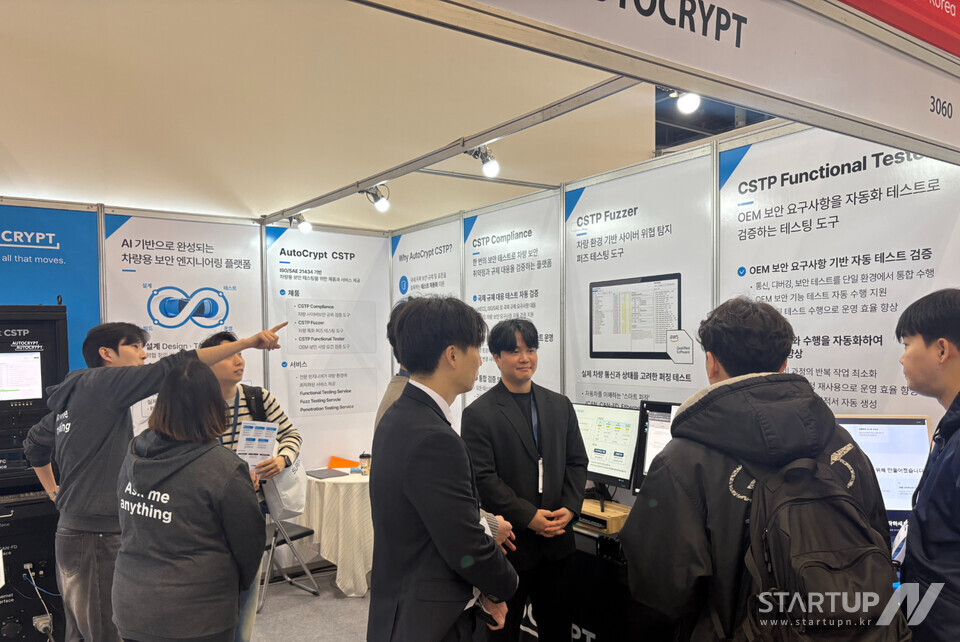
AutoCrypt, an AI mobility security specialist, is accelerating its push into the automotive cybersecurity testing market.
AutoCrypt (co-CEOs Seokwoo Lee and Deoksu Kim) unveiled its vehicle cybersecurity testing platform, AutoCrypt CSTP (Cyber Security Testing Platform), at the Automotive Testing Expo Korea 2026 held at KINTEX in Goyang, Gyeonggi Province, from March 18–20.
At the show, the company demonstrated an integrated testing suite that validates security vulnerabilities and supports regulatory compliance in real vehicle environments, drawing interest from industry professionals.
The CSTP demonstration on site comprised three solutions: CSTP Fuzzer, CSTP Compliance, and CSTP Functional Tester.
Each solution is designed to detect a range of security vulnerabilities in vehicle electronic control units (ECUs) and in-vehicle network environments, and to verify that security features operate correctly.
A key selling point AutoCrypt highlighted is the platform's ability to identify security risks early in development and validation. With software taking on a larger role in vehicles, the company aims to meet growing demand from global OEMs and Tier 1 suppliers that require security validation from the outset of development.
AutoCrypt says CSTP can raise vehicle security quality while improving development efficiency. As cybersecurity regulations tighten, the company sees increasing demand for test automation and unified testing platforms.
\"CSTP is designed to proactively detect security vulnerabilities during the early stages of vehicle development,\" said Seokwoo Lee, co-CEO. \"The platform focuses on meeting the regulatory and quality requirements demanded by global OEMs and Tier 1 suppliers.\"
He added the company plans to use the exhibition to expand overseas partnerships and to strengthen its competitiveness in cybersecurity testing.
The Automotive Testing Expo Korea is an international trade show centered on vehicle testing, validation and analysis technologies, giving attendees a view of industry trends across ADAS (advanced driver-assistance systems), autonomous driving, electric vehicles, simulation and software testing.
As vehicles transition to software-defined architectures (SDV), cybersecurity has become essential rather than optional. However, the global market already features numerous security vendors, so technical maturity and proven real-world deployments will be key factors in determining future success.