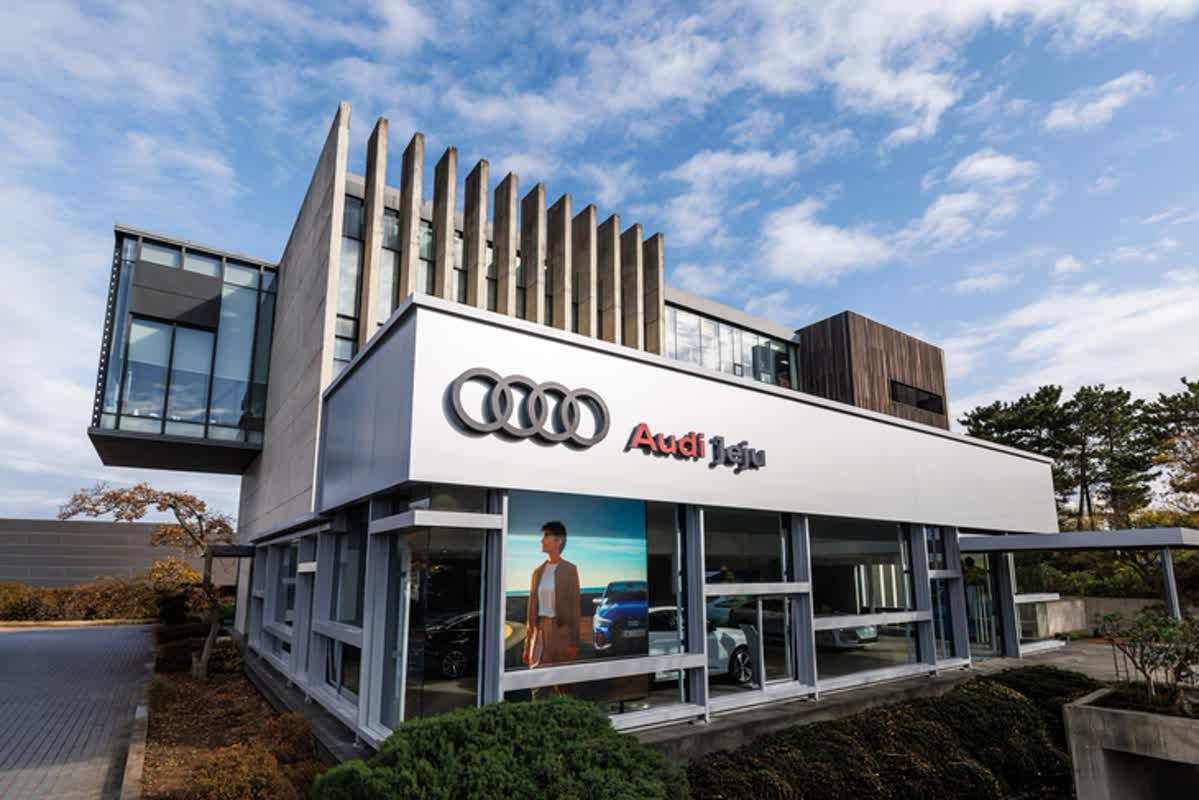
▲Exterior view of the Audi Jeju showroom.
Audi and Volkswagen, which struggled in South Korea after "Dieselgate," are mounting a comeback. This year both brands replaced senior leadership—including corporate and marketing heads—and pushed new models into the market to lift sales.
On the 12th, the Korea Imported Automobile Association (KAIDA) reported that Audi sold 3,138 vehicles in the South Korean market in the first quarter, a 54.7% increase from 2,029 a year earlier.
Both marques now sit nearer the top of the import-brand rankings. They still trail the market leaders—Tesla (20,964), BMW (19,368) and Mercedes‑Benz (15,862)—but are closing in on BYD (3,968), Lexus (3,755) and Volvo (3,628). Audi appears well positioned to rejoin the annual 10,000‑unit club.
Volkswagen’s results are improving as well: first‑quarter sales rose 6.7% to 1,293 units from 1,212 in the same period last year.
Both companies are making gains in the imported gasoline segment. In last month's fuel‑type best‑seller list, three gasoline models landed in the top 10: the Audi A3 40 TFSI (4th), the Audi Q5 40 TFSI quattro (6th) and the Volkswagen Atlas 2.0 TSI (7th).
Recently, both firms have overhauled leadership and started internal reorganizations. On the 1st of this month, Michael Ant assumed the role of CEO for Volkswagen’s division. He joined the company in 1998 and has experience selling Volkswagen, Škoda and Audi across major markets including Germany and China.
On March 3, Audi named Lee Gyu‑hee as head of marketing communications. Lee previously served as brand management director, marketing director and head of the brand innovation project house at Volkswagen Group China, and led marketing and communications for Alpine across the Asia‑Pacific and Middle East regions.
Both brands plan an aggressive new‑model push this year. Audi will launch the A6 and Q3; the new A6 will ride on an updated platform and incorporate a mild‑hybrid system, while the Q3 will arrive with an enhanced driver‑assistance package.
▲Volkswagen showroom test‑drive event poster.
Both companies are also widening customer touchpoints. Audi restructured its service network so every domestic center can handle electric‑vehicle repairs and has bolstered its team of high‑voltage battery specialists. It recently named KCC Auto Group as a new official dealer and signaled plans to expand its retail network.
In the first quarter, Audi ran an "Audi Open House" across its nationwide official showrooms, earning positive feedback. Customers had opportunities to test‑drive models including the A3, Q3, Q7 and Q8 and participate in a range of events.
Volkswagen is offering test drives of its full lineup at showrooms through May 24. Visitors who complete the event participation process can receive promotional prizes.
As recently as 2015, Audi and Volkswagen were fixtures among the "Big 4" in South Korea’s imported‑car market, posting annual sales of 32,538 and 35,778 units respectively and maintaining double‑digit growth. At that time, the Volkswagen Tiguan was the market's best seller, followed by the Audi A6.
After Dieselgate broke at the end of that year, both companies suffered certification cancellations on key models and other setbacks. With limited product to sell, their dealer networks were also disrupted. Last year, Audi sold 11,001 units in South Korea and Volkswagen sold 5,125.
Reporter Yeo Heon‑woo yes@ekn.kr