By Jeong Hyun-jun — Hyundai Motor is pressing to regain control of India’s sedan market with the refreshed Verna, which gets significant design and feature upgrades. The automaker is banking on aggressive pricing and stronger product value to retake momentum and challenge for the No. 2 sales position.
Industry sources said on March 10 that Hyundai Motor India Limited (HMIL) has officially launched the 2026 model-year The New Verna, a mid-cycle facelift, and begun full-scale sales. Pricing starts at 1,098,400 rupees (about $11,738), depending on trim and options. The top-spec 1.5-liter turbo GDi with a 7-speed DCT is priced at 1,825,400 rupees (about $19,510).
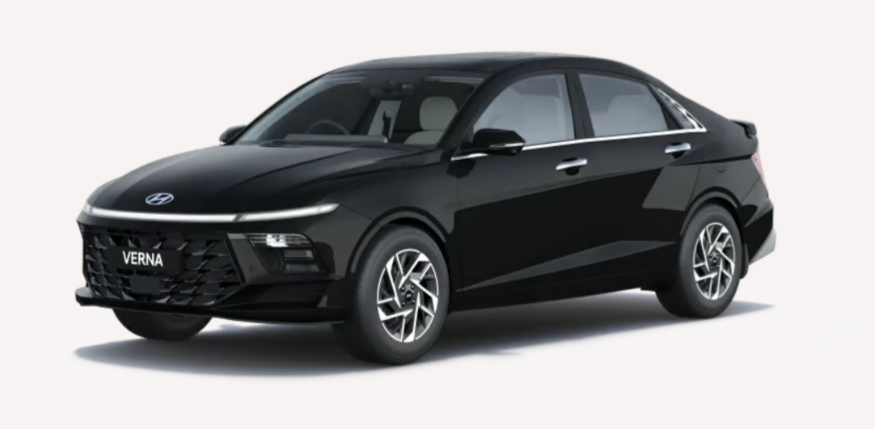
Hyundai sharpened the Verna’s exterior and added new convenience features to lift its competitive standing. The front end features a redesigned bumper, a larger grille and bigger dual LED headlamps. A horizontal LED light bar that spans the rear of the fascia has been given a thicker profile to enhance visual presence.
At the back, L-shaped taillights connect to an LED light bar to create a cohesive silhouette. The rear bumper integrates a diffuser with a silver insert, and the car rolls on 16-inch diamond-cut alloy wheels to reinforce a more dynamic stance.
The cabin is laid out around a driver-focused cockpit. The package includes a D-cut steering wheel and an 8-way power-adjustable driver’s seat with memory. For the first time in its class, the Verna offers a 4-way power-adjustable front passenger seat to improve occupant comfort. Infotainment upgrades include dual 10.25-inch screens, an 8-speaker Bose audio system and a 360-degree camera, among other modern features.
Two powertrain choices are available. A 1.5-liter naturally aspirated gasoline engine pairs with either a 6-speed manual or an IVT (intelligent continuously variable transmission). The performance-oriented 1.5-liter turbo gasoline engine can be ordered with a 6-speed manual or a 7-speed dual-clutch transmission (DCT).
Safety equipment aims above its segment peers. The Verna offers Level 2 advanced driver-assistance systems (ADAS), seven airbags, a dashcam and more than 75 advanced safety features. Hill-start assist control (HAC) and a tire pressure monitoring system (TPMS) are standard.
Hyundai plans to use the new Verna to challenge rivals such as the Honda City and Volkswagen Virtus and to expand sales in India. HMIL’s growth is already visible: last month it reported local sales of 66,134 units, its best February performance since establishing operations in India. The company currently sits third in monthly sales behind Mahindra (97,177 units), but it is closing the gap and could reclaim second place.
Tarun Garg, managing director of Hyundai Motor India, said the new Verna is more than a routine product upgrade — it’s a statement of engineering excellence and driving purity. With bold styling and advanced safety technology, he said Hyundai will reinforce its commitment to delivering top value to Indian customers.
Separately, Hyundai is preparing a full redesign of its key India model, the Creta. The next-generation Creta, due in 2027, is expected to be equipped with a HYBE-led powertrain, a move that should further strengthen Hyundai’s position in India. The Creta remains a core volume model, having sold more than 200,000 units in India last year alone.