Jang-seok Lee, a professor in Gachon University's Department of Media Communication, led the research team. With support from the Our Education Research Institute (chair Lee Hyun), they surveyed 517 middle- and high-school students nationwide, ages 14 to 19. The study, titled “Mechanisms of Trust Formation in Short-Form News among Youth,” was released on the 21st.
Youth news consumption: short-form platforms dominate
The study found that 72.1% of respondents identified short-form platforms—TikTok, YouTube Shorts, and Instagram Reels—as their primary news source. Long-form video and streaming platforms accounted for 20.1%, portals 7.7%, and not a single respondent cited traditional outlets like TV or newspapers as their top source.
How teens encounter news also stood out. Some 71.8% said they don’t actively seek out news; instead, they encounter it passively when algorithms surface content as they use social media. In other words, platform recommendations largely determine what news teens see.
The researchers analyzed nine variables—platform characteristics, content factors, social influences, and more—and found that peer conformity had the largest effect on trust in short-form news (standardized coefficient β = .253). Teens were more likely to judge posts with many likes or comments as trustworthy without applying critical scrutiny.
Algorithmic personalization ranked second (β = .163), ease of use third (β = .150), and real-time interaction fourth (β = .142). The findings suggest that platform convenience, familiarity, and peers’ reactions shape trust more than factual accuracy.
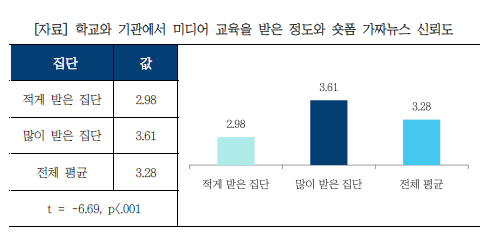
The more education they get, the more easily fooled they are — the paradox of media education
The study’s most startling finding linked the amount of media literacy education to trust in fake news. After showing participants real short-form fake-news videos and measuring trust, students who had received more media literacy instruction scored significantly higher—3.61 versus 2.98 on a five-point scale (p < .001).
The researchers offered two explanations. First, current media literacy instruction has structural limits. Although all respondents said they had received media literacy education within the past year, they averaged only 6.64 hours per year—about three hours per semester. The curriculum emphasized theory, such as criteria for spotting fake news and distinguishing news outlets, but lacked hands-on fact-checking exercises like tracing sources and cross-checking.
Second, superficial instruction produced an overconfidence effect. The team likens this to the Dunning–Kruger effect: students acquire an unfounded confidence in their ability to spot fake news without gaining real evaluative skills, which lowers their guard when checking information.
Lead researcher Jang-seok Lee said current media literacy education faces a double problem: it not only fails to block fake news, it can also backfire by disarming learners’ defenses.