40 Promising Companies and 11 Investment Firms in One Room…Targeting Follow-Up Funding, Not a One-Off Pitch
Success Stories in Vegan Cheese and Natural-Ingredient Automation…Nurturing a Private-Led Ecosystem
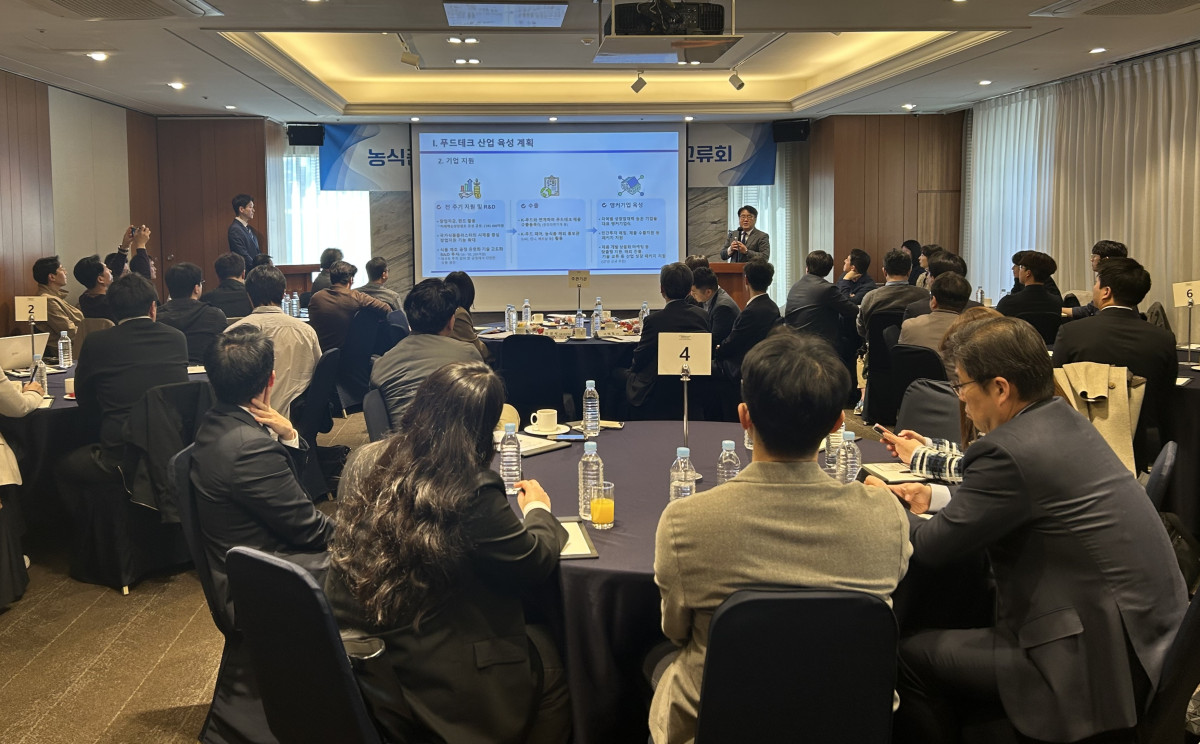
Food‑tech and green‑bio companies that have the know‑how but lacked funding and networks are finally knocking on investors’ doors. With the government moving past basic support and actively connecting startups to private capital, Korea’s agri‑food new industry is shifting from early-stage nurturing to a phase where scaling up is the priority. The big question now: can these innovations turn R&D wins into expanded production and real market traction?
On the 7th, the Ministry of Agriculture, Food and Rural Affairs hosted an investment exchange at COEX in Seoul to link promising food‑tech and green‑bio firms with investment managers.
The event brought together 40 companies and 11 specialized investment firms. Unlike typical investor briefings that spotlight just a few presenters, this format let many companies meet investors directly and set the stage for follow‑on funding talks. Participants ranged from startups under seven years old to mid‑sized firms, enabling discussions across commercialization stages—from tech validation and prototyping to mass production and market growth.
Companies in attendance showed strong tech and growth potential across both sectors. Food‑tech firms focused on ten key areas—plant‑based foods, cell‑cultured foods, personalized nutrition, convenience foods, 3D food printing, food upcycling, smart food manufacturing, eco‑friendly packaging, smart food distribution, and restaurant innovation services. Green‑bio firms covered six areas—seeds, microbes, natural products, veterinary drugs, insects, and food ingredients—selected through recommendations from local governments and related organizations.
The government is doubling down on these investment linkages because it sees financing and commercialization—not technology—as the main choke points for the agri‑food new industry. According to the ministry, last year the agri‑food mother fund raised KRW 317.9 billion (≈ $238.4 million) through 13 sub‑funds—the largest result since the fund launched in 2010. The share of private investment climbed from 44.5% the year before to 64.6%.
Many companies win R&D recognition but then stall because they can’t secure the capital needed to scale production and break into markets. That’s why the government is prioritizing deeper engagement with private investors.
Policy finance has already helped some firms accelerate. A food‑tech startup that created vegan‑cheese manufacturing technology by combining plant‑based ingredients with fermentation secured KRW 5.5 billion (≈ $4.125 million) from the agri‑food mother fund in 2020 and 2022, then was named a pre‑unicorn in 2022. A green‑bio company that automated herbal pharmaceutical production—from diagnosis to dispensing—using natural ingredients received KRW 4.0 billion (≈ $3.0 million) from the mother fund in 2023 and 2025 and won a CES 2025 Innovation Award.
The mood at the event was optimistic. “Startups rarely get direct access to specialized investment managers,” a participant said. “Today we pitched our business model to several firms in one place and agreed to continue substantive funding talks soon.”
Jeong Kyung‑seok, the ministry’s Food Industry Policy Officer, emphasized the government’s commitment: “We will actively support food‑tech and green‑bio so they can grow into global leaders in future food industries based on a private‑sector‑led ecosystem.”