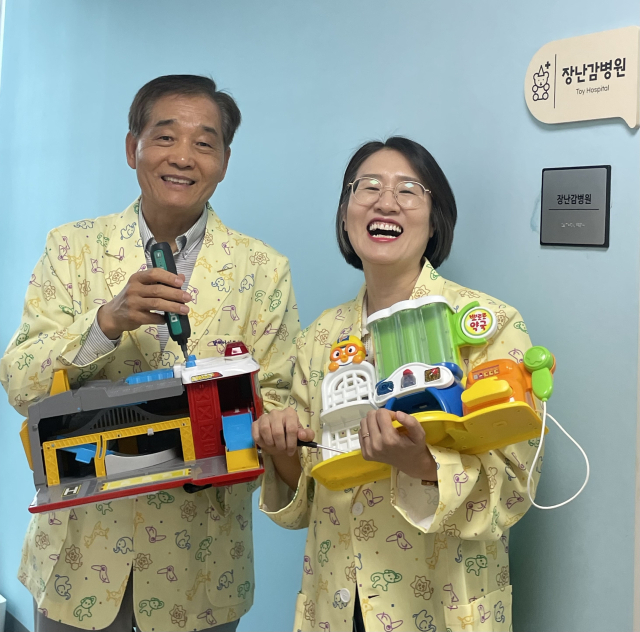
A 5-year-old boy hesitantly opens the door, clutching a worn toy car. \"Please fix it,\" he says in a small, clear voice. The toy’s stains and scuffs testify to how long he’s treasured it.
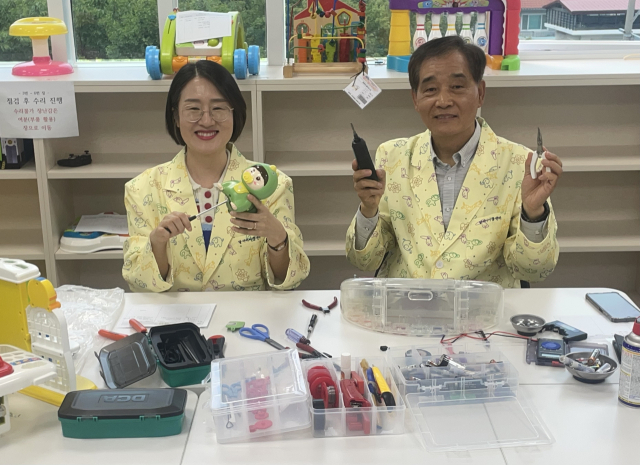
This is Daegu’s only toy hospital. Thirteen volunteer \"doctors\" repair toys here, adults who stand beside children’s imaginations. On the 30th, I visited the toy hospital run and supported by the Dalseo Child Dream Center.
◆ An ER for broken toys
Screwdrivers, batteries and screws of every size lie scattered across a crowded workbench. Broken toys wait in line while urgent voices call out, \"Jeong, this one won’t work,\" and \"Kwon, try prying it with that.\" After an hour of taking things apart and putting them back together, a light finally comes on and the toy begins to play sound. \"I get a huge thrill when I fix something,\" says Kim Young-seok (63), the toy hospital’s technical adviser. \"It’s even more rewarding when a child hugs the repaired toy and jumps for joy.\" Kim, who worked in rail maintenance, took on the technical adviser role after retiring.
Most toy problems are relatively simple: broken wires, corroded battery contacts, loose switches or dust-clogged circuit boards. Toys with complex electronic boards—keyboards or electronic learning toys, for example—are far harder to repair. \"We try everything we can, but sometimes we can’t fix them,\" Kim said. \"That’s especially upsetting because I worry the kids will be disappointed.\"
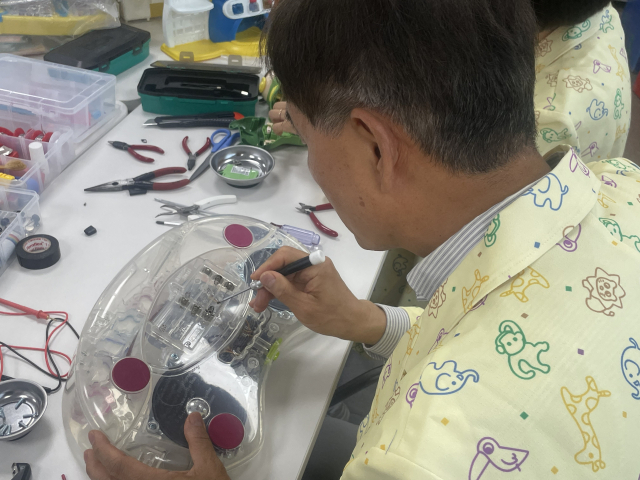
They don’t give up easily. If a repair proves too difficult, the toy may be sent to an \"advanced hospital\"—a stage where Dalseo Child Dream Center director Yoo Chang-woo steps in and repairs it personally. Kim says the toy hospital idea began with Director Yoo’s interest; Yoo is so committed he even comes in on his days off to help, Kim added with a laugh.
◆ Learning to fix—novices become technicians
What makes this place special is that most of the 13 \"doctors\" had no prior experience with tools. They volunteered out of a single desire: to fix children’s toys. \"At first I didn’t even know the names of screwdrivers,\" said Kwon Hyuk-hwan (67). Now he diagnoses, repairs and tests toys on his own.
Last August, the volunteers trained for a month with an expert from a toy company in Busan, learning everything from basic tool use and switch mechanics to foundational electrical knowledge. They discovered repair work requires more equipment than expected—screwdrivers, soldering irons, voltage and current meters, wire strippers and soldering tools. People who once found basic tools unfamiliar learned by handling them and repeatedly disassembling broken toys until repair techniques sank in.
The volunteers’ know-how grows with each job. \"At first I was cautious even to take things apart,\" said Jung Hyun-hee (47). \"After working on many kinds, I can tell where something’s broken just by looking.\" As experience accumulated, repair times dropped. If they’ve fixed a similar toy before, they can quickly identify and resolve the problem.
◆ Beyond repairs: resource recycling
The toy hospital does more than fix toys. Cheap, disposable toys often end up as plastic waste. Here, volunteers repair broken toys and either donate them or sell them at low cost. If a toy can’t be fixed, they strip it for reusable parts and transform character figures into keychains to give to children. Toys that nearly ended up in the trash return to kids in a new form.
A Dalseo Child Dream Center official said this effort grew out of thinking not only about child welfare but also about resource recycling, and that the Dalseo District Office has shown strong interest.
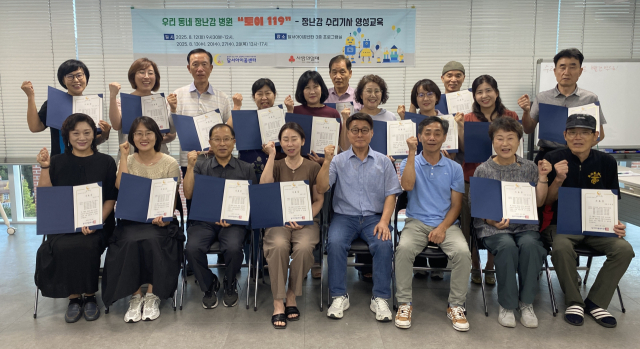
Being Daegu’s only toy hospital also makes it unique. People travel from nearby cities such as Gyeongsan, and the hospital even receives requests for on-site repairs. \"Once I went to the northern district because they had collected a lot of broken toys,\" said Lee Jong-yoon (73). \"It’s hard work, but the sense of reward is greater.\"
◆ Why volunteer without pay? Because it connects memories
Most of the toy doctors are from a generation whose children are grown. Repairing toys naturally brings back memories. \"It makes me think a lot about when my kids were little,\" one volunteer said. \"When I repair a toy that plays children’s songs, I find myself singing along.\" They volunteer their time without pay, but the work is more than a technical task: restoring a broken toy revives childhood memories. \"We hear ‘thank you for fixing the toy’ a lot, but we’re the ones who want to say thank you,\" they added.
Toys that nearly became trash move again, and children’s smiles return. Fixing a toy does more than restore a device; it preserves a child’s memory and brings an adult’s memories back to life. In this small hospital, someone’s precious time quietly continues today.