Capable of striking from all directions, including Antarctic routes
Accuracy doubled… Deployment by year-end
Accuracy doubled… Deployment by year-end
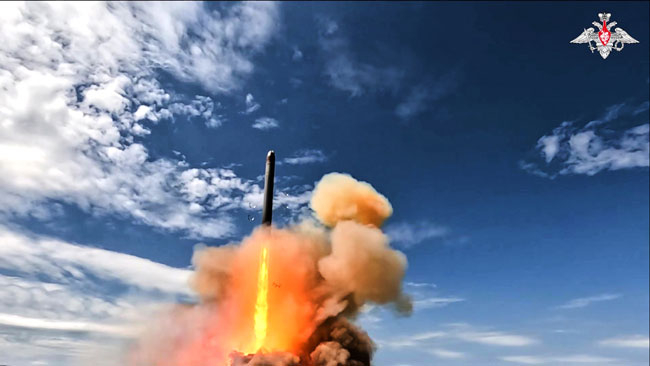 The Russian military says it successfully test-fired its domestically produced RS-28 Sarmat intercontinental ballistic missile (ICBM), a strategic system reported to carry roughly 10 nuclear warheads and to have a range of about 35,000 kilometers (approximately 21,750 miles). By showing a missile that Moscow says could reach the U.S. mainland and all of Europe via Arctic, Antarctic or even spaceborne trajectories, Russia appears intent on pressing its technological advantages before Western audiences.On the 12th (local time), state news agency TASS released video of the test launch. President Vladimir Putin, after receiving a briefing from Sergey Karakayev, commander of Russia’s Strategic Rocket Forces, congratulated the team and said the Sarmat will enter operational service by the end of the year. NATO refers to the system as "Satan 2." The Sarmat was developed to replace the R-36M2 Voevoda — a missile in service since 1988 — and is reported to carry roughly 10 warheads in a single salvo.Putin also asserted that the missile can fly on suborbital trajectories, that its range exceeds 35,000 kilometers, and that its accuracy has doubled — claims he said would allow the Sarmat to defeat current and future air- and missile-defense systems. That range is about twice the previously reported 18,000 kilometers and approaches the Earth's circumference of roughly 40,000 kilometers. Analysts warn that, if deployed, a missile with that reach would let Russia vary launch directions and trajectories far beyond the Arctic, including over the Antarctic and via space paths.U.S. and European defenses, analysts say, are largely configured around Arctic approaches; the Sarmat’s advertised flight profiles could complicate those layered defenses. Putin described the system as "the world's most powerful missile system" and claimed the combined yield of its warheads exceeds by more than four times that of the most powerful Western missiles in the same class.