[MyDaily — Reporter Bang Geumsuk] Market Kurly is positioning fashion as its next growth engine, accelerating its evolution from a grocery app into a full-fledged lifestyle platform.
On the 23rd, industry sources reported that Market Kurly posted its first annual profit, driven in part by growth in nonfood categories such as fashion.
On a consolidated basis for 2025, the company recorded KRW 2.3671 trillion in revenue and an operating profit of KRW 13.1 billion (approximately $1.78 billion and $9.83 million, respectively). Gross merchandise value rose 13.5% year over year to KRW 3.5340 trillion (about $2.65 billion).
Fashion still makes up less than 10% of total sales, but it’s growing rapidly. Sales jumped 140% in the first half of last year. Loyal customers who originally came for premium groceries have started buying apparel, raising average order values. That helped push the average spend to roughly KRW 114,000 (about $85.50), placing Market Kurly near the top among specialty commerce platforms.
A Market Kurly spokesperson said, “One major factor behind last year’s performance improvement was growth in seller delivery (3P). Fashion accounted for more than half of that growth and helped drive profitable expansion.”
To double down on fashion, Market Kurly has beefed up its team and structure. It recently recruited Choi Hang‑seok, formerly of Handsome and the online platform EQL, as head of fashion and reorganized a dedicated “Fashion & Accessories Group.” The company is highlighting curated selections by putting MDs with premium-brand experience—think Time Homme and Ermenegildo Zegna—front and center.
The core audience is women in their 30s and 40s. Market Kurly is targeting time-pressed professionals with strong purchasing power by expanding workwear and convenient, short‑trip “one‑mile” pieces. Instead of indiscriminately adding SKUs, it’s differentiating through a handpicked roster of brands that meet a certain quality bar.
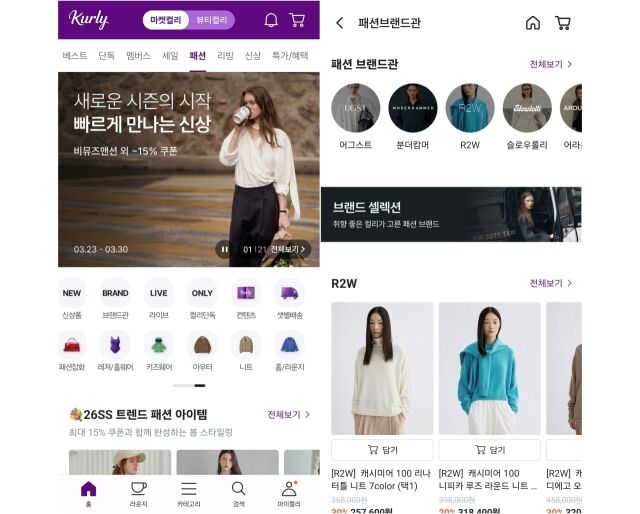
The platform’s brand mix makes that direction clear.
Designer labels—from Hannam‑dong’s Wunderkammer to R2W, ORR, and Around Yul—have chosen Market Kurly as a key channel and now rank among its top sellers.
Jewelry brand Honest Seoul saw lab‑grown diamond pieces priced around KRW 1,000,000 (about $750) sell during a live broadcast at 55 times their usual rate, signaling that Market Kurly’s customer base will spend on higher‑end jewelry.
An industry source noted, “Coupang has a mass‑market image, which makes premium brands cautious. Market Kurly benefits from a premium image built on curated food, giving it a relative advantage in attracting high‑sensitivity brands.”
Market Kurly now boasts about 4.5 million monthly active users (MAU), up more than 30% year over year, and its paid membership program has topped 1.4 million subscribers. Renewal rates exceed 70%. That loyal base underpins the company’s push into nonfood categories like fashion and beauty.
Logistics remain Market Kurly’s strongest asset. The company has expanded its fulfillment service (FBK), which combines seller delivery (3P) with its own logistics network, and extended its signature dawn‑delivery service to fashion. When partners stock merchandise in Market Kurly’s fulfillment centers, the company handles overnight delivery—so customers can order clothing at night and wear it the next morning.
Market Kurly expects synergies from combining its beauty vertical—which has grown to about KRW 500 billion in transaction volume—with fashion. Having secured roughly 1,000 beauty brands and grown that category, the company could boost corporate value and revive IPO plans if fashion becomes a stable growth pillar.
Market Kurly passed a preliminary listing review in 2022 but postponed its IPO after disappointing 2023 results. Analysts say that, given the ownership structure’s reliance on financial investors, a public listing remains an attractive path for investors seeking returns.
Still, the fashion arm faces hurdles. Many consumers still see Market Kurly primarily as a fresh‑food grocery app, and established online fashion platforms such as Musinsa, Ably, and W Concept already have a head start.
The curation‑first approach that succeeded for groceries could limit how broadly Market Kurly expands its fashion assortment.
An industry insider said, “Beauty Curly (Beauty Kurly) made a splash quickly with big marketing campaigns—like using Jennie—whereas fashion appears to be in a ‘finding its voice’ phase: carefully selecting brands and building a portfolio.”
They added, “The question is whether Market Kurly can craft a convincing fashion‑platform identity that transcends its fresh‑food roots.”
Market Kurly continues to lean into a premium, carefully curated fashion identity.
A company representative emphasized, “Our priority isn’t simply adding more brands. It’s about delivering the experience that ‘Market Kurly’s fashion picks are different’ through thoughtful curation.”