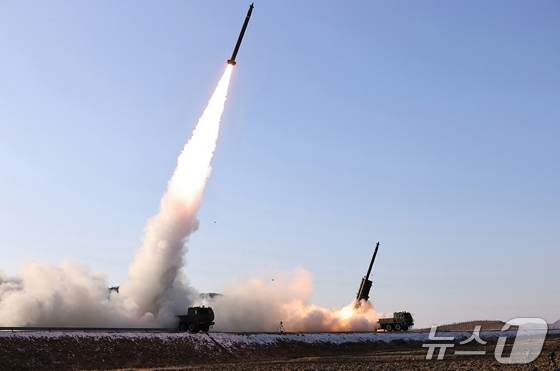
North Korea has stepped up military provocations, launching ballistic and cruise missiles in quick succession. Analysts say these are not primarily signaling moves but weapons acceptance tests meant to validate new systems, indicating Pyongyang is accelerating its weapons modernization.
On April 19, North Korea launched a ballistic missile from the Sinpo submarine base into the East Sea (Sea of Japan). Earlier this month it fired an unidentified projectile near Pyongyang on April 7, a short-range ballistic missile (SRBM) near Wonsan on April 8, and cruise and anti-ship missiles from the new destroyer Choe Hyun on April 12 — then carried out another launch roughly a week later.
This year, Pyongyang has staged multiple shows of force: a hypersonic and ballistic missile launch on Jan. 4, a test-firing of an upgraded large-caliber rocket system on Jan. 27, and a strike with a 600 mm super-large rocket on March 14. In April alone it has conducted four provocations, shortening the intervals between tests.
'Cluster munitions, electrostatic bombs' and other tests — advancing deterrence while trying to evade sanctions
North Korea has employed a wider range of systems in recent provocations. The cruise missile launched on April 12 is among the weapons Seoul and Washington monitor most closely. Pyongyang claims cruise missiles can carry nuclear warheads, but U.S. and South Korean assessments remain inconclusive.
The United States, South Korea and other international actors have not yet sanctioned North Korea's cruise missiles, judging the likelihood of a nuclear payload to be low. That assessment gives Pyongyang both the incentive and the opportunity to accelerate cruise missile development. Some analysts also argue North Korea is diversifying new weapons in part to evade sanctions.
During tests from April 6–8, North Korea loaded the short-range ballistic missile Hwasong-11Ga (KN-23) with submunitions (cluster munitions) and fired it. The submunitions, which Pyongyang calls \"dispersal warheads,\" pack dozens or hundreds of small bomblets into a single warhead. On detonation, the bomblets scatter and can cause casualties and damage across a wide area. This is the first recorded use of cluster munitions in a provocation since 2022.
Pyongyang also claims it tested an electromagnetic-weapon system and a \"carbon-fiber bomb,\" a graphite-based electrostatic weapon. In an airburst, the warhead reportedly releases nickel and carbon fibers that can adhere to power lines or transformers and damage electrical systems. North Korea presented this as one of its new capabilities.
Kim Jeong-sik, First Vice Department Director of the Party's Munitions Industry Department, who oversaw the tests, described electromagnetic weapons and carbon-fiber munitions as \"strategic special assets that can be combined and applied across multiple domains and military means.\"
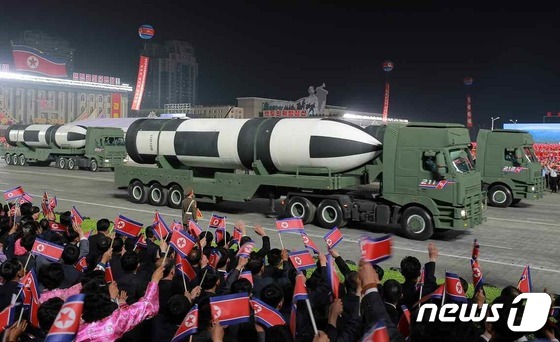
Kim Jong Un: Displaying power is exercising deterrence — observers expect continued provocations with new systems
The recent spike in provocations traces back to instructions Kim Jong Un issued at the 9th Party Congress in February, where he ordered frequent demonstrations of force to support weapons development.
Kim said, \"Continuously testing the reliability and effectiveness of components of nuclear deterrence and demonstrating that power constitutes the responsible exercise of war deterrence.\" That language suggests North Korea now treats military provocations as a routine element of its military activity.
Because directives from the supreme leader are expected to be carried out, experts say North Korea is likely to continue staging frequent provocations using a range of weapon systems. Analysts predict Pyongyang will emphasize \"acceptance firing\" — tests that validate performance and operational capability — especially for new systems nearing deployment.
Im Eul-chul, a professor at the Institute for Far Eastern Studies at Gyeongsang National University, said, \"To implement the 'New Five-Year Defense Development Plan' announced at the 9th Party Congress, North Korea is racing to complete its nuclear forces on its own timetable. Beyond simple weapons development, Pyongyang is rapidly shifting toward routine nuclear operations and modern warfare centered on AI and electronic warfare, and we can expect a series of tests to support that transformation.\"