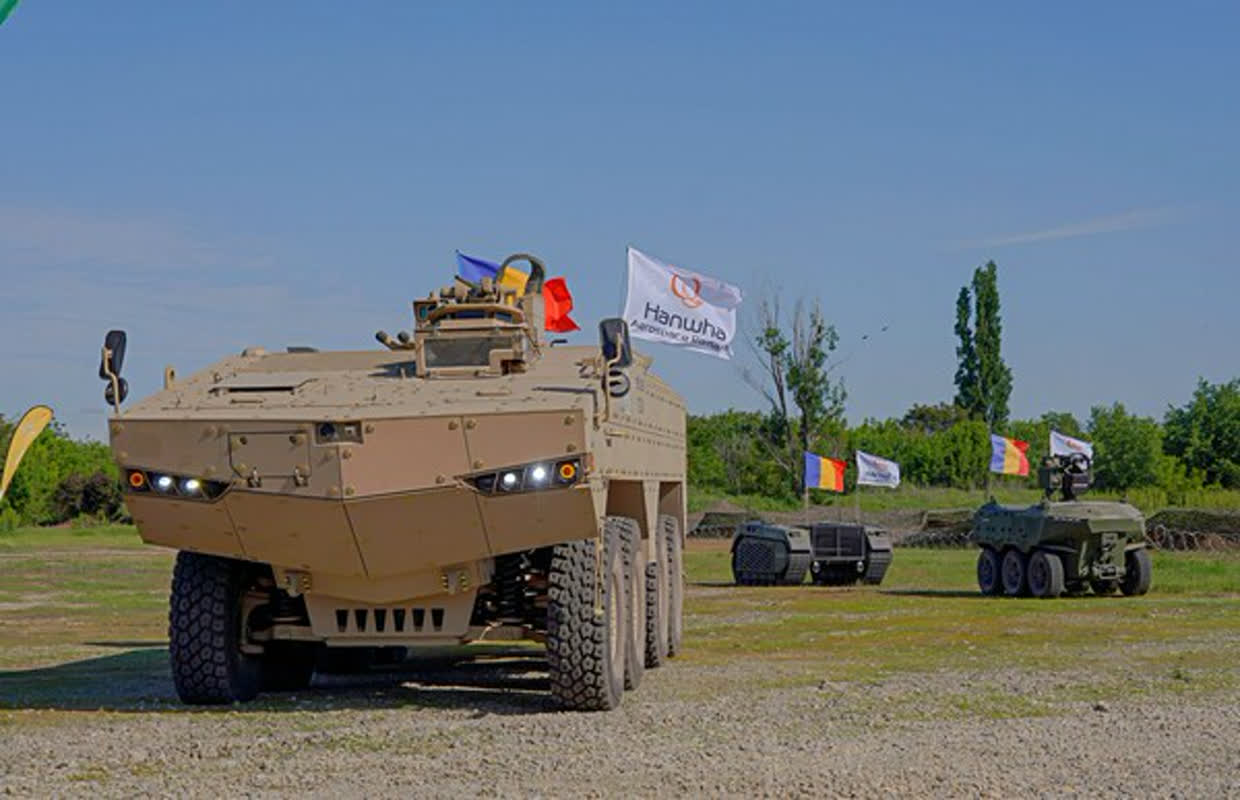
[Point Economy] Hanwha Aerospace demonstrated the live operational performance of an advanced manned-unmanned combined combat system in Romania, stepping up efforts to expand into the European defense market. Rather than offering standalone platforms, the company presented a future battlefield ecosystem in which crewed vehicles and unmanned robots exchange real-time data and operate as a single coordinated unit — a concept that drew praise from local military leaders.
Hanwha Aerospace said on May 14 that it was the only South Korean firm to participate in the Demo Day on May 12 (local time), held alongside BSDA 2026 (Black Sea Defense & Aerospace). The demonstration took place at an outdoor training range near Bucharest and was attended by roughly 50 senior officers, including Romanian Army Chief of Staff Ciprian Marin, who observed South Korea’s unmanned combat capabilities in action.
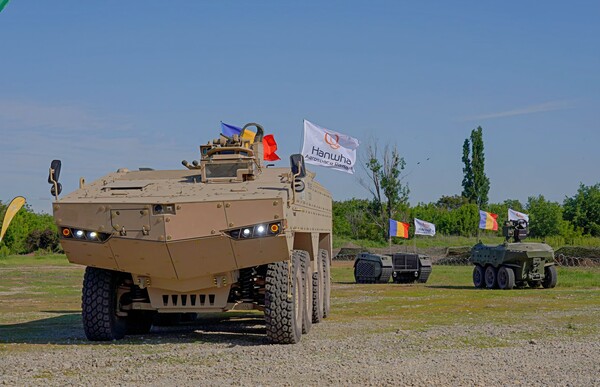
The demonstration focused on manned-unmanned teaming (MUM-T) that linked the TIGON wheeled armored vehicle, the next-generation multipurpose unmanned vehicle GRUNT, and Estonia’s Milrem Robotics THeMIS. In the scenario, unmanned vehicles moved into high-risk areas first to conduct reconnaissance. TIGON then transported troops and provided fire support. The demo also showed unmanned resupply and casualty evacuation, illustrating how the concept could reduce battlefield casualties and shape future ground operations.
The exercise was significant because it reflected Romania’s operational needs. Romania sits on NATO’s eastern flank, and the alliance requires strict interoperability and standardization across members’ weapon systems. The Romanian military has expressed strong interest in unmanned systems that can integrate with its existing wheeled armored vehicles. To address that, Hanwha selected TIGON for the demo and used live operations to visualize the tactical advantages and MUM-T employment concepts that emerge when manned and unmanned platforms operate together.
The integrated operational concept demonstrated can also be linked to Romania’s confirmed purchase of 54 K9 self-propelled howitzers and to proposed Redback armored vehicles.
A Hanwha Aerospace official told this publication on May 14, “We are concentrating companywide resources to implement manned-unmanned combined operation concepts across our ground defense portfolio, including the K9 and Chunmoo.”
The Redback armored vehicle, slated to enter low-rate production in the first half of this year, is designed with the scalability to meet NATO technical standards. If Redback orders proceed, Australia’s H-ACE production base will scale up. That ramp-up is expected to boost the economy of South Gyeongsang Province, centered on Changwon, as suppliers of major components such as engines and transmissions increase deliveries.
Park Byung-ho, head of Hanwha Aerospace’s LS4 project group, said the demonstrations proved the technical competitiveness and scalability of domestically produced unmanned ground vehicles (UGVs) in Europe. He added that the company proactively presented next-generation operational concepts NATO customers want and outlined a direction for unmanned systems development that aligns with the South Korean military’s priorities.