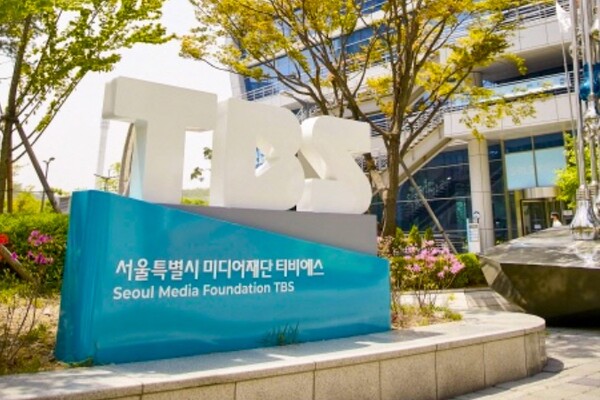
The Broadcasting, Media and Communications Commission (BMCC) voted to grant TBS a conditional license renewal and, citing the broadcaster’s prolonged financial strain after Seoul cut budget support, approved allowing commercial advertising.
On the 29th, the BMCC convened a full meeting at the Government Complex Gwacheon and approved a three-year conditional renewal for TBS. The broadcaster had initially failed to meet the reauthorization score and faced a hearing on the 22nd. Hearing panelists examined the improvement plan TBS submitted to address those shortcomings and ultimately approved the conditional renewal.
The commission attached several conditions. TBS must faithfully implement a business-normalization plan to resolve the financial difficulties that followed cuts to Seoul’s contributions, and it must submit an annual report on the prior year’s performance to the BMCC by the end of April each year. By the end of August, TBS must submit a plan to improve its internal review system to strengthen broadcast fairness. If TBS amends its charter and is later designated a public-interest corporation that solicits donations, it must set up measures to protect editorial fairness and independence. Failure to meet major conditions during the renewal period could result in license revocation.
The BMCC said it approved commercial advertising after weighing TBS’s sharply worsened finances following Seoul’s 2024 removal of its city-funded designation and the hearing-stage proposals to diversify revenue streams, including ads. The commission also said it would revisit the ad-allowance decision if TBS’s financial situation changes significantly, for example through increased public support.
Commissioners were divided over allowing commercial advertising. Commissioner Lee Sang-geun, an opposition appointee, argued that permitting ads would amount to an unprecedented special favor and questioned whether the BMCC should accept such a shift. He also warned that allowing advertising in an already fragile radio market could lead to audience concentration, and asked how regulators would manage that risk. Commissioner Choi Soo-young, also an opposition appointee, agreed to the conditional renewal but called commercial advertising a “huge privilege,” urging the commission to define more clearly the circumstances under which its decision could be revisited.
Commissioner Ko Min-soo, a ruling-party appointee, countered that TBS was established as a corporation capable of running broadcast advertising and that the previous ban had been imposed by the Korea Communications Commission, the BMCC’s predecessor. He noted that broadcasters such as KBS and EBS accept license fees while airing advertisements, and said treating ad allowance for TBS as special treatment would be hard to justify. He added that the commission must set clear internal procedures, methods, timelines and criteria for any future review of the ad-allowance decision.
Commissioner Yoon Sung-ok, also a ruling-party appointee, said the root of TBS’s crisis lies in questions about the public obligations of a public broadcaster—above all, what fairness means and how a public broadcaster can live up to it. She acknowledged ongoing discussions about strengthening review systems and adhering to programming codes, but emphasized that TBS’s management and staff must recommit to serving citizens and fulfilling public duties if they want to restore legitimacy.
BMCC Chair Kim Jong-chul said the commission carried out the renewal review while balancing efforts to strengthen broadcasters’ public responsibilities with institutional flexibility to respond to changing management conditions. He added that the BMCC will continuously monitor whether stations comply with renewal conditions and will take strict legal measures if they do not.