President Lee, at meeting with U.S. senators
“South Korea should resume wartime operational control to ease the U.S. burden”
U.S. delegation: “Korea’s defense spending increase and U.S.-bound investments are important commitments”
“South Korea should resume wartime operational control to ease the U.S. burden”
U.S. delegation: “Korea’s defense spending increase and U.S.-bound investments are important commitments”
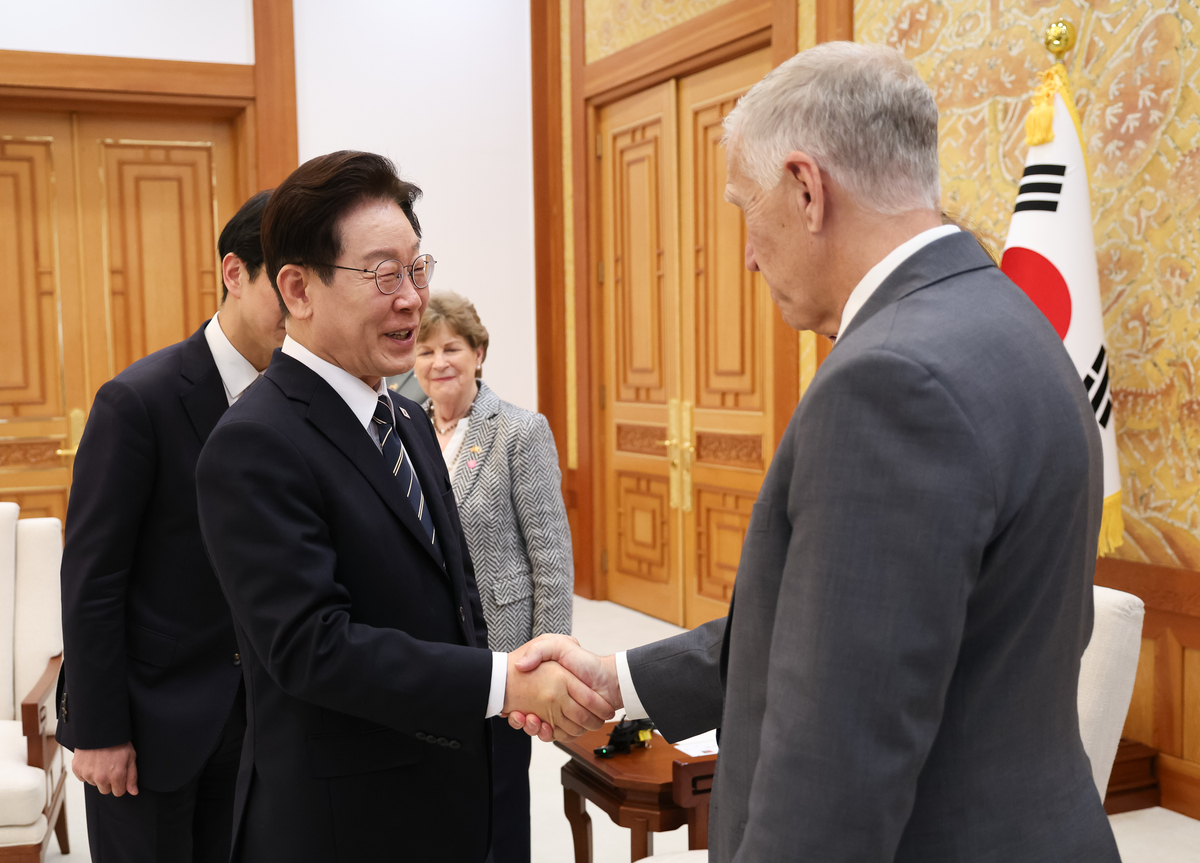
Last January’s “drum diplomacy” by President Lee Jae-myung resurfaced at a cordial meeting with a delegation from the U.S. Senate two months later, helping set a warm tone. At that meeting, President Lee reiterated the need for the return of wartime operational control.
On April 2, he told the U.S. Senate delegation that Seoul aims not only to boost defense spending but also to reduce the U.S. burden by reassuming wartime operational control. “We want to protect safety and peace in Northeast Asia, particularly around the Korean Peninsula, on our own,” he said.
Speaking in the Blue House’s reception room in the afternoon, he added, “We judge that defense of the Korean Peninsula should be handled by our own capabilities and resources, in line with U.S. planning.”
He acknowledged, “The people of the Republic of Korea remain grateful that the United States intervened in the Korean War and helped preserve our system,” and noted, “Over the decades, Korea has grown both economically and politically.”
He described denuclearization of the peninsula as “a critically important issue for Korea,” adding, “Peace and stability on the peninsula are not merely a regional concern; they have implications for Northeast Asia and the wider world.”
He said resolving the issue requires dialogue between North Korea and the United States, and that Seoul must perform an effective coordinating role to secure concrete outcomes. In that context, he said the Korean government asked President Donald Trump to act as a “peacemaker,” while Seoul would take on a “pacemaker” role.
He also noted, “South Korea is facing various difficulties because of the situation in the Middle East, and I wanted to hear your perspectives and judgments on that situation as well.”
He mentioned he had delivered a speech to the National Assembly on a supplementary budget that morning and adjusted his schedule to accommodate President Trump’s national address earlier in Korea time.
The delegation included Senator Tom Tillis and Representative John Curtis on the Republican side, and Senators Jeanne Shaheen and Jacky Rosen on the Democratic side. James Heller, Chargé d’Affaires at the U.S. Embassy in Seoul, was also present.
Senator Shaheen said, “We’ve invested considerable effort in the transfer of wartime operational control and we’ve made progress. Those efforts must be built on the capability to respond to any crisis.”
On the Middle East conflict, she said, “We understand the difficulties Korea is facing because of this situation. We came to convey our strong commitment to the U.S.-Korea relationship and to hear the president’s views on how the two countries can deepen cooperation on Middle East issues and others.”
She added, “Senator Tillis and I will visit Camp Humphreys tomorrow. We look forward to seeing firsthand how our forces contribute to maintaining peace on the Korean Peninsula.”
Representative Curtis said, “With increasing threats from China and North Korea, sustaining credible deterrence is essential. Roughly 28,000 U.S. troops are stationed in South Korea, and our commitment to peace and stability on the peninsula is unwavering. We came on a bipartisan basis to emphasize that.”
He called President Lee’s pledge to raise defense spending and to purchase $25 billion in U.S.-made weapons by 2030 “a very important commitment,” noting that the United States has taken note.
He also thanked Seoul for planned investments in the U.S. totaling about $350 billion, including sizable investments in shipbuilding, calling those moves “highly significant.”
The meeting included lighthearted moments that drew laughter from attendees.
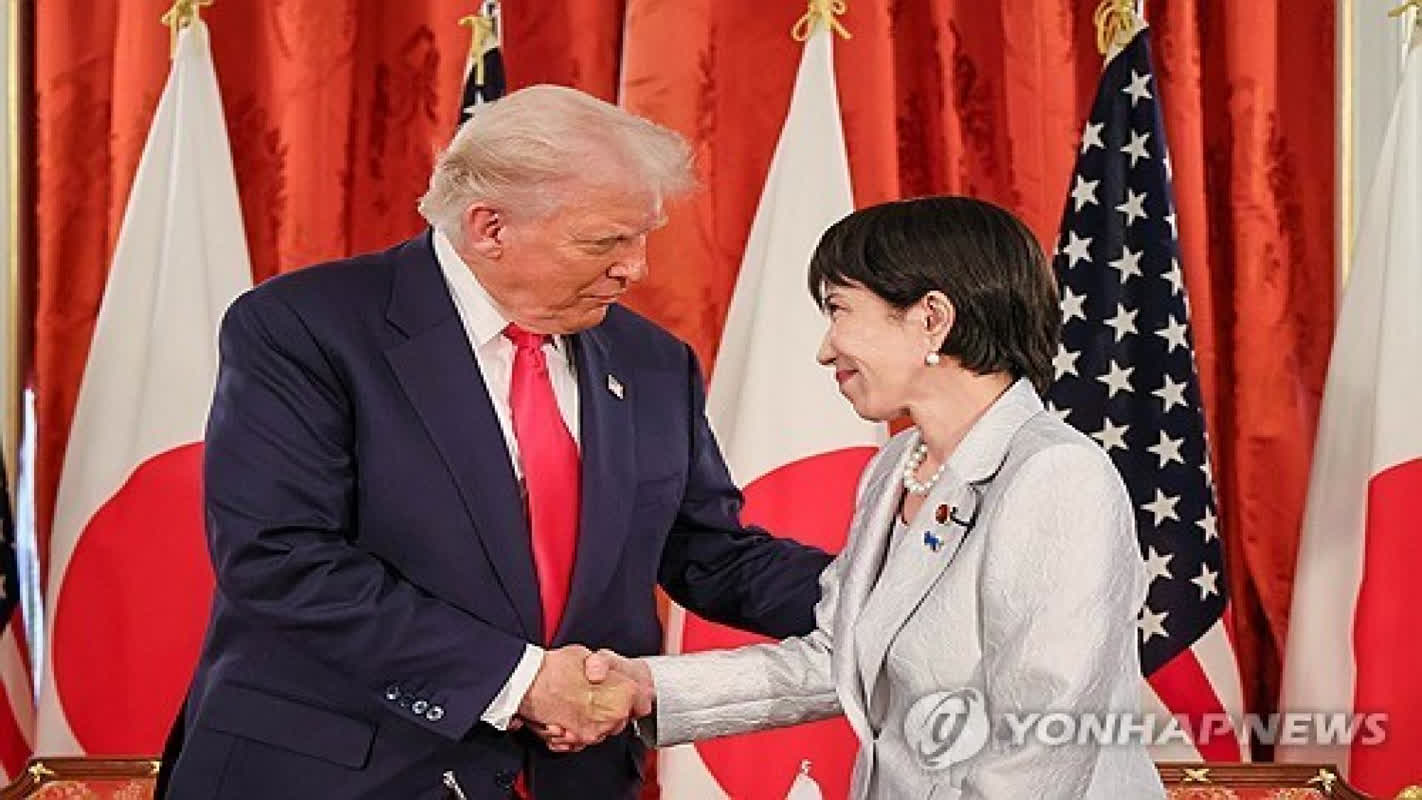
Senator Shaheen, recalling that President Lee and Japan’s Prime Minister Sanae Takaichi performed drums together in Japan last January, joked, “I had hoped the president would play the drums for us,” prompting laughter.
She added, “We deeply appreciate and take note of the strong relationship between the president and Prime Minister Takaichi. We value it highly.”
Representative Curtis quipped, “Korean cultural influence is growing in the U.S. I have 19 grandchildren, and each one is a big fan of ‘K-pop Demon Hunters,’” and President Lee responded with a smile.