From BB and CC creams to protein shakes and leggings, they’re rising in tandem…Looks natural, but is this an expensive self-care strategy?
The 'clean girl' trend no longer refers only to sheer makeup. Originating in clear skin, neat hair and neutral-toned outfits, it has broadened into an image of deliberate self-management that includes diet, exercise routines and healthy daily habits. Eating well, working out regularly and tending the body consistently are now consumed as an aesthetic in their own right—not merely ways to look pretty.

The 'clean girl' trend first surfaced on TikTok in late 2021 and expanded into fashion and beauty in 2022. Early markers included toned-down color for a translucent complexion, a slicked-back bun, tidy brows, lip gloss, gold accessories and neutral outfits. The look appears effortless, but it presumes ongoing care of skin, hair and body—what might be called managed naturalness.
On May 5, CJ Olive Young reported that BB and CC cream sales in the first quarter rose 97% year over year, while searches for foundation-free keywords climbed 33%. Consumers are favoring products that preserve skin texture while subtly correcting redness and blemishes over heavy, full-coverage foundations.
BB and CC creams originally combined soothing and corrective benefits. Aligned with the 'clean girl' trend, they are meeting renewed demand for light but polished skin: minimal correction that makes skin look healthier rather than a base that entirely masks it.
Notably, this spending has not stayed confined to beauty items. Over the same period, Olive Young’s sports and protein drink sales rose 114% year over year. Riding the wellness wave, olive oil sales jumped more than 20-fold compared with the second half of last year. What began with clear skin and neat hair has widened into lifestyle habits such as protein intake, healthier diets and body care.
An Olive Young spokesperson said, \"Alongside the preference for natural-looking skin associated with the 'clean girl' trend, we see a clear uptick in customers buying healthy-lifestyle products like protein shakes. Consumers now experience beauty and wellness not as separate categories but as one integrated curation.\"
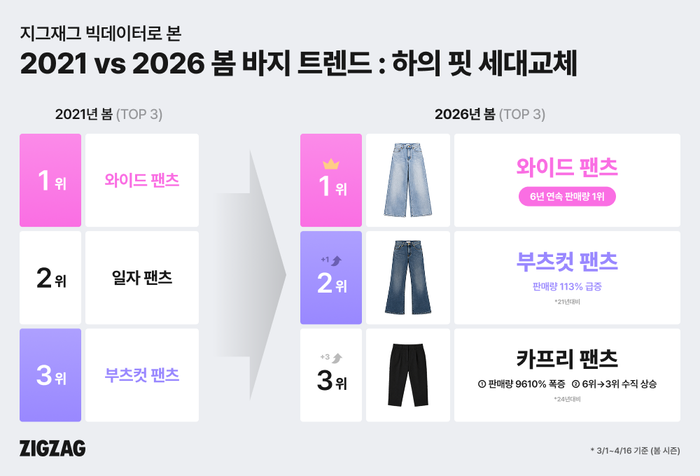
Fashion reflects a similar shift. Style-commerce platform ZigZag’s big-data analysis released April 29 showed wide-leg pants sales up 313% versus 2021. Comfortable yet tailored silhouettes have become everyday defaults. At the same time, boot-cut and capri pants climbed the ranks, and low-rise styles that reveal the abs and waistline saw sales surge 576% over two years.
This isn’t just a search for comfort. Wide pants, boot-cut training pieces, skirt-leggings and cropped zip-ups emphasize ease while subtly showcasing a body shaped by exercise. As the 'clean girl' image expands from a naturally pretty face to someone who consistently manages their body, fashion has shifted to convey both comfort and disciplined self-care.
Musinsa’s data confirms the trend. From January through March this year, leggings sales on Musinsa were up 90% year over year, and yoga and Pilates goods rose 50%. A Musinsa representative said, \"As the beauty trend that highlights natural skin texture spreads into fashion, many customers now seek athleisure they can wear every day. Shoppers place greater value on an ideal fit for their body and a lifestyle that signals health than on visible brand logos.\"
Diet has become part of the 'clean girl' image, too. On platforms like TikTok, the hashtag #cleangirl returns roughly 1.5 million posts featuring matcha, protein drinks, salads, low-sugar snacks, olive oil and protein-rich foods as part of a clean routine. If the earlier 'clean girl' emphasized clear skin and neat hair, today it describes a whole-life aesthetic—morning workouts, protein-based meals, sleep routines and swelling control.
But critics caution that this self-management trend is not wholly benign. Encouraging healthy eating, exercise and routine can tip into pressure to maintain a constantly managed body and life. The 'clean girl' promotes harmless-seeming naturalness, yet sustaining that look often demands more time, money and self-control—risks that can become another form of compulsion.
Eunhee Lee, a professor of consumer studies at Inha University, said, \"The 'clean girl' appears harmlessly natural, but in reality it is high-cost marketing and a sophisticated differentiation strategy. Where flashy past fashions could be partly achieved with accessories or technique, the core of 'clean girl'—healthy skin and a toned body—often requires vast investments of capital, time and sometimes innate advantages.\"
She added, \"Emphasizing a message like 'I look this good without trying' draws an exclusive line most people can’t easily copy, aiming for a sense of superiority. It’s paradoxical that maintaining 'naturalness' can cost more in money and energy than buying clothes. In a capitalist society, fierce competition now wears the mask of 'health' and becomes a new form of pressure.\"
© Dailian Co., Ltd. Unauthorized reproduction and redistribution prohibited
- Greta Lee: My driving force is freedom; daring direction gives someone else a chance [27th JIFF]
- 'Karaoke mishaps' aren’t funny… Vocal polyp experiences faced by Naul of V.O.S [Kim Hyo-kyung’s Daily Health]
- Where to go on Children’s Day… Great for outings High near 24°C, temperature swings around 15°C [Today’s Weather]
- Jung Ha-dam: Hosting the Jeonju International Film Festival closing ceremony feels extra special since it’s my mother’s hometown [27th JIFF]
- Lee Soon-sil releases 'Flowers Blooming on Stone'… Beyond a North Korean defector memoir, a fierce survival record [New Release]