Unlocking Korea: How the 2026 K-Tourism Roadshow in Singapore Attracted Over 17 Billion Won in Sales
Lee Jang-won | 2026.03.10
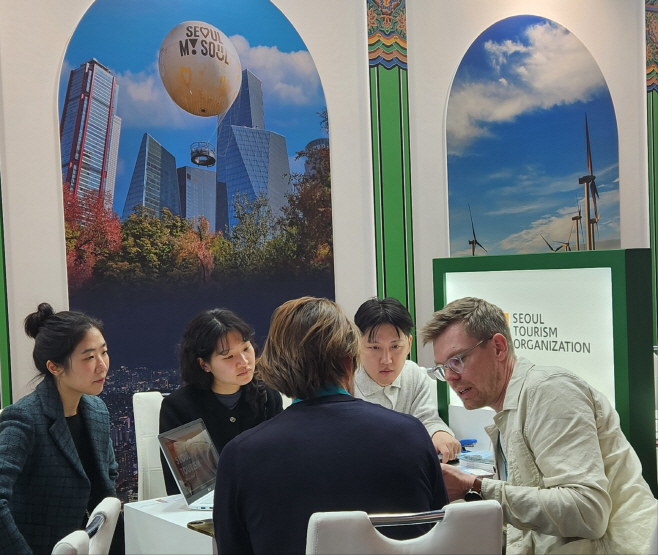 | | Korea tourism pavilion in Berlin. / Provided by Korea Tourism Organization |
|
With the government raising this year’s target to 23 million international visitors, the Korea Tourism Organization is turning up the charm with more tailored on-the-ground promotions overseas.
On March 10, the KTO highlighted that business travel from Germany is a key opportunity. It recently signed a multilateral agreement with FRM, a Frankfurt-area public agency focused on investment and promotion; Ansenio, a German distributor of medical and health products; and T'way Air to stimulate business tourism to Korea. Roughly 27% of German visitors to Korea come for business, and the pact is intended to drive higher-value inbound travel through coordinated efforts.
The KTO also ran a major Korea pavilion at the Berlin International Travel Trade Show (ITB) from March 3–5 to showcase what Korea has to offer. The pavilion brought together 28 partners — domestic travel agencies, airlines, the Seoul Tourism Foundation, Busan Tourism Organization and the Gyeongsangbuk-do Cultural Tourism Organization among them. Germany is one of the markets whose visitors tend to explore multiple regions while in Korea, so the pavilion emphasized regional experiences. Attendees could try hands-on activities like assembling a wooden model of Cheomseongdae, take part in K-culture quizzes and browse curated exhibits. The KTO invited German media and travel agents to the Korean Cultural Center in Berlin for tourism briefings and Korean food demos. During the fair, it held 753 business meetings and estimates inbound travel package sales at about 33.5 billion KRW (≈ $25,125,000 USD).
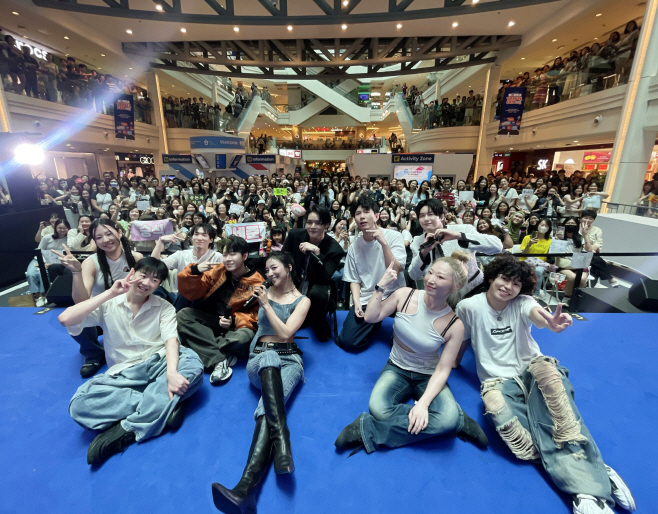 | | Musical performance at the Singapore K-Tourism Roadshow. / Provided by Korea Tourism Organization |
|
In Singapore, the KTO leaned into beauty and food — two irresistible draws for local travelers — by staging the 2026 Singapore K-Tourism Roadshow from March 6–8. The K-culture zone offered one-on-one skin diagnostics, personal color consultations and DIY norigae tassel-making. The K-food zone served up Korean eats from food trucks. Big Korean brands and beauty experts — including Kolmar Korea, Jung Saem Mool and Bibigo — took part, and the program featured musical acts, makeup showcases and celebrity-chef cooking demos. The vibe was very much experiential marketing: taste it, try it, fall in love.
The KTO also focused on turning Singapore’s high repeat-visitor rate into deeper regional travel. Local booths highlighted Gangwon, Busan and Jeju to showcase authentic local content. The event invited 11 local travel agencies to promote Korea packages and generated more than 1.7 billion KRW (≈ $1,275,000 USD) in sales, the KTO reported.
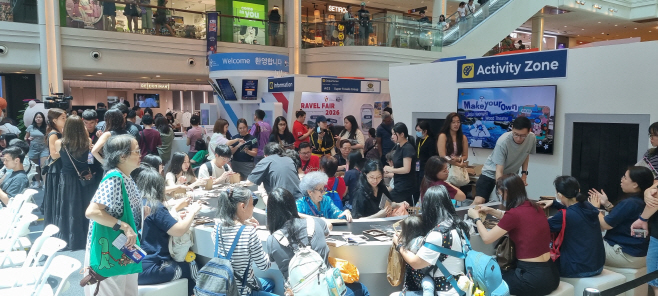 | | K-culture DIY experience. / Provided by Korea Tourism Organization |
|