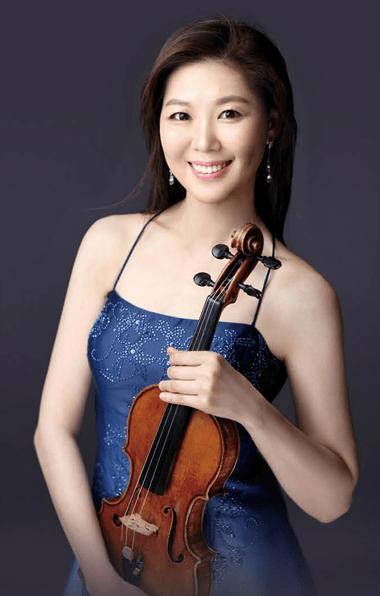
By Lee Sang-wan, News Culture — Violinist Kim Miryeong, who has long pursued the essence of music, will give a solo recital.
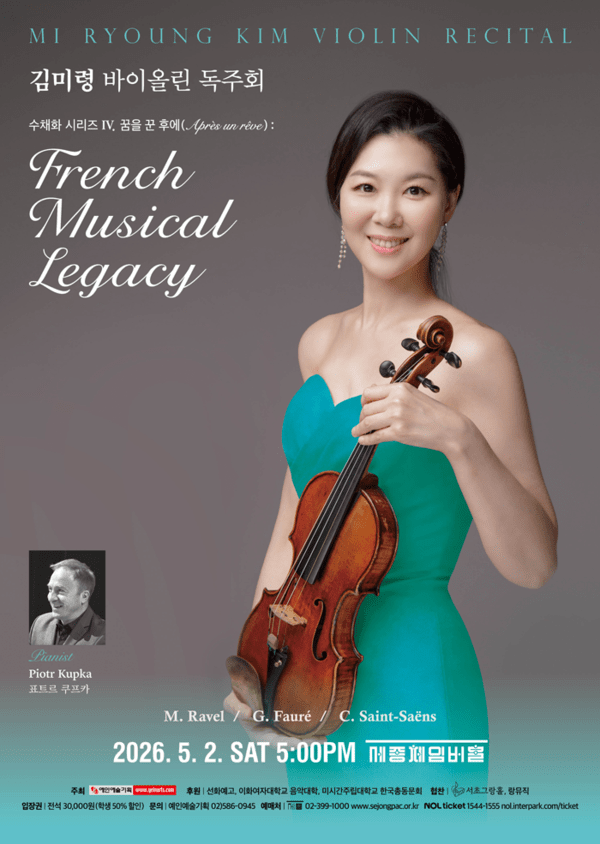
Kim will appear in the \"Kim Miryeong Violin Recital\" at 5 p.m. on the 2nd of next month at Sejong Center’s Sejong Chamber Hall.
The program features works by Ravel, Fauré and Saint‑Saëns, presenting the elegant melodies and vivid tonal colors of French music through an intimate violin-and-piano dialogue. Pianist Piotr Kupka will join Kim to create a finely tuned chamber partnership.
Kim graduated from Sunhwa Arts High School and earned both her bachelor’s and master’s degrees with honors from Ewha Womans University’s College of Music. After serving as a full-time member of the Bucheon Philharmonic, she moved to the United States and, at Michigan State University, became the first Korean to earn a Doctor of Musical Arts in violin and a Master of Music in viola simultaneously on full scholarship. Studying both instruments has added scholarly depth and broadened her string sensibility.
She studied with Walter Verder of the Verder Trio—an inheritor of the Ivan Galamian tradition—and with Yuri Gandelsman, former principal violist of the Israel Philharmonic. While at Michigan State, Kim won multiple awards and fellowships, including the Alexander Schuster Principal Violinist Award, graduate fellowships, the Romeo Tata Graduate Fellowship, and support from the Chicago Bells‑Cheney Foundation.
Kim has also developed a notable international profile. After placing in the American Protege International String Competition, she made her debut at Carnegie Hall in New York. She was selected for Phi Kappa Lambda, the American honorary music society, and has performed solo and chamber programs at venues such as Seoul Arts Center, Kumho Art Hall, Sejong Chamber Hall, Taiwan’s Chiang Kai‑shek Memorial Hall, and Chicago Symphony Hall.
Her ensemble experience is extensive. Kim toured North America with Yo‑Yo Ma and participated in ensemble workshops; she has appeared with the Moldova National Chamber Orchestra, Chernivtsi Philharmonic (Ukraine), Union Chamber Orchestra, Michigan State University Orchestra, Bucheon Philharmonic, Mostly Philharmonic, Seoul Symphony, and Pan‑Asia Philharmonia, among others. Her work as both soloist and chamber musician highlights her musical balance.
She has also built a strong record as an orchestra leader, serving as concertmaster of the Chicago Classical Symphony, principal of the West Michigan Symphony, associate principal of the Chicago Civic Orchestra, and a member of the Lansing Symphony. In Korea, Kim was a permanent member of the Bucheon Philharmonic and has been invited as guest concertmaster and principal with the Seongnam City Orchestra, Hwaeum Chamber, and Seoul Academy Ensemble, earning recognition for her leadership.
As an educator, Kim remains active and combines her artistic work with community outreach. She has participated in charity concerts such as the Hope Concert in Germany, a rice-and-bread benefit in Cambodia, and fundraising performances for African missions. She currently serves as music director of the Andong Sinfonietta and as an adjunct professor at National Kyungguk University.
The recital program centers on French composers. Ravel’s Sonata for Violin and Piano in A minor (posthumous) reflects youthful lyricism; its conversational interplay between violin and piano reveals the clarity and delicate expression of Ravel’s early style.
She will also perform Fauré’s Romance in B‑flat Major, Op. 28, and Après un rêve, Op. 7, No. 1—works that showcase Fauré’s graceful lines and intimate emotion, bringing the lyricism of French romantic music to life through the violin’s singing tone.
The program concludes with Saint‑Saëns’ Sonata for Violin and Piano No. 1 in D minor, Op. 75, a work that combines dazzling technique, romantic fervor, and tightly woven structure. The sonata requires both wide expressive range from the soloist and close interplay with the pianist, and promises to intensify the evening.
Lee Sang-wan, News Culture — prizewan2@nc.press