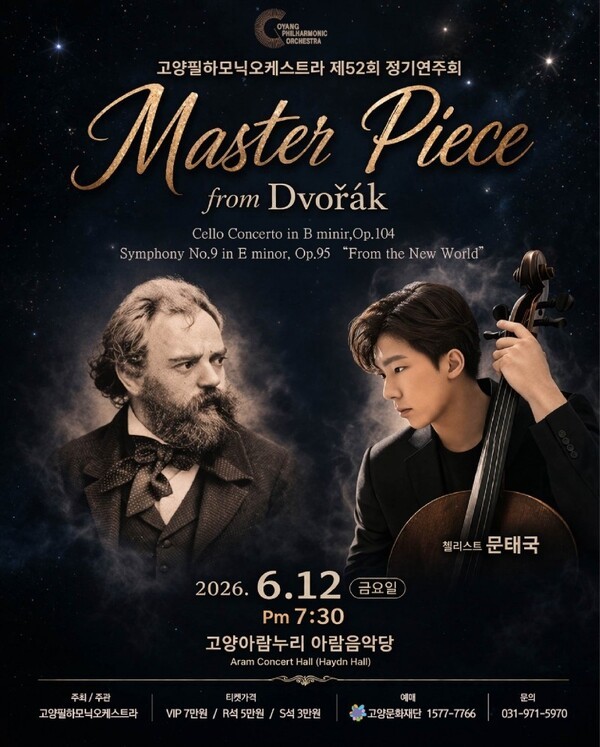
[NewsCulture reporter Lee Sang-wan] Music by Antonín Dvořák, the foremost composer of Czech Romanticism, will fill the stage at Goyang Aram Nuri’s Aram Music Hall.
The Goyang Philharmonic Orchestra will present "MASTER PIECE from DVOŘÁK" on the 12th of next month at 7:30 p.m. at the Aram Music Hall.
The first half features Dvořák’s Cello Concerto in B minor, Op. 104, with cellist Moon Tae-guk as soloist. The second half presents one of Dvořák’s signature symphonies, Symphony No. 9 in E minor, Op. 95, “From the New World.”
Dvořák combined national melodies, Romantic lyricism and a sweeping orchestral palette grounded in Bohemian folk traditions. His time in the United States left an unmistakable mark on his work: impressions of a foreign landscape, longing for home and a warm human sensibility thread through his scores.
The Goyang Philharmonic’s program brings together the two pillars of Dvořák’s output. The Cello Concerto spotlights the solo instrument’s lyrical voice against the orchestra’s dramatic sweep, while "From the New World" demonstrates Dvořák’s command of symphonic scale and memorable themes. Presenting concerto and symphony in one evening highlights both his intimate chamber instincts and his large-scale orchestral language.
Conductor Ahn Hyun-seong will lead the concert. Ahn studied under H. D. Volz at the State University of Music in Trossingen, Germany, where he completed a master’s degree. He also trained at the conservatories in Opava and Brno in the Czech Republic, strengthening his foundations as a conductor. His credits include appearances with the Jeonju and Mokpo municipal symphonies, the Opava City Orchestra, the National Symphony Orchestra of Ukraine, the Janáček Chamber Orchestra, the Uzbekistan National Symphony and the Ho Chi Minh City Orchestra. He is the Goyang Philharmonic’s principal conductor.
Ahn has balanced the orchestra’s subscription series with audience-friendly programming, growing its presence in the local community. As principal conductor, he aims to reconcile Dvořák’s folk-inflected melodies, dense string textures and the narrative interplay of brass and woodwinds to anchor each performance.
Cellist Moon Tae-guk, the soloist, performs regularly at home and abroad. He won first prize at the André Navarra International Cello Competition in 2011 and at the Pablo Casals International Cello Competition in 2014, and he took the inaugural János Starker Prize. He served as a resident artist at Kumho Art Hall in 2017 and as an in-house artist at Lotte Concert Hall in 2022. His win at the Pablo Casals competition was the first by an Asian artist.
Moon is known for a rich tone and assured interpretations, consistently engaging core cello repertoire. Dvořák’s concerto demands both technical command and prolonged lyrical phrasing: the solo cello must dialogue with the orchestra while steering the work’s emotional trajectory. Moon is expected to emphasize the instrument’s low resonance and its human, singing line.
Completed during Dvořák’s American period, the Cello Concerto in B minor, Op. 104, is one of the most frequently performed works in the cello literature. The first movement contrasts a powerful orchestral opening with the cello’s singing line; the soloist shapes the movement’s feeling through sustained melodic phrasing rather than flashy display.
The second movement centers on Dvořák’s warm lyricism, with the cello building emotion in its low register while the orchestra adds complementary color. The third movement alternates dance-like vigor and wistful reflection, driving the concerto toward a grand, homesick conclusion.
Symphony No. 9 in E minor, Op. 95, "From the New World," grew out of Dvořák’s impressions of the United States. Often called the New World Symphony, it blends American influences with Bohemian sentiment. Themes that evoke folk tunes, memories of home and the experience of a new land unfold on a sweeping symphonic scale.
The first movement opens with a dark, tense introduction before a forceful principal theme; the orchestra conveys both anticipation and alienation toward the new world. The second movement begins with the famous English horn melody, widely heard as a homesick longing and the symphony’s most lyrical moment.
The third movement is a scherzo, with rhythmic energy and echoes of folk dance. The fourth movement gathers the work’s momentum and drives toward a majestic close, as brass, strings and woodwinds exchange themes and conclude the symphony’s narrative.
Founded in 1999, the Goyang Philharmonic Orchestra is a private professional ensemble dedicated to revitalizing regional culture and widening access to classical music. Through subscription concerts, special programs, collaborations with domestic and international artists, community arts initiatives and performances for local residents, it has worked to broaden Goyang’s classical music base.
The orchestra presents a wide range of repertoire, from the traditional canon to audience-friendly programs, seeking to deepen connections with local listeners while raising its professional standards. The 52nd subscription concert is an opportunity to hear the Goyang Philharmonic’s accumulated orchestral strengths through the music of Dvořák.
A production representative said the performance will share Dvořák’s deeply human sensibility and timeless message with the audience, offering a powerful and moving experience.
NewsCulture Lee Sang-wan prizewan2@nc.press