A major choral work returns to the stage after a 15-year absence.
On May 21, the Seoul Metropolitan Chorus presents Carmina Burana at the Grand Theater of the Sejong Center for the Performing Arts as part of its Masterpiece Series. The staging unites chorus, orchestra, and ballet under a single musical concept.
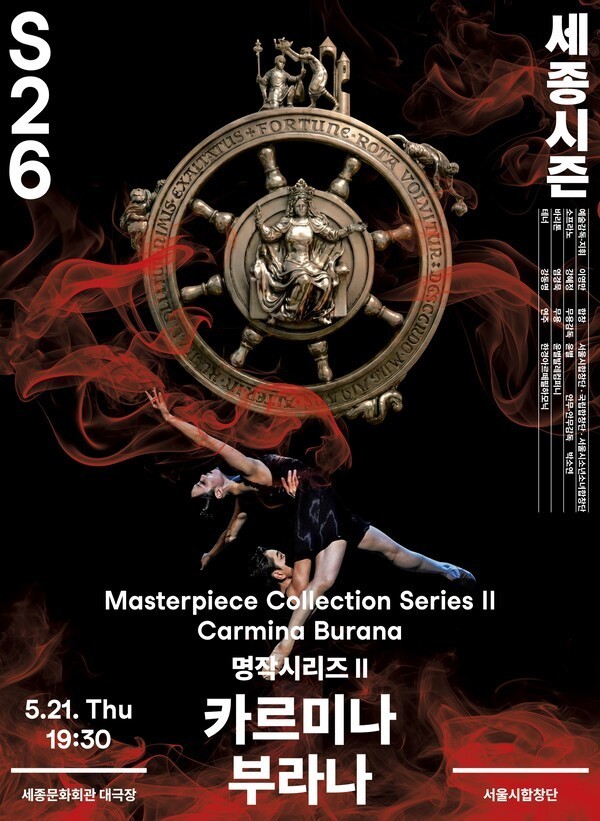
Soprano Kang Hyejung, baritone Yeom Kyungmook, and tenor Kang Dongmyung assume the principal solo roles, each channeling the work’s central theme of fate and propelling its shifts in mood and narrative.
The Seoul Metropolitan Chorus leads a combined ensemble of roughly 120 singers, including the National Chorus of Korea and the Seoul Metropolitan Youth Choir. The interplay between adult and youth voices adds textural contrast, while the Hankyung Arte Philharmonic provides the orchestral support.
Dance features prominently: the Yoon Byeol Ballet Company brings roughly 30 dancers, translating the score’s structures into visual movement. The choreography underscores rhythmic patterns and transitions rather than presenting an independent narrative thread.
Composed by Carl Orff, Carmina Burana is built on driving rhythmic repetition and a direct, elemental harmonic language. The integration of chorus, orchestra, and movement accentuates those qualities, preserving clarity even as the production expands in scale.
The opening and closing section, “O Fortuna,” frames the performance; its cyclical structure anchors the piece and draws the full ensemble together at pivotal moments.
Artistic director Lee Youngman said the production prioritizes both grand scale and structural coherence while probing new possibilities through collaboration with dance.
This staging presents Carmina Burana not as mere spectacle but as a work that balances sound, structure, and movement.
Reported by News Culture M.J._mj94070777@nc.press