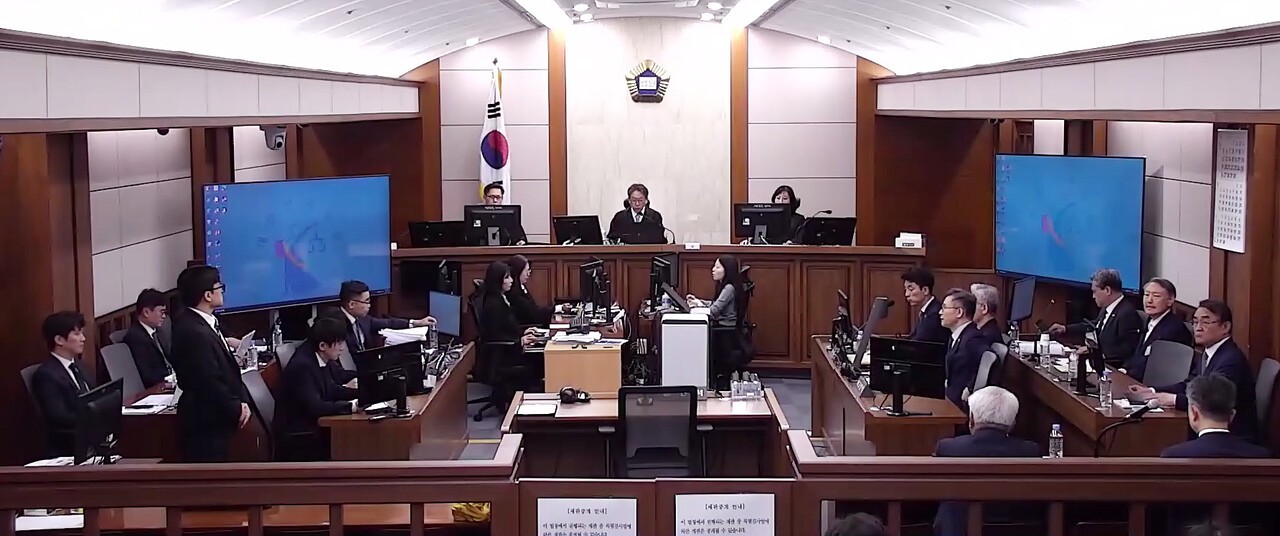
According to legal sources on the 25th, Special Prosecutor Jo Eun-seok’s team made the request at the sentencing hearing held the previous day (24th) before Criminal Division 36 of the Seoul Central District Court, presided over by Judge Lee Jung-yeop.
The prosecution characterized the case as an anti-state, anti-citizen crime intended to manufacture wartime conditions on the Korean Peninsula to protect political power.
“The commander-in-chief, the defense minister and the counterintelligence commander—who are charged with safeguarding the people’s lives and safety—sought to create wartime conditions on the peninsula to provide grounds for declaring emergency martial law,” the special prosecutors said. “That conduct is an anti-state, anti-people crime.”
They added that the defendants’ actions caused tangible harm to national security and severely undermined the country’s military interests.
Prosecutors allege that around October 2024, Yoon and others ordered an operation to deploy unmanned aerial vehicles into Pyongyang to provoke North Korea militarily and secure a pretext for declaring martial law.
They say the operation heightened military tensions between the Koreas and that operational and force-related military secrets appear to have been exposed when one of the drones crashed inside North Korean territory.
The prosecution factored into its sentencing request that Yoon, as commander-in-chief, led the plot, and that Kim assisted from the planning stages through execution.
Prosecutors also said they considered sentencing precedents from related cases because this matter is directly tied to the Dec. 3 emergency-martial-law incident.
The defendants have denied the charges.
In his closing statement, Yoon spoke for about an hour, arguing the drone operation was a legitimate response. Kim is also reported to have denied the allegations.
At a press conference immediately after the hearing, Yoon’s legal team said the operation was a lawful exercise of self-defense in response to North Korea’s so-called “trash-balloon” provocations and had nothing to do with martial law. They called the prosecution’s effort to link the operation to martial law “speculation” and “a baseless fiction.”
“A politically driven special prosecution that investigates and indicts a military response to North Korean provocation is, in effect, self-harm to South Korea’s security,” the defense added. “It undermines defense capabilities, strains the U.S.–South Korea alliance and benefits North Korea—acts that amount to betrayal.”
The hearing was held behind closed doors for reasons of military secrecy and national security, but the sentencing hearing will be public under constitutional principles. The first-instance verdict is scheduled for June 21.