According to the Times, a string of polls conducted since the fighting began shows a plurality of Americans oppose strikes on Iran.
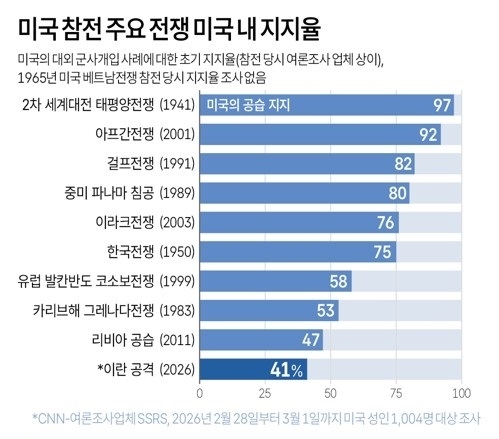
An urgent Reuters-Ipsos poll conducted immediately after hostilities began found only 27% of respondents supported a U.S. strike on Iran. A CNN poll conducted with SSRS between Feb. 28 and March 1 of this year, surveying 1,004 U.S. adults, found 41% backed airstrikes.
A Fox News poll of 1,004 likely voters — reflecting more conservative opinion — showed 50% in favor of strikes, leaving public opinion essentially split.
But the Times noted even the Fox News result, the highest among recent surveys, is well below the early support levels recorded at the outset of previous wars.
The Times cited Gallup polling showing 97% of Americans supported military action immediately after the Pearl Harbor attack and the U.S. declaration of war on Japan. Early backing for the 2001 Afghanistan campaign reached 92% (Gallup), and even the Iraq War, which later drew heavy criticism, enjoyed 76% support in polls taken right after it began. The NORC at the University of Chicago found 75% of Americans supported U.S. entry into the Korean War at its start.
Some analysts attribute the relatively weak support for action against Iran to the Trump administration’s failure to build a clear public case in advance.
Loyola University Chicago professor Sarah McSeay said “Before the 2003 Iraq War, officials spent about a year laying out why the war mattered, why other options had been exhausted, and why military action was necessary,” adding “the U.S. rarely entered foreign conflicts without a clear pre-conflict communication strategy.”
Observers also point to deeper political polarization at home, arguing the environment has changed since the eras when the nation more readily rallied at the start of a war. Harvard professor Matthew Baum said, “There was a time when politics stopped at the border, but that era is over.”