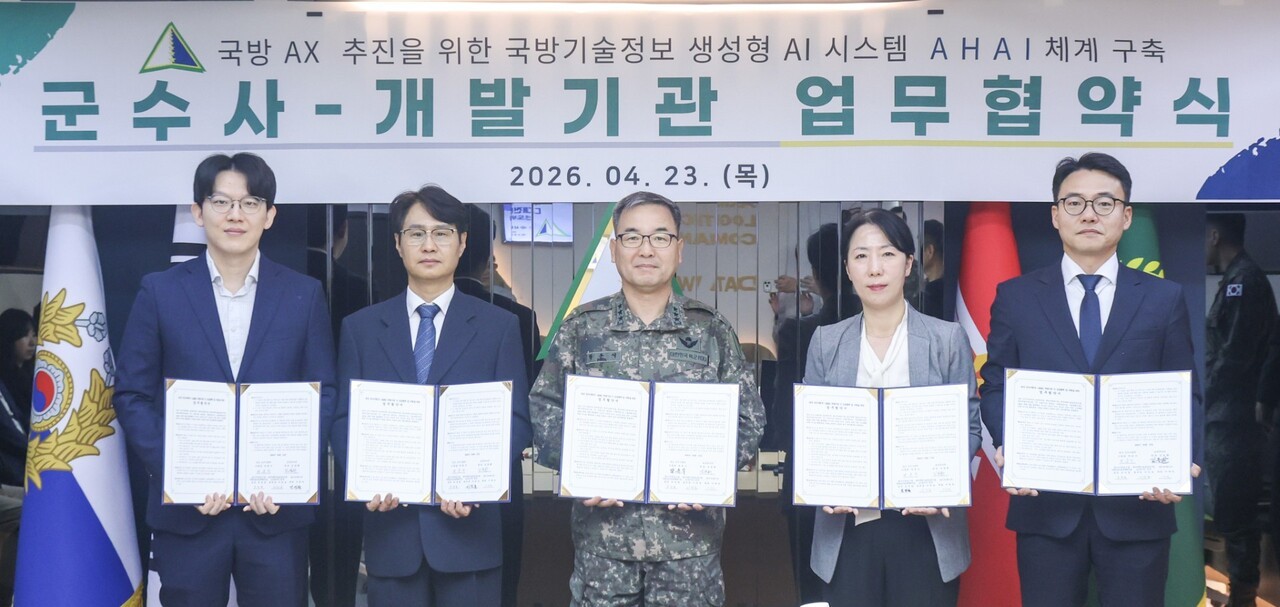
FortyTwoMaru (CEO Kim Dong-hwan) announced on April 24 that it has signed a memorandum of understanding (MOU) with the Army Logistics Command, the Korea Institute for Defense Analyses (KIDA), the Korea Institute of Science and Technology Information (KISTI) and DataMaker to develop AX capabilities for the military logistics sector.
As part of the AHIA future defense R&D program, the collaboration will bring together government, industry and military partners to build a logistics-focused foundation model aimed at strengthening national defense competitiveness.
Previous defense AI efforts concentrated on surveillance and reconnaissance, weapons systems and command-and-control. This initiative shifts the focus to logistics, applying AI across supply, maintenance and transport—from weapon systems to daily consumables.
Partners say the project will extend beyond model R&D to full lifecycle collaboration, covering infrastructure operations, performance optimization and the training of specialized personnel.
FortyTwoMaru will lead development of the logistics-specialized foundation model. The company plans to employ solutions such as retrieval-augmented generation (RAG42), AI reading comprehension (MRC42) and domain-specialized lightweight models (LLM42) to build models with precise training and inference capabilities.
KISTI will provide the AI model training infrastructure, DataMaker will handle data cleansing, and the Army Logistics Command and KIDA will oversee AHIA system operations and support demonstrations and evaluations.
“As the Claude Miso incident showed, sovereign defense AI is an urgent and critical issue—comparable in severity to a cyber 'nuclear' weapon,” Kim Dong-hwan said. “Through this agreement, we will marshal public, private and military capabilities to lead South Korea’s defense AI effort and make a concrete contribution to strengthening the military’s support posture.”
By Haewon Kim | hwkim@aitimes.com