South Korea's defense authorities have, for the first time, publicly confirmed that North Korea has been secretly conducting radio-frequency attacks against South Korean space assets for more than a decade.
Seoul's high-end reconnaissance satellites — launched at great expense — now face the prospect of being blinded and deafened not by kinetic strikes but by invisible radio-frequency interference.
New evidence suggesting that North Korea received advanced electronic-warfare technology from Russia in exchange for troop deployments has set off serious alarms about the security environment above the Korean Peninsula.
Invisible electronic warfare threatens space assets worth trillions of KRW (roughly hundreds of millions to a few billion USD)
On the 16th, the office of Rep. Yoo Yong-won of the People Power Party, a member of the National Assembly's Defense Committee, released documents it obtained from the Defense Ministry showing that North Korean forces attempted multiple radio-frequency attacks against South Korean satellites from the early 2010s through 2024.
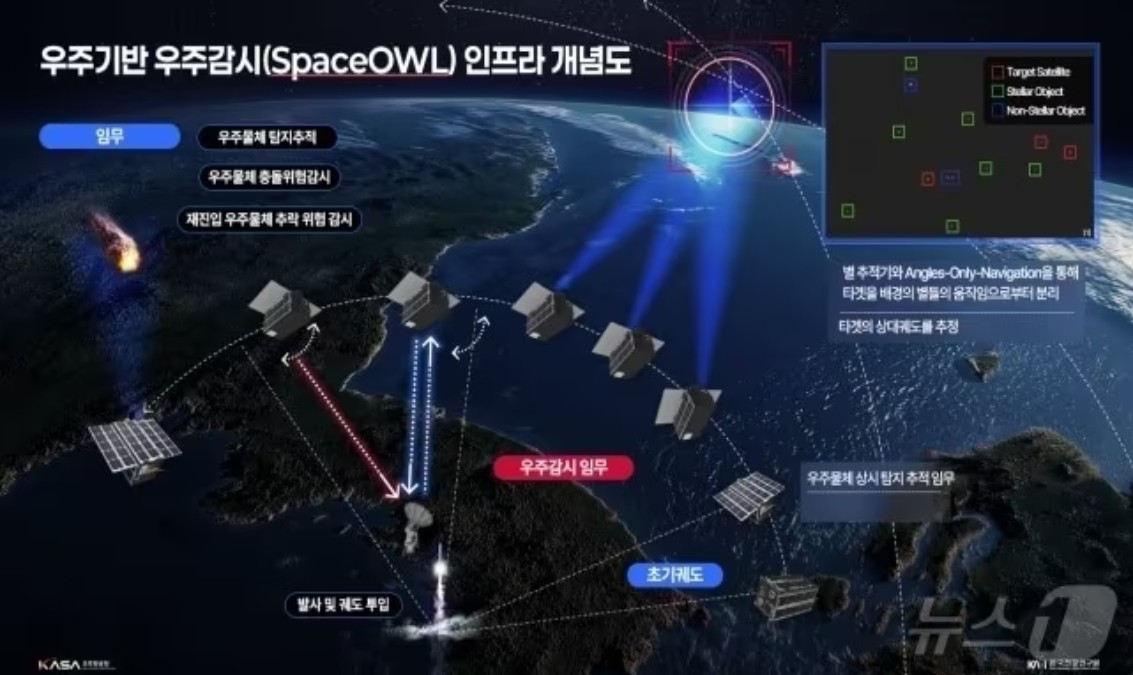
Analysts say the campaigns targeted a broad set of military and civilian systems — including synthetic aperture radar (SAR) satellites, electro-optical/infrared (EO/IR) reconnaissance platforms and communications satellites — to degrade surveillance and disrupt normal operations.
Rather than attempting to physically intercept satellites, North Korea appears to use powerful ground-based jamming systems to overwhelm or spoof signals between satellites and ground stations.
For example, when low-Earth-orbit reconnaissance satellites downlink imagery to ground stations, attackers can inject high-power noise to corrupt the data. They can also block uplinked command signals, temporarily denying ground controllers the ability to steer or manage the satellite.
That asymmetric electronic warfare has already produced tangible effects on South Korean forces.

In April 2024, a naval S-100 reconnaissance unmanned helicopter crashed near the northwest islands after North Korean jamming disrupted its GPS. Later that year, a Heron reconnaissance drone in November and a KUS-9 UAV in December both lost orientation and crashed — an unprecedented string of incidents.
Backed by Russia, North Korea formalizes space warfare — South Korea's challenge
Compounding the threat is the rapid pace at which North Korea appears to have upgraded its electronic-warfare capabilities with Russian technical assistance. In May, a Multinational Sanctions Monitoring Team (MSMT) made up of 11 countries, including South Korea and the U.S., reported that Russia supplied electromagnetic systems and jamming equipment to North Korea and provided operator training beginning in November 2024.
The National Intelligence Service also told the National Assembly's intelligence committee in June that it assessed Russia had provided jamming equipment and technical advice to North Korea in return for troop deployments.
Buoyed by that technical support, Kim Jong Un used the Workers' Party's 9th Congress in February to openly call for expanding space-warfare capabilities, specifically naming special assets to attack adversary satellites and potent electronic-warfare systems to paralyze command nodes.

If North Korea can use high-powered jammers to neutralize South Korean reconnaissance satellites transiting the peninsula during a conflict, the operational and strategic consequences would be severe.
Those satellites are the eyes of the kill chain — they detect mobile missile launchers and shifts at nuclear sites that enable preemptive strikes — and losing that visibility could blind defenders before hostilities begin.
Beyond the battlefield, large-scale jamming could cascade into civilian crises: delayed commercial flights, stranded fishing vessels, major communications outages and other life-threatening disruptions.
Seoul must urgently strengthen satellite anti-jamming capabilities and field integrated defenses that can locate and rapidly strike jamming sources, so high-value space assets launched at great cost are not rendered useless by a single ground-based radio signal.