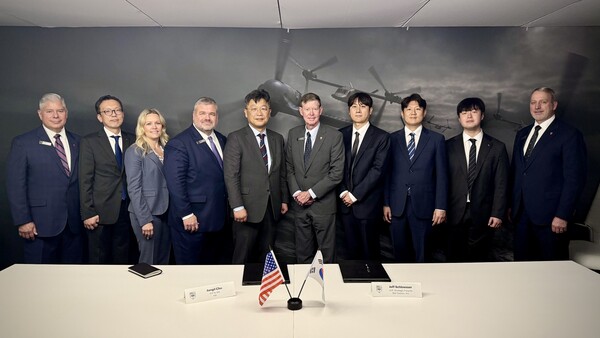
[The Public — Eun‑hye An] Korea Aerospace Industries (KAI) said on April 27 (local time) that it signed a memorandum of understanding with U.S. defense firm Bell Textron to pursue solutions for the Republic of Korea’s Next Generation High‑Speed Medium Utility Helicopter (HSMUH) program.
The agreement focuses on the MV‑75, the Next‑Generation Vertical Lift (NGVL) airframe Bell is developing in cooperation with the U.S. Army. KAI said the partnership is intended to align with U.S. government priorities and policies while jointly addressing South Korea’s HSMUH requirements.
The MV‑75 was officially selected for the U.S. Army’s Future Long‑Range Assault Aircraft (FLRAA) program and is now under system development at Bell Textron. On April 15 (local time), Bell announced the platform’s official name: Cheyenne II.
KAI and Bell Textron plan to examine solutions such as a modular open systems approach that enables rapid, cost‑effective upgrades to weapon and mission systems. They also said they will pursue broader industrial cooperation as the project advances into more detailed phases.
Jo Jeong‑il, head of KAI’s division, said the collaboration with Bell Textron will markedly advance the Republic of Korea’s next‑generation aviation capabilities. “By combining KAI’s proven systems‑development expertise with Bell Textron’s cutting‑edge technologies, we will prepare a flexible, powerful weapons system that allows our forces to respond immediately to rapidly changing battlefields,” he said.
Jeff Schloesser, senior vice president at Bell Textron, described the MV‑75 as a platform that demonstrates the apex of next‑generation vertical‑lift technology. “South Korea’s HSMUH program provides an important opportunity to extend this advanced capability into global markets and to strengthen interoperability between the United States and its allies,” he said.