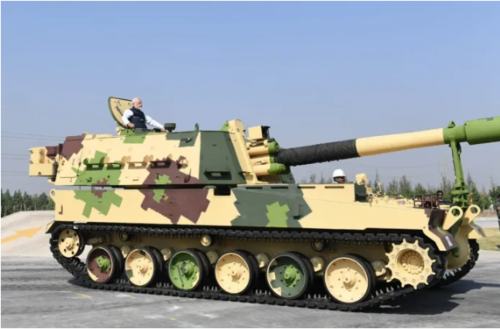
[The Public = Reporter Hong Chan-young] India is moving to purchase additional units of South Korea’s K-9 Vajra self-propelled howitzer, signaling a deeper phase in Korea-India defense cooperation. The relationship is evolving from straightforward arms sales to a model that combines local production with technology transfer.
Seoul Shinmun (April 23) and local defense outlet Defense In report New Delhi is considering procuring 200 more K-9 Vajra systems. The program would be implemented through a production partnership between Hanwha Aerospace and India’s Larsen & Toubro.
The K-9 Vajra is a 155mm, 52-caliber tracked self-propelled howitzer derived from South Korea’s K-9 platform and modified for Indian conditions. India acquired 200 units across the first two phases; completing a third phase would expand the fleet to roughly 400 guns.
At the heart of the program is increased localization. Local component content rose from about 50% in phase one to 60% in phase two, and it is expected to reach roughly 70% in phase three. Analysts say the effort is shifting toward establishing a domestic production base in India rather than simply exporting finished systems.
Crucially, the partnership is moving toward greater technology transfer. Local media report cooperation could extend into key subsystems, including fire-control systems, electronic suites and specialized armor materials.
The initiative also carries political weight. Prime Minister Narendra Modi attended the inauguration of a production facility in Hazira, Gujarat, and rode in a K-9 Vajra, underscoring his backing for the program’s expansion.
On performance, the K-9 Vajra has strengthened its position within the Indian military. Initially adapted for desert operations, the platform has been upgraded for high-altitude and extreme-cold environments, maturing into an all-weather fire-support asset.
Operational use has been viewed positively. Indian forces have employed shoot-and-scoot tactics in recent operations, demonstrating rapid-response capability and survivability. Those results have prompted New Delhi to reassess the K-9 as a precision-strike, frontline artillery asset.
Domestic analysts contend the additional procurement will accelerate India’s self-reliant defense-industrial strategy. They argue the Korea-India collaboration now spans weapons purchases, technology transfer and production infrastructure—and that expansion could reshape India’s wider defense ecosystem.