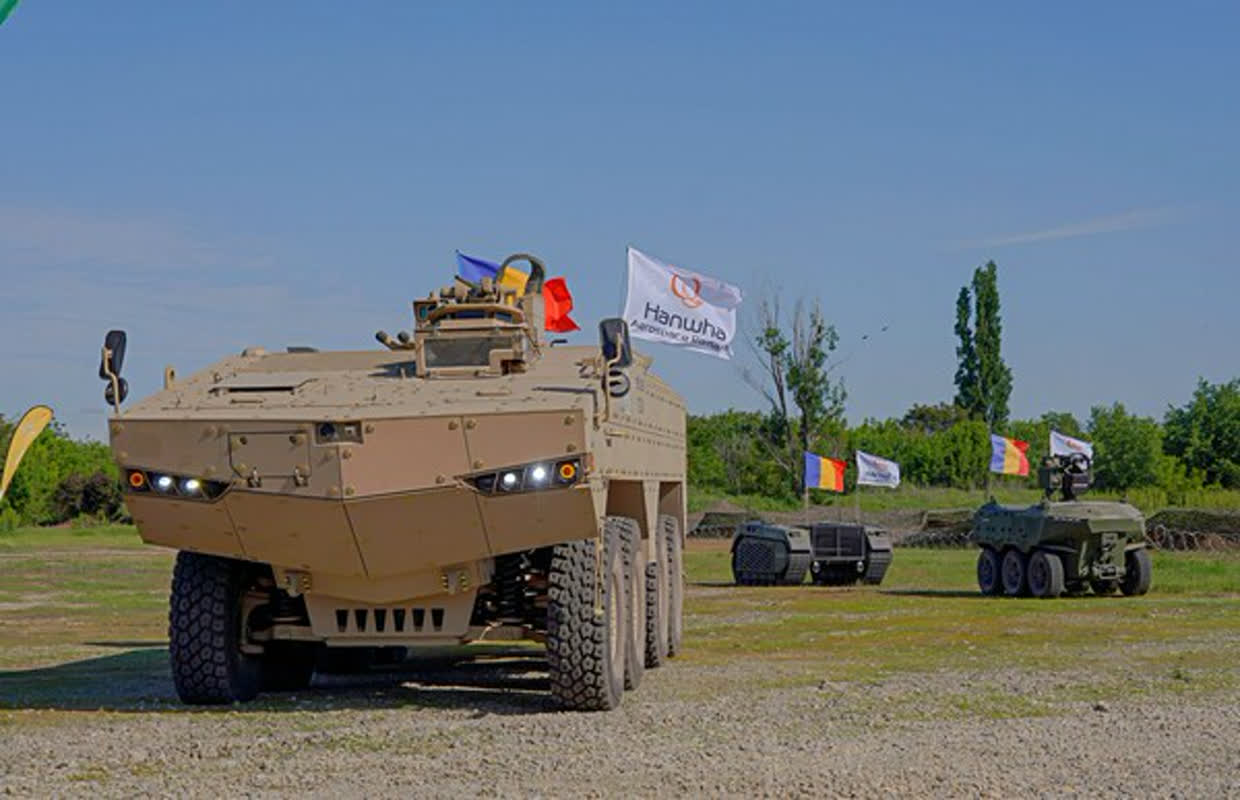
Hanwha Aerospace (CEOs Kim Dong-gwan and Son Jae-il) held its Hanwha Tech Academy 2026 event at the Hanwha Building in Jung‑gu on April 29, where it showcased key technologies aimed at domesticating airborne munitions.
 Working with the Agency for Defense Development (ADD), Hanwha is moving to replace foreign-dependent aerial weapons with domestic systems to strengthen South Korea’s self-defense and improve export competitiveness for indigenous platforms such as the KF-21 — a strategy intended to boost K‑defense exports.
At the event, the company highlighted its work on Ducted Ramjet Propulsion and outlined the current status and future roadmap for airborne-munition development.
A ducted ramjet propulsion system uses air ingested during flight to burn solid fuel and generate thrust. Because it does not carry a separate oxidizer, it offers extended range, rapid acceleration and sustained high speeds — characteristics that make it a core technology for advanced aerial munitions. Europe’s MBDA Meteor long‑range air‑to‑air missile uses a similar concept.
Since 2005, Hanwha Aerospace says it has spent 22 years conducting core research under ADD leadership on ducted‑ramjet components including propellants, gas generators and combustors.
Building on that work, the company plans to take an active role in government‑led programs to develop ducted‑ramjet–based weapons such as long‑range air‑to‑air missiles and supersonic anti‑ship missiles.
Hanwha has also been developing advanced artillery-round technologies with the government to improve the hit probability of the 155 mm rounds fired by the K9 self‑propelled howitzer.
Precision‑guided projectiles are intelligent shells that can strike high‑value targets with relatively few rounds. They integrate navigation systems combining GPS and INS, guidance and control units, and steering surfaces such as tail fins.
Whereas traditional self‑propelled howitzers specialize in area suppression using large volumes of fire, pairing them with precision‑guided rounds enables point strikes with missile‑like accuracy.
Hanwha also unveiled a ballistic‑correction fuze that adjusts a shell’s trajectory midflight using GPS data to increase hit probability. The fuze addresses the accuracy degradation that occurs at longer ranges and can be used as a drop‑in replacement for existing fuzes, enhancing operational flexibility.
Both the precision‑guided rounds and the ballistic‑correction fuzes incorporate domestically developed anti‑jamming capabilities to counter enemy electronic warfare measures.
Developing these advanced rounds domestically will allow faster responses to changing military requirements and create opportunities to export additional ammunition to countries that operate the K9.
A Hanwha Aerospace spokesperson said, "We will actively participate in the domesticization of advanced defense technologies in cooperation with the government and industry partners to strengthen self‑defense and expand K‑defense exports."