![[박승준 논설주간]](https://contents-cdn.viewus.co.kr/image/2026/03/CP-2023-0070/image-d2d4ac6d-32f5-42e5-9ea6-9eac64b1d47c.png)
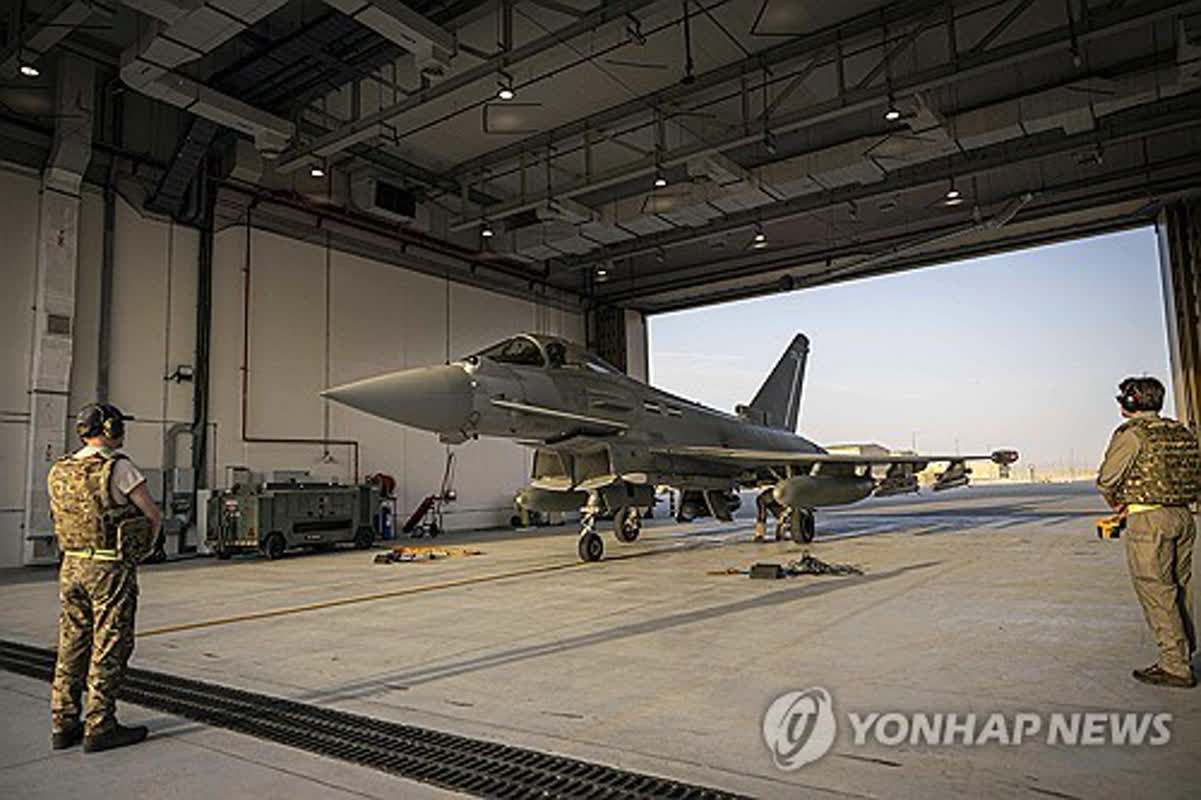
With spring arriving, warm days often bring a haze of fine dust drifting in from the Chinese mainland. On the 19th of last month, when the high hit roughly 8°C (about 46°F), heavy particulate settled over the area surrounding Osan Air Base. Visibility on the nine‑hole fitness golf course was reduced by dust and fog, making it hard to see flying balls. Yet the runway was alive with repeated, thunderous jet takeoffs. From my experience as an Air Force officer assigned to a combat airfield in 1978–1979, the jets that morning were likely flown by U.S. pilots. U.S. aviators, who tend to be taller and physically stronger than their ROK counterparts, often pull an almost vertical climb after takeoff to reach altitude quickly. They also tend to finish their approaches near the runway end and descend sharply with aggressive turns to land. During joint ROK‑U.S. exercises, our squadrons sometimes posted banners warning, “Do not imitate U.S. flight maneuvers.”
It later emerged that on Feb. 18–19, F‑16s launched from Osan had flown into airspace between Korea’s Air Defense Identification Zone (KADIZ) and China’s ADIZ over the Yellow Sea. China, reportedly taken by surprise, scrambled roughly ten J‑16s in response. One cable news outlet even reported that the U.S. jets were equipped with live ordnance capable of missile launch. Conflicting domestic coverage muddied the facts, but Defense Minister Ahn Kyu‑baek is said to have phoned U.S. Forces Korea commander Javier Brunson to protest the unannounced flights and to have received an apology. Brunson later said, “We do not apologize for our state of readiness,” a statement that added confusion to an already tense episode.
More troubling was how Chinese online outlets framed the incident. Many cited a Bloomberg piece and unverified AI‑generated material from a source called AI Deep Seek, then amplified the story with sensational headlines: “Inside the Sino‑U.S. aerial showdown over the Yellow Sea: J‑16s overwhelm F‑16s — some claim the U.S. jets were actually targeting Korea.” To support the “overwhelm” claim, they noted that the F‑16s retreated immediately when J‑16s scrambled as they neared Chinese airspace beyond the KADIZ. Some outlets went further, floating the unlikely theory that the sorties were meant to undermine warming ties between President Lee Jae‑myung and Xi Jinping ahead of Lee’s planned Beijing visit.
On Feb. 28, President Donald Trump and Israeli forces struck targets in Tehran in an operation reported to have eliminated elements of Iran’s leadership, including Ayatollah Khamenei. That strike occurred ten days after the aerial standoff over the Yellow Sea. No official link has been established between the two events. Still, given the wider U.S.–Israel actions against Iran, commanders at China’s Shenyang Command of the Northern Theater who ordered the scramble over the Yellow Sea likely watched the Tehran strike with serious concern.
We should take a close look at two recent U.S. documents: the National Security Strategy (NSS) released by the White House on Dec. 5 and the National Defense Strategy (NDS) released on Jan. 23 by the U.S. Department of Defense. The NSS explicitly asks South Korea and Japan to shoulder more of the defense burden “to deter adversaries and protect the First Island Chain.” The NDS likewise calls for a strong defense line along the First Island Chain to check China’s military expansion and urges key regional allies and partners to contribute more to collective defense.
The First Island Chain described in those documents runs from the Japanese archipelago south through Okinawa, past Taiwan and the Philippines, and down toward Borneo. John Foster Dulles first articulated a comparable line in 1951 to check Soviet and Chinese moves into the Pacific. In the 1980s, Chinese naval commander Liu Huaqing adopted the First Island Chain as the backbone of a “near‑sea active defense” coastal strategy.
Japan is already building missile facilities along the chain and is developing a missile site on Yonaguni Island, just 110 km (about 68 miles) from Taiwan. When the United States asks South Korea to help defend the First Island Chain, it expects Korea to handle threats from the North while the U.S., together with Japan, helps deter China’s push toward that line. If roughly ten U.S. F‑16s from Osan did indeed fly near Chinese airspace over the Yellow Sea and provoked a U.S.–China aerial standoff, and if Defense Minister Ahn called Commander Brunson to protest—and word of that reached President Trump and Secretary of Defense Hegses—one can only speculate how Washington’s top leaders might react.
A week after the Tehran strikes and the reported death of Iran’s leader, China opened its annual National People’s Congress in Beijing on March 5. The New York Times reported that China set a 2026 economic growth target of 4.5–5.0 percent—the lowest since 1991—increased its defense budget by 7 percent, and unveiled a 15th five‑year plan aimed at reducing dependence on U.S. and Western industrial and military technologies. The Times added that Xi Jinping planned to meet President Trump in Beijing in the coming weeks and that Trump’s hardline actions in Iran and Venezuela underscored for Xi the United States’ willingness to use overwhelming force. Chinese analysts told the paper they did not expect Washington to apply that kind of brute force directly against China.
The specter of U.S. force seemed to put Foreign Minister Wang Yi on the defensive. At a March 8 press briefing at the Great Hall of the People, a foreign reporter asked how China viewed U.S. and Israeli strikes on Iran and what solution Beijing favored. Wang replied that China takes an objective and fair stance on the international situation and called for an immediate cessation of hostilities. He reiterated Beijing’s principles for the Middle East: respect sovereignty, avoid misuse of force, adhere to noninterference, and resolve contentious issues politically. “As a true friend and strategic partner of Middle Eastern countries,” he added, “China calls on them to pursue joint security, restore order and safeguard people’s well‑being to help restore world peace.”
Wang stopped short of naming the United States or directly criticizing President Trump; he stuck to diplomatic formulae and sounded cautious. He appeared rattled by the Iran strike. On the upcoming Trump‑Xi summit in Beijing, he said both countries are major powers and cannot remake each other; they can only change how they engage. He offered a restrained forecast that 2026 could be a year of healthy, stable U.S.–China relations, noting, almost wryly, that at least both leaders are in good health.
Xi Jinping, who serves as China’s president, general secretary of the Communist Party and chairman of the Central Military Commission, met March 7 with NPC delegates from the PLA and armed police units and issued a directive worth noting. Xi ordered that anti‑corruption efforts and the Party’s absolute control over the military be maintained without wavering, and he called for full commitment to modernizing national defense and the armed forces while 行穩致遠 (advance steadily to achieve long‑term goals). The phrase 行穩致遠 appears chosen in light of recent U.S. displays of force in Iran and Venezuela. Stuck between Washington and Beijing, Seoul needs to watch shifts in tone from both powers and calibrate its words and actions carefully.
Author's major background
▷BA in Chinese Language and Literature, Seoul National University ▷Ph.D. in International Politics, Korea University ▷Founding Beijing correspondent, Chosun Ilbo ▷Visiting professor, Department of Chinese Studies, Incheon National University ▷Adviser, Choi Jong‑hyun Academic Institute ▷Editorial columnist, Aju Business Daily
▷BA in Chinese Language and Literature, Seoul National University ▷Ph.D. in International Politics, Korea University ▷Founding Beijing correspondent, Chosun Ilbo ▷Visiting professor, Department of Chinese Studies, Incheon National University ▷Adviser, Choi Jong‑hyun Academic Institute ▷Editorial columnist, Aju Business Daily