Analysts say the attack on the HMM Namu-ho as it transited the Strait of Hormuz closely resembles the tactics used by precision-guided suicide drones. They point to repeated strikes on the same spot within a short interval, the pattern of hull damage and the recovered debris as consistent with Iranian-made drone systems.
According to government sources, the Namu-ho was struck by an unidentified aerial object near the Strait of Hormuz on the 4th.
On the 10th, however, the Foreign Ministry’s joint government investigation into the incident did not name an attacker. The ministry described the weapon only as an “unidentified aerial vehicle,” stopping short of labeling it a drone or a missile.
The ship’s CCTV captured the object, but officials said the footage alone could not identify the launcher or determine the exact type and size. They said further forensic analysis of engine wreckage and other debris is required.
Documents and materials secured by the Foreign Ministry and military indicate the strike used a so‑called double‑tap method, with two impacts at the same point about a minute apart.
Military analysts say that pattern is typical of suicide‑drone attacks: an initial strike breaches the outer hull, and a follow‑on vehicle enters the same breach to inflict maximum internal damage.
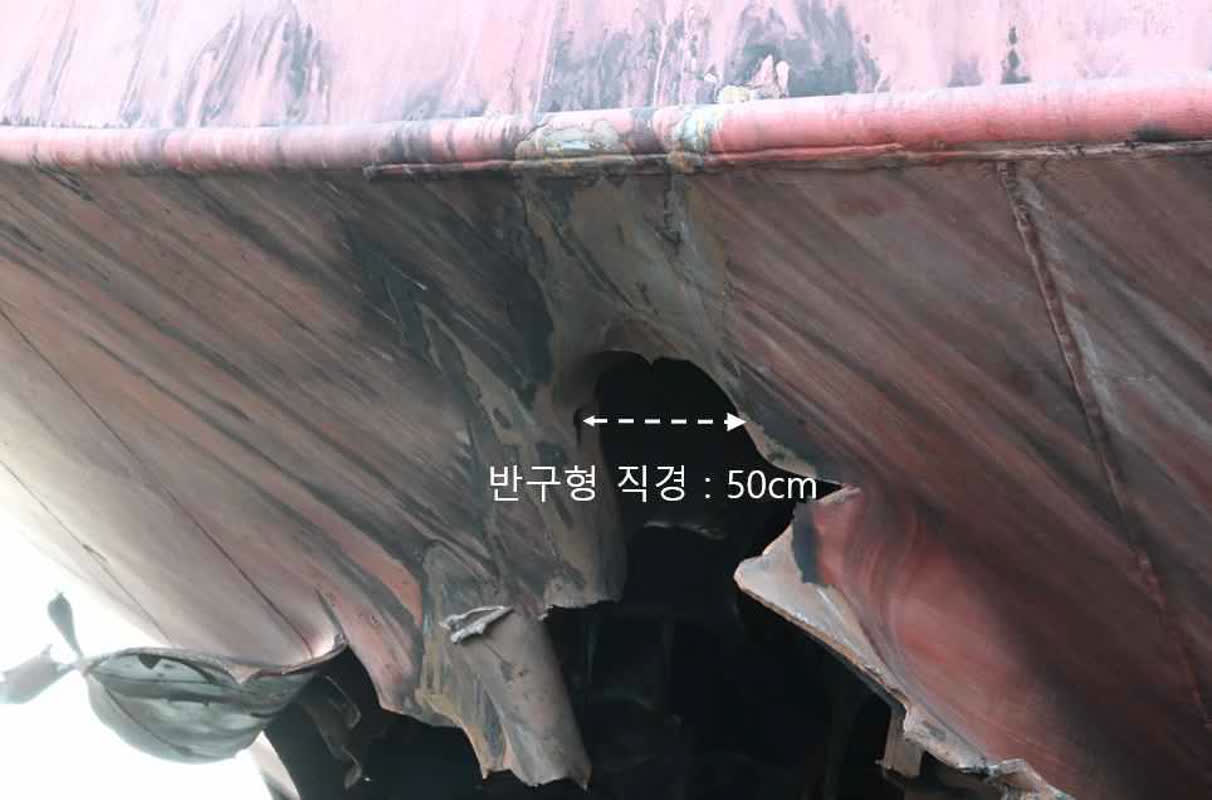
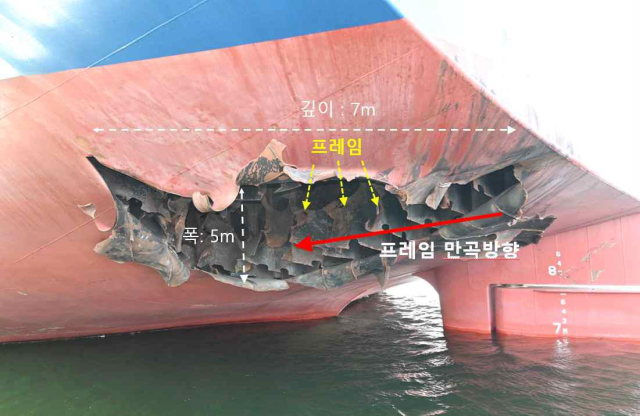
The impact zone concentrated roughly 1 to 1.5 meters above the waterline, a fact that bolsters the drone hypothesis. Sections of hull plating were bent sharply inward, and damage extended into the engine room.
Foreign Ministry spokesperson Park Il told reporters that, given the damage pattern consistent with blast pressure and the hemispherical penetration shape, a mine or torpedo strike appears unlikely.
Experts add that the hull was not cleanly severed and there were no signs of a large‑scale explosion, which points toward a relatively small‑warhead suicide drone rather than a heavyweight anti‑ship missile. Officials noted penetration marks extending roughly 7 meters into the engine room.
A key lead is engine wreckage recovered at the scene. Authorities are conducting a detailed forensic examination focused on the wreckage’s design and component layout.
The timing of the attack also drew attention. The incident occurred as the U.S. was expanding ship‑protection operations in the Strait of Hormuz — a move Tehran publicly denounced as a threat to its security.
Rep. Yoo Yong‑won, a member of the National Assembly defense committee from the People Power Party, publicly raised the possibility of an Iranian drone. On the 11th, he told Channel A Radio’s Political Signal that an Iranian drone was a likely culprit.
Citing photos released by the Foreign Ministry, he argued that for the ship’s 1–2 cm steel plating to be bent so dramatically and produce such an opening would require a vehicle carrying a warhead on the order of about 100 kilograms.
He dismissed theories that a heavyweight anti‑ship missile caused the damage, saying a 250‑kg anti‑ship missile would have produced a far larger breach. He also cast doubt on claims that fast attack craft — referencing the Kosar — could reliably strike the same spot twice in succession. He noted that Iran’s Shahed‑136 carries roughly a 50‑kg warhead, and two successive hits would equate to about 100 kg of explosive force.
On the attack method, Rep. Yoo said the CCTV showed strikes about a minute apart, consistent with a double‑tap tactic: the first drone creates a hole and a second follows into that opening to destroy the interior with a secondary explosion.
He added that investigators must determine whether Iran targeted the vessel deliberately or whether hardline elements of the Islamic Revolutionary Guard Corps carried out indiscriminate strikes. If Iran is found responsible, he said, Seoul should lodge a strong protest and demand measures to prevent recurrence.
Military analysts see similarities with Iran’s Shahed series of suicide drones. Yoo Ji‑hoon, a research fellow at the Korea Institute for Defense Analyses, told Munhwa Ilbo the impact was likely not a simple collision by a reconnaissance drone but rather an attack by a suicide UAV carrying explosives, a small cruise munition, or a low‑altitude maritime attack vehicle.
He said the strike’s proximity to the upper hull and the blast effects extending into the engine‑room systems indicate the object approached at or just above the waterline and detonated on impact.
Experts have pointed to Iran’s Shahed family and the longer‑range Arash series as possible candidates. Yoon Yong‑hyun, a special professor in Future Mobility at Kookmin University, told Munhwa Ilbo that the double‑tap pattern — two precise strikes at the same location — is more consistent with a drone attack than with a cruise missile, which would be unlikely to hit the exact same spot twice.
Jo Sang‑geun, a research professor at KAIST, told JoongAng Ilbo that if evaluators found an engine and two precise strikes in short succession, the weapon was likely a medium‑sized or larger suicide drone. He suggested the attack may reflect a sophisticated gray‑zone tactic intended to deter the South Korean navy from joining U.S. operations without prompting full escalation.
Foreign military analysts and international media have also raised the possibility of a Shahed‑136 suicide drone strike. The Shahed can use satellite navigation to aim at a ship’s engine room precisely and, because its warhead is relatively light, may not always leave a visibly large hull breach.
However, Shin Jong‑woo, secretary‑general of the Korea Defense and Security Forum, told JoongAng Ilbo investigators cannot entirely rule out an anti‑ship cruise missile with an exposed engine.
The U.S. has effectively pointed to Iran as the likely perpetrator. U.S. Secretary of Defense Pete Hegseth said U.S. forces were communicating with the Korean ship and that such targeted attacks reflect Iran’s indiscriminate behavior, urging South Korea to take a stronger role. Iran’s foreign ministry denied involvement, though media outlets sympathetic to the Islamic Revolutionary Guard Corps reportedly framed the attack as a legitimate warning.