Independent foundation-model consortium, security firms take part
“Working to join Project Glasswing”
May 11 meeting scheduled between the Ministry of Science and ICT and Anthropic’s global policy lead
Officials may lay out concrete response measures as early as the end of this month
Plan to develop a South Korea–focused, security-specialized AI model over the medium to long term
“Working to join Project Glasswing”
May 11 meeting scheduled between the Ministry of Science and ICT and Anthropic’s global policy lead
Officials may lay out concrete response measures as early as the end of this month
Plan to develop a South Korea–focused, security-specialized AI model over the medium to long term
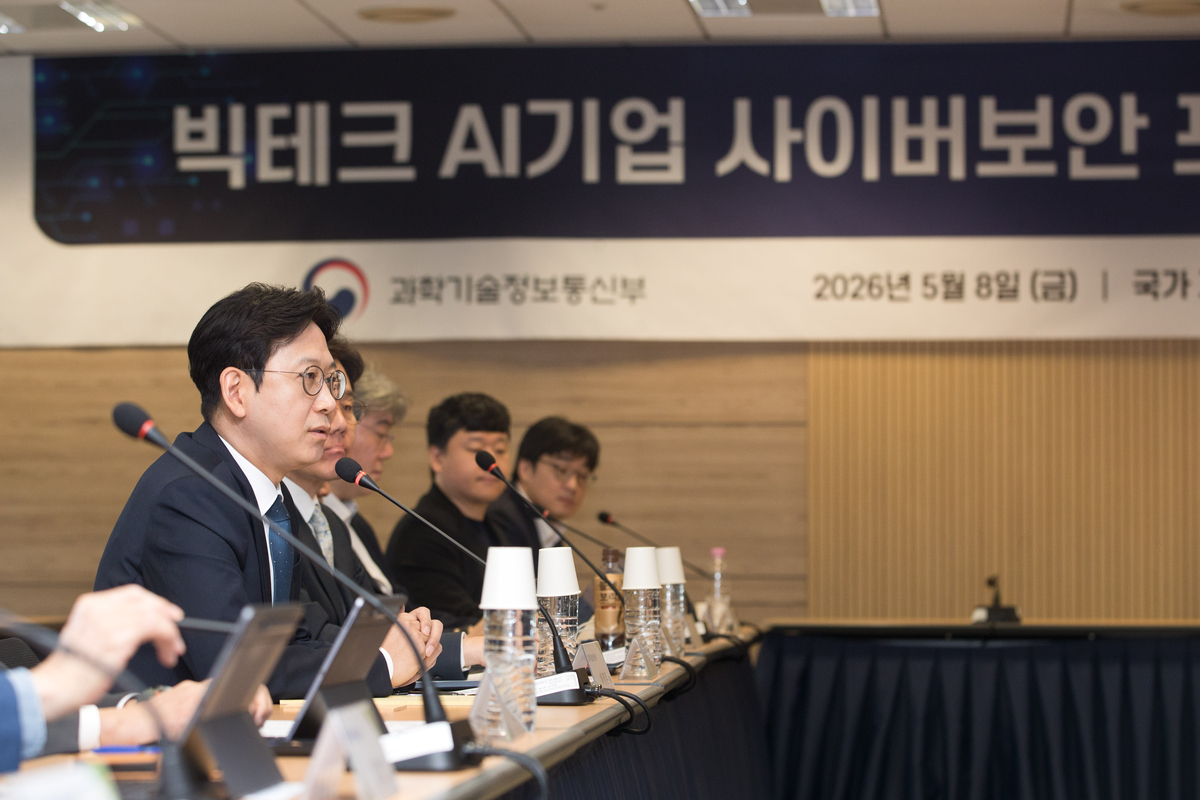 The Ministry of Science and ICT said on May 8 that it convened a roundtable with industry, academic and research experts to discuss responses to cybersecurity projects from global AI firms, prompted by what officials have called the “Mitos shock.”
 Ahead of a May 11 meeting between Michael Selito, Anthropic’s head of global policy, and Ryu Je-myeong, the ministry’s second vice minister, public- and private-sector stakeholders are coordinating to map a joint response.
The roundtable followed the ministry’s request on April 14 that roughly 30,000 companies led by CISOs review their security readiness, and the April 30 distribution of “Guidelines for Corporate Response to AI-driven Cyberattacks and CEO Action Steps.” The ministry said it convened experts across fields to assess the security implications of high-performance AI models and potential countermeasures.
Participants included companies involved in developing independent foundation models (독파모), such as SK Telecom, Upstage and Motif Technologies; major AI firms; academic experts in AI security including the president of the Korean Institute of Information Security; heads of leading information-security companies including the Korea Information Security Industry Association; and CISOs from large corporations.
Views diverged on the impact of AI security models. Some participants said such models will significantly reshape cybersecurity; others argued the threat is overstated. Still, there was consensus that the emergence of high-performance, AI-driven cybersecurity services like Mitos requires coordinated short- and long-term action by both government and industry.
The roundtable also reviewed a live vulnerability assessment using AI. As part of an AI security evaluation, the Korea Internet & Security Agency (KISA) used Anthropic’s latest model to run a simulated penetration test against a domestic company and found seven vulnerabilities in roughly 10 minutes.
On that point, Choi Woo-hyuk, director of the Information Security Network Policy Office at the ministry, told a background briefing that, after coordinating with one domestic firm, they ran a series of scenario attacks using Anthropic’s “Claude Opus 4.7” model and uncovered seven real vulnerabilities. “What would have taken a human attacker days, the model completed in about 10 minutes,” he said.
Finalize medium- to long-term response measures by late May–early June
 Experts from industry, academia and research largely agreed on a two-track approach: in the short term, bolster defenses by applying existing general-purpose AI models and security technologies; in the medium to long term, develop proprietary AI models specialized for cybersecurity.
 Short-term options discussed included services like the U.K. National Cyber Security Centre’s (NCSC) early-warning offerings and mandatory patching requirements for high-risk firms. The recommendation was to combine current AI capabilities with security tooling and establish early-detection systems for corporate and organizational cyber threats, even if those models do not match Mitos’s performance.
Choi added that the ministry is continuing discussions to enable domestic companies and institutions to participate in “Project Glasswing,” the coalition Anthropic formed with major Big Tech firms to manage the risks associated with the Mitos model.
Regarding a Plan B if Korea’s participation in Glasswing is delayed or blocked, he said the ministry has already distributed a code of conduct to corporate CISOs and will comprehensively review additional options as it develops medium- and long-term response plans.
Participants also agreed that, given the prospect of a second or third “Mitos shock,” strengthening the competitiveness of domestic proprietary AI models and developing security-focused models are essential. Choi said the ministry is exploring multiple paths, including developing security-specialized models based on independent foundation models or further hardening those models’ security features.
The ministry said it will continue follow-up consultations with the security industry and expects to announce related medium- and long-term response measures at the end of this month or in early June.
- [Exclusive] Prosecutors step up expertise in investigations of technology leaks at Samsung semiconductor lines
- “Let’s eat pizza and then go to service” — New York cathedral sells out as Gen Z reshapes American churches [Park Si-jin’s Global Pick]
- "If I report it, the loss is 2,000 KRW (approximately 1.50 USD)" — a distressed small-business owner
- Will July adjust long-term special levies and fair market values…“Additional listings may hit three Gangnam districts” [KoJoobu]
- Korea’s version of SpaceX takes shape…Hanwha to buy more KAI shares by year-end [Biz-Plus]
- Home-price outlook dampened by regulation…Seoul metro says “prices still rising”
- “No drugs, no vaccine” — breathing stops and organs destroyed…world on alert after suspected human-to-human transmission reports
- [Exclusive] Science talent award budget cut from 2.1 billion KRW (approximately 1.575 million USD) to 1.6 billion KRW (approximately 1.2 million USD)…“We can’t even cover judges’ travel expenses”
- 2028? 2029? When will wartime operational control transfer? Lee: “We must prepare to operate independently” [Lee Hyun-ho’s Military! Talk]
- Reducing coverage for non-severe cases and cutting premiums — the “5th-generation indemnity” plan — launches on the 6th