Free Democracy Institute commissioned a wireless ARS survey of 1,001 people on the 14th and 15th
68% said “There are spies,” three times as many as those who said “There are not”
46.9% oppose transferring counterintelligence investigators from the Counterintelligence Command to the military police; 38% support it
Yoo Dong-yeol: “In 2 years and 3 months, authorities have arrested, prosecuted, or confirmed zero spies — spy investigations have effectively been suspended.”
68% said “There are spies,” three times as many as those who said “There are not”
46.9% oppose transferring counterintelligence investigators from the Counterintelligence Command to the military police; 38% support it
Yoo Dong-yeol: “In 2 years and 3 months, authorities have arrested, prosecuted, or confirmed zero spies — spy investigations have effectively been suspended.”
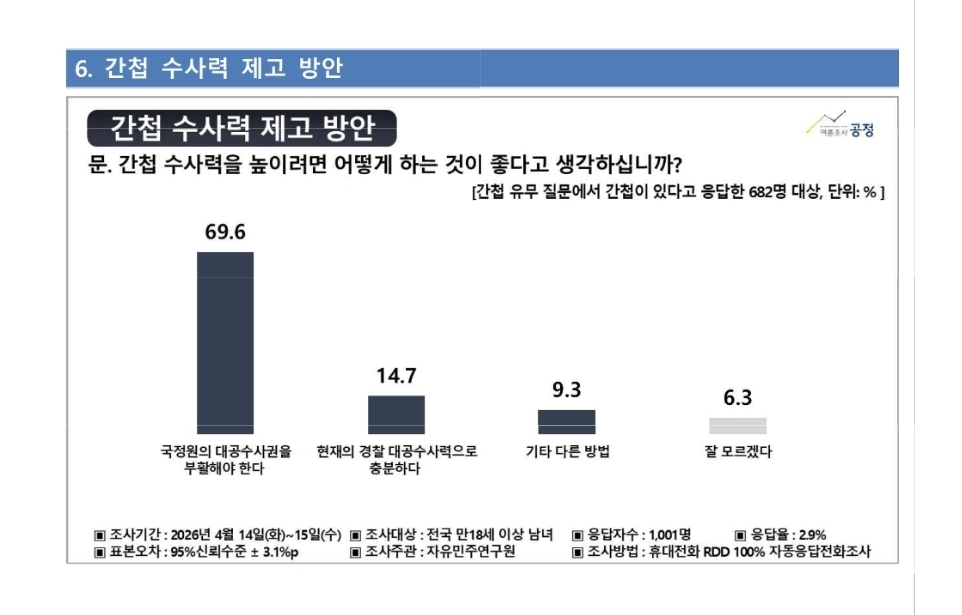
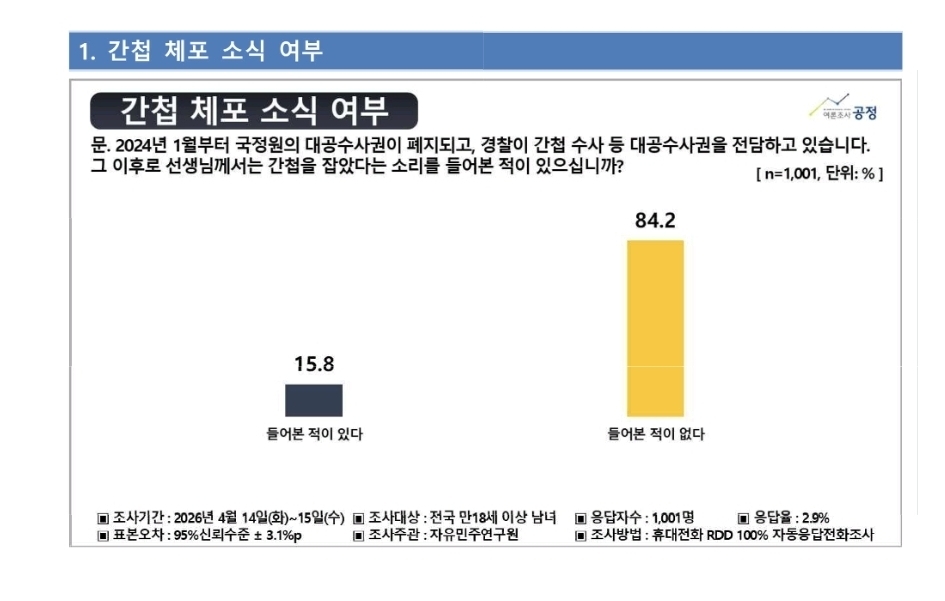 84.2% of respondents said they had not heard reports of spy arrests. Polling Firm Gongjeong provided the poll.> 68% of South Koreans say they believe spies exist in the country. Yet more than two years after the National Intelligence Service’s (NIS) domestic counterintelligence authority moved to the police in January 2024, 84.2% of respondents said they had not heard news of any spy arrests. About 70% of respondents identified restoring the NIS’s counterintelligence authority as the best way to strengthen spy investigations.
 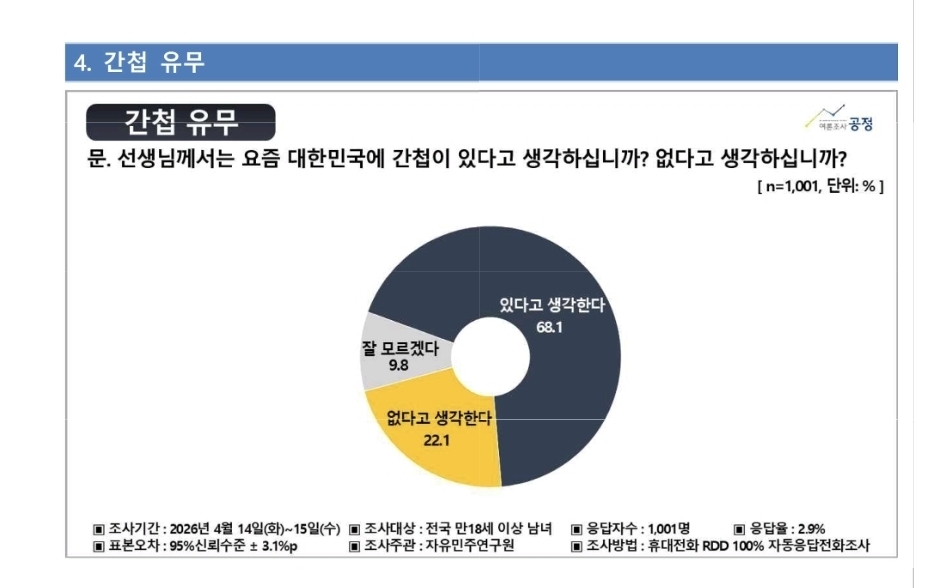 In response to the question “Do you think there are spies in South Korea?” 68.1% said yes and 22.1% said no — roughly three times as many said yes. Polling Firm Gongjeong provided the poll.> The Free Democracy Institute (Director Yoo Dong-yeol) commissioned Polling Firm Gongjeong to conduct a wireless ARS phone survey of 1,001 men and women aged 18 and older nationwide on April 14–15. The survey returned those results.
  When asked whether they had heard news of spy arrests since January 2024 — when the NIS’s counterintelligence powers were transferred to the police — 84.2% said they had not, while 15.8% said they had, a roughly 5.3-to-1 gap. Polling Firm Gongjeong provided the poll.> Yoo Dong-yeol, director of the Free Democracy Institute, said, “From January 1, 2024, through April 2026, there have been zero cases in which authorities arrested, prosecuted, and confirmed spies. For 2 years and 3 months, South Korea’s spy investigations have effectively been dormant.”
 Asked why spy investigations have lagged, 37.2% blamed a North Korea–friendly policy and 28.9% pointed to weak police will and capability in counterintelligence — together accounting for 66.1% of critical responses.
On ways to bolster investigative capacity, 69.6% favored restoring the NIS’s counterintelligence authority, while 14.7% said the police’s current counterintelligence capability is sufficient.
The survey also asked about the government’s plan to dismantle the military Counterintelligence Command and transfer spy investigators to the military police under the Defense Investigation Headquarters. 46.9% opposed the move, while 38% supported it — an 8.9 percentage-point gap.
Regarding trust in the government’s security policies, 47.1% said they do not trust them, compared with 39.9% who said they do — a 7.2-point difference.
The survey had a 2.9% response rate and a sampling error of ±3 percentage points at the 95% confidence level. Respondents self-identified as moderate 35.9%, conservative 30.2%, and progressive 24.2%.