
The box-office momentum for Living with the King shows no signs of slowing. It led the national box office for eight consecutive weeks and had drawn more than 15.6 million admissions through March 29. Excluding the two pandemic years, South Korea logged at least one film surpassing 10 million admissions every year from 2012 through 2024; that streak ended in 2025. In 2026, however, Living with the King rekindled the trend, giving the industry an encouraging start to the year.
Still, moviegoing in Korea hasn’t recovered to pre-pandemic levels. A Korean Film Council report released March 5 found annual total attendance averaged about 220 million from 2016 to 2019. By contrast, annual totals from 2022 to 2025 ranged roughly from 106 million to 120 million — about a 50% decline. Using 3 million admissions as a rough benchmark for a modest commercial success, Korea averaged about 20 such films per year in 2016–2019; from 2022–2025, that figure fell to fewer than 10 per year.
The nature of the film product has shifted over the past five years. Movies used to be like a meal: people went to theaters as routinely as they ate three times a day, arranged to meet in front of cinemas, and watched films with family during holidays. Since 2022, though, only sequels released over holiday periods have cleared 3 million admissions — and Living with the King, which opened during the 2026 Lunar New Year holiday, is the first non-sequel to do so. Relying on weak competition alone no longer guarantees steady audiences.
OTT platforms are largely responsible for displacing the cinema as a daily habit. As subscription services proliferated, more viewers chose to watch films at home without paying extra for individual titles. Even the BTS comeback live on March 21 drew fewer attendees in person than expected, while many viewers reported watching the stream at home on Netflix despite not being dedicated K-pop fans. Going to the movies now feels more like getting dessert: optional rather than essential. Audiences open their wallets only for films that generate enough buzz.

In January, the Dubai chewy cookie — nicknamed "Du-zzonku" — exploded in popularity, with long lines forming on city streets. The Du-zzonku craze and the Living with the King phenomenon share a lot in common. The film didn’t open like a sequel or major blockbuster that grabbed attention right away; instead, positive word of mouth slowly built momentum. It drew about 1.75 million admissions in its fourth week and roughly 1.72 million in its fifth — an unprecedented run since attendance tracking stabilized.
Du-zzonku followed a similar arc: it gained traction gradually and then, after passing a tipping point, became a must-try dessert. Praise spread, nearby purchases multiplied, and the sense of "I’m the only one who hasn’t tried it" pushed interest into exponential growth. After that, the trend itself sustained further sales. The bandwagon effect — "Everyone’s seeing it," "Everyone says it’s great" — was the key to the boom.
Prices for Du-zzonku varied, but at its peak it sold for about 7,500 KRW (approximately $5.63). The average movie ticket in Korea in 2025 was about 9,600 KRW (approximately $7.20), so the cost difference wasn’t large. The price can feel steep for some, but many consumers considered it worth the novelty, the curiosity, and the social currency of having tried it. Reflecting these parallels, Google Trends shows broadly similar search-interest patterns for Du-zzonku and Living with the King.
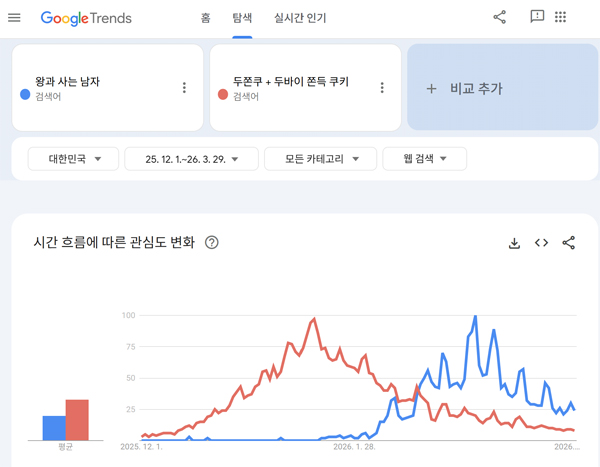
Audiences no longer flock automatically to big-budget blockbusters simply because they feature star actors or acclaimed directors. That makes the case for midrange productions — films with budgets around 10 billion KRW (approximately $7.5 million) like Living with the King — persuasive. Still, the playbook for creating a Du-zzonku–style hit in the OTT era must be different from traditional marketing strategies.