Fashion platform W Concept abruptly replaced its CEO this month — a move insiders link to the company’s first loss since joining the Shinsegae Group last year and the urgent need for a new game plan. Under the new leadership, W Concept looks poised to refocus on reclaiming its edge as a fashion-first platform.
First time in the red
On the 6th, W Concept named Lee Ji-eun, the executive director in charge of Product Category 2, as its new CEO. Former CEO Lee Joo-cheol stepped down after 2 years and 4 months and will remain with the company as an adviser.
The timing surprised observers because the change didn’t come during the usual executive reshuffle season. Shinsegae had confirmed Lee Joo-cheol’s position in last September’s regular appointments, but just six months later the company shifted to a new CEO — a strong signal, analysts say, that W Concept’s disappointing results last year forced an expedited leadership change.
W Concept recorded an operating loss for the full year — its first in six years and its first since being acquired by Shinsegae in 2021. Last year the platform’s gross merchandise value reached 650 billion KRW (about $487.5 million), up 13% from the previous year, but profitability weakened after the company ramped up marketing spending. Industry estimates indicate the loss was substantial.
“Replacing the CEO outside the normal cycle shows how severe the internal sense of crisis was,” a source at a rival fashion platform said. “They likely felt an urgent need to restore W Concept’s competitiveness as a fashion destination.”
Launched in 2008 as a women’s fashion platform with a mission to discover outstanding but little-known Korean designer labels, W Concept built its brand around emerging designers and won loyal followings among style-conscious women in their 20s and 30s.
Shinsegae Group acquired 100% of W Concept through SSG.com in April 2021. At the time, W Concept led the women’s fashion platform market, and the deal promised meaningful synergies with Shinsegae’s online and offline retail channels, including its department stores.
A fading identity
In the early phase after joining Shinsegae, W Concept and its parent delivered several concrete results. In 2022, W Concept opened offline stores at Shinsegae Department Store’s Gyeonggi branch, expanding sales channels for its designer labels. SSG.com also launched a dedicated W Concept section, using W Concept’s curated designer roster to shore up SSG.com’s weaker fashion lineup.
W Concept expanded into lifestyle categories by adding Shinsegae’s home brand Casamia and participated in major group promotions like “Korea SSG Day” and “Landers Day,” which produced short-term sales spikes.
But critics argue these moves diluted W Concept’s identity. As collaborations with group channels increased, the platform lost some of the exclusivity that once made it the go-to for hard-to-find designer pieces. “W Concept used to be synonymous with women’s designer brands, but after the Shinsegae takeover its identity as a designer-brand platform weakened,” an industry insider said.
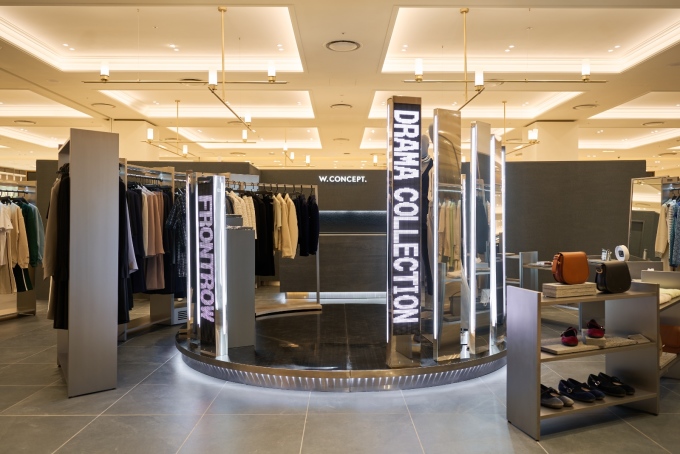
Expected synergies with the group also underperformed. W Concept pulled out of three Shinsegae Department Store locations it had opened in September last year, which analysts see as further evidence the partnership hasn’t delivered as hoped. W Concept says those closures came after it achieved the goal of giving designer brands an offline showcase.
When Lee Joo-cheol took the helm in September 2023, he shifted the business to a profitability-first model — a change some say eroded W Concept’s competitive appeal. A former Gmarket executive, Lee prioritized cutting advertising and promotion costs to boost margins.
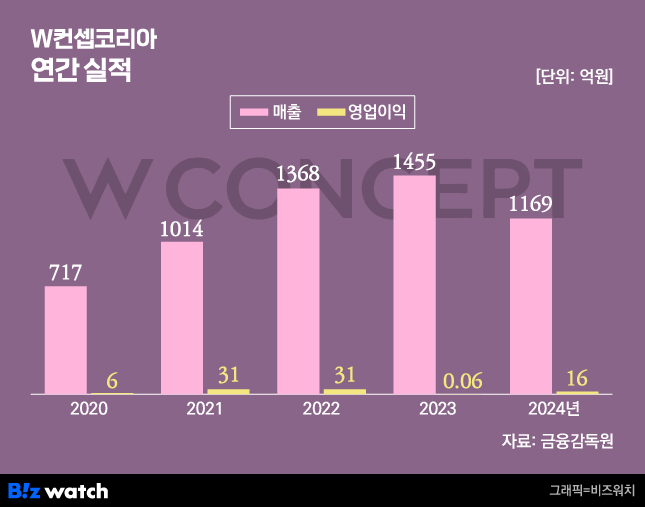
Those cuts did produce short-term gains: operating profit climbed from 5.82 million KRW (about $4,365) in 2023 to 1.6 billion KRW (about $1.2 million) the following year — a 282.2% increase. But the company’s top line contracted: revenue fell 19.6%, from 145.4 billion KRW (about $109.1 million) in 2023 to 116.9 billion KRW (about $87.7 million) in 2024.
Back to fashion
As W Concept’s identity blurred and its scale shrank, competitors pulled ahead. W Concept led rival 29CM in transaction volume as recently as 2021, but that gap has closed and reversed. Last year W Concept reported 650 billion KRW (about $487.5 million) in GMV, while 29CM posted roughly 1.3 trillion KRW (about $975 million) — about double W Concept’s figure.
Direct GMV comparisons have limits because the platforms’ mixes differ: around 50% of 29CM’s GMV comes from non-fashion categories like furniture and home goods, while fashion accounts for roughly 90% of W Concept’s sales. Still, industry observers say 29CM outperforms W Concept even on fashion metrics. W Concept also trails 29CM in monthly active users: as of December last year, 29CM had 1.61 million MAUs versus W Concept’s 1.01 million.

With the CEO change, W Concept is set to double down on its core: fashion. Lee Ji-eun is the company’s first female CEO and a seasoned fashion executive. She studied clothing at Chung-Ang University and built her career at major fashion firms including LF and Kolon Industries’ FnC division.
At LF, Lee launched women’s brands and led the men’s division. At Kolon FnC, she headed the CN division and led a sports-brand rebranding. She joined W Concept in October as executive director in charge of Product Category 2, overseeing athleisure and private-label brands and spent five months getting to know the organization.
A W Concept spokesperson said, “In a fiercely competitive fashion market, we will reassess the core capabilities of our fashion-vertical platform and strengthen our fundamental competitiveness. We’re also reviewing offline store strategies from multiple angles.”