A South Korean fashion-tech startup is turning heads with a new service that introduces a standardized digital language to garment production — an industry where communication often breaks down because everyone speaks a different terminology.
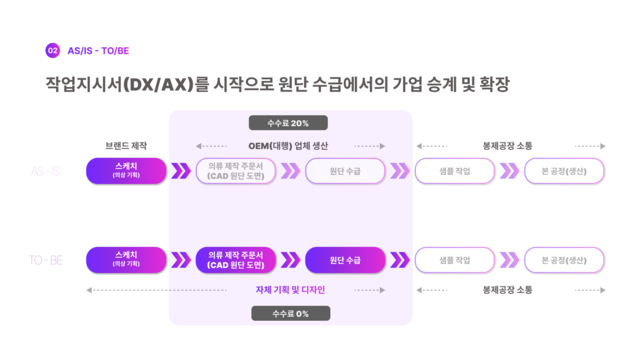
On the 29th, the Korea Venture Business Association announced that fashion-tech startup Padit officially launched a digital production language for clothing manufacturing. Designers, factories, and brands frequently rely on different terms and workflows, leading to repeated sampling, delayed delivery dates, and communication slip-ups. Padit says it has packaged a unified digital production language that spans design through manufacturing and delivered it as a service to address those issues.
Padit’s platform merges garment schematics, computer-aided design (CAD) patterns, and work-order generation into a single data stream. When a designer uploads a sketch and basic specifications, generative AI automatically produces CAD patterns and work orders. Factories can access the same screen to review, refine technical details, and use that information directly in production. The aim is to prevent designers’ intentions from getting lost in translation and to capture factory know-how as data so brands and manufacturers can collaborate in a shared language.
Padit is testing the service in real production sites through the Donggori job-linkage platform in Dongdaemun and an industry-academic partnership with Kyung Hee University, and it’s refining features based on field feedback. In collaboration with the Dongdaemun District Office, Padit signed an MOU with a network connecting roughly 1,800 sewing factories to promote the digital production standard across that network. Using the data it has collected, Padit plans to expand beyond Korea’s sewing ecosystem and position the platform as a collaborative language linking Asian production hubs with global fashion brands.
“We’re not trying to change trends or styles; we want to change the way clothes are made behind the scenes,” a Padit spokesperson said. “Our goal is to build a structure where designers and factories connect through a single data language across borders, languages, and skill levels — and to scale that from the domestic sewing ecosystem to the global supply chain.”