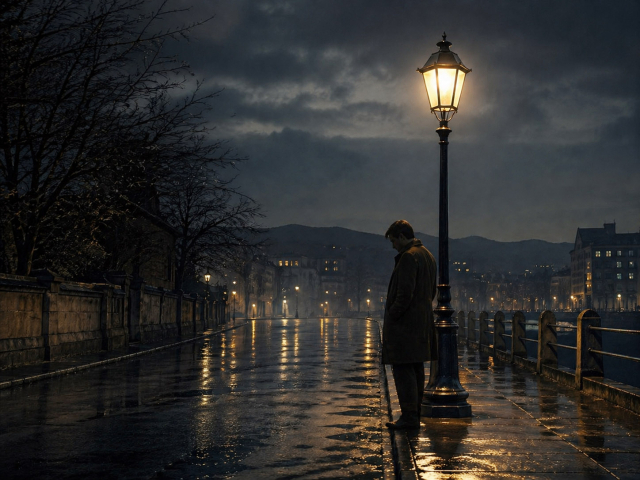
A single, blocked lamp hangs in an empty sky. Where does it signal my hollow self to go — a sad sign. Summer’s long light folds its wings in haste; rows of tall buildings, pale as tombstones, sink into dusk. The brilliant nightscape lies tangled like overgrown weeds; thought goes mute and seals its mouth. Blended into the hollow parade of crowds, why do I carry such heavy sorrow that my stretched shadow grows so dark...
This is \"Wasa Lamp\" by Kim Kwang-kyun, a modernist poet of Korea’s Japanese colonial era. A city night lit by a Wasa lamp can seem both dazzling and desolate because those lights throw melancholy shadows. The poem is a portrait of the alienation people felt under modern civilization. In \"Wasa Lamp\" we can see how imagist poetry captured the urban mood of the 1930s. A Wasa lamp is a gas light — a streetlamp.
The streetlight image stands for civilization. Yet civilization’s glow carries loneliness. Kim uses a mournful voice to expose the emptiness behind urban splendor and the solitude of individuals who lose their way there. Through contrasts — light and dark, high-rises and weeds, crowds and solitude — he delicately renders human disconnection within civilized space. Packed with sensory images, the poem creates a scene that feels almost tangible and quietly desolate.
On a rainy street, on a lonely street, how can I forget those days that rang out and left? O faint streetlight in this deep night, will you even stir the sickness in my heart? Under the dim flame, beneath the lonely lamp, how can I forget that love that rang and departed? In this street where dreams run deep, O rain-wet streetlight, will you endlessly wake the farewells in my heart?
Hwang Geum-sim’s song \"Lonely Streetlight\" carries the same atmosphere as Kim’s \"Wasa Lamp,\" as if the poem had been set to music. Both the poem and the song appeared in 1939, and their shared urban-night imagery evokes the same wistful feeling. But \"Lonely Streetlight\" frames the city night through the pain of heartbreak and a resigned reflection — a sensibility made for popular song. Lyricist Lee Bu-pung also came from the Dong-A Ilbo New Year’s Literary Contest.
It’s striking that \"Lonely Streetlight\" was a hit in 1939, not 1979. At a time when popular Korean music leaned toward the five-note scales of enka, a song blending a blues melody with tango rhythm demonstrated the variety and depth of Korean popular music under colonial rule. Hwang, who rose to stardom with \"Alttelhan Dangsin,\" and composer Jeon Su-rin of \"Hwangseong Yetter\" showed notable creativity.
Hwang Geum-sim, blessed with exceptional looks and a honeyed tone, delivered a rich, aching vocal on \"Lonely Streetlight\" that revealed another side of her artistry. She was among the era’s finest vocalists, bringing Western textures to Korean songs with great taste. Even outside the trot genre, her blues-inflected performance warmed the raw wounds of colonized Koreans. For that reason, \"Lonely Streetlight\" remains a valuable piece of our popular-music heritage.
The song’s origin story survives as well: a woman who briefly worked in the entertainment district to help pay a lover’s tuition, later abandoned by the man after she rose to fame — a melodramatic tale fit for a sentimental ballad. The lone figure standing beneath the streetlight outside the teahouse he frequented becomes the poem’s poetic self. Today’s streetlights burn brighter, and their shadows run deeper. People still ask, looking at the lonely streetlight: \"Where does it tell me to go alone — this sad signal?\"
Pop culture critic