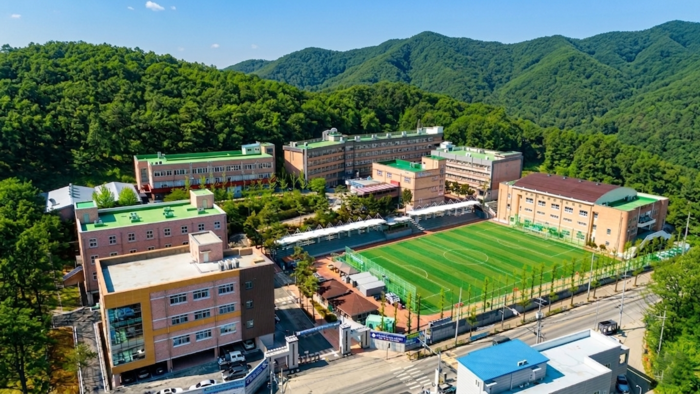
Gyeonggi Automotive Science High School was the first in the country to be designated by the Ministry of Education as a \"Future Automobile Partnership-type Specialized High School\" and is widely regarded as the nation's leading specialized vocational high school. In 1973, founder Han Sang-ho acquired Soseung High Public School in Siheung. In June 1977 he established the Hanin Academy foundation and opened Hanin Technical High School, creating a framework for formal vocational education.
The school posts dominant outcomes: it has led the nation in successful candidates for the German automotive apprenticeship program Ausbildung for nine consecutive years; earned the top rating in the industry–academia integrated apprenticeship school performance evaluation four years running; and captured the most medals in the automotive division at the Gyeonggi Province skills competition for seven straight years.
For the 2026 academic year, the curriculum is organized around a 3-Track departmental system designed for the future mobility industry. Departments specialize in three core areas—hardware (HW), software (SW) and design. The school is also the country’s only Ministry of Education partnership-type specialized high school and will receive about 6 billion KRW (approximately 4.5 million USD) in funding over five years. That investment will fund state-of-the-art training facilities developed in collaboration with local governments, universities and industry partners and enable tailored workforce development aligned with regional and corporate needs.
One program unique to Gyeonggi Automotive Science High is a high-tech contract major in autonomous driving. Under an agreement with the Gyeonggi Autonomous Driving Center, students use vacation periods (120 hours per year) to work alongside professional researchers, building autonomous vehicles and developing software. The program offers advanced, hands-on research experience well beyond typical high school training.
To produce job-ready graduates, the school runs multiple government-supported initiatives and industry–academia collaborations. Ausbildung follows the German dual vocational model: a 36-month program with 70% company-based practical training and 30% university-level theory. In partnership with BMW, Mercedes-Benz and others, the program produced the country’s largest cohort of successful candidates for nine consecutive years (2016–2025), totaling 184 graduates.
Through a high-school work-study system, the school links partner firms as learning companies and integrates NCS-based job training with on-the-job training (OJT) in the automotive field (98 students) and software development (47 students). Under a program to cultivate skilled high-school graduates for promising industries, the school delivers practical training focused on eco-friendly future vehicles. Students receive more than 100 hours of hands-on training annually as part of the regular curriculum.

Graduates continue on to higher education and careers with strong outcomes. In 2026 college admissions, the school posted the best results among vocational high schools, placing students into programs such as Konkuk University’s Department of Mechanical, Robotics and Automotive Engineering and Aerospace Mobility Engineering, Kookmin University’s College of Automotive Mobility, and Kwangwoon University’s AI Robotics program. Last year, graduates also achieved top acceptance rates among vocational high schools for roles at Samsung Electronics’ DX and DS divisions, the Korea Railroad Corporation and military civil service positions.
The school has produced notable startup success stories. A student who interned at M&S EV Tuning later founded AeroArt. Another former employee launched Daon Motors. Numerous graduates who began in company internships have gone on to start businesses that match their skills and interests.
Supporting specialized education for future mobility, the school has industry-grade infrastructure. After its designation as a partnership-type specialized high school last year, the campus completed the BMW Handok Motors Dream Center to enhance learning facilities. The school operates dedicated EV and hybrid training bays and an \"AI Autonomous Driving and Connected Car Lab\" equipped with Altino and Xycar platforms, a 1/12 track, Arduino sensors and i7-class PCs. Facilities are optimized for certifications in maintenance, painting and bodywork, and the campus includes a professional-grade tuning workshop comparable to commercial tuning shops.
Principal Kim Im-sik said, \"To respond to the rapidly changing future mobility industry, we will continually innovate our educational approach so students can grasp converging technologies and chart their own futures. We will expand cutting-edge training facilities and field-centered education so students can grow into leading experts in their fields.\"
Reporter Lee Ji-hee